 Facebook
 Google
 GitHub
 Linkedin
Sun, Shade, and Energy: Six Flags Park Installs Solar Carports
The Magic Mountain theme park near Los Angeles has covered parking lots with solar canopies, bringing 12.37 MW of solar energy capacity online.
A renewable energy microgrid can provide businesses and industries with backup power and reduce operating costs, but installing conventional wind or solar may require empty land they don't have. Yet, these businesses often have spacious parking lots for employees and customers, which raises the question: why not use that space to install a solar panel canopy?
Six Flags Magic Mountain has done exactly that. It has constructed the largest solar carport in California and one of the largest in the U.S. Developed with Solar Optimum, the 637,000-square-foot canopy provides 12.37 MW of capacity. The park officially switched on the power on Oct. 1 after over three years of planning and construction.
Six Flags Magic Mountain publicly announced the project went live across its official channels (including Facebook and Instagram) to coincide with National Energy Awareness Month.
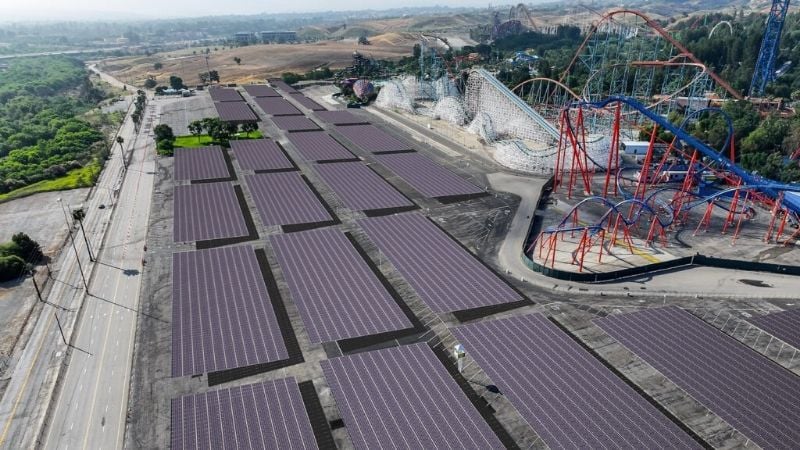
The solar carport at Six Flags Magic Mountain. Image used courtesy of Solar Optimum
Double Duty Solar Power
The solar carport uses 22,908 Recom bifacial solar panels installed across 36 carport frames and covering about 4,315 parking spaces. The bifacial panels can harvest sunlight from overhead sunlight and from ultraviolet light reflected from the asphalt-surfaced lot.
The system will generate about 20.8 million kWh of electricity annually and includes a 2 MW/8 MWh battery storage system. Six Flags states it will remain grid-connected, but the solar carport will offset 100% of its annual electricity use for the theme park and nearby Hurricane Harbor, its water park.
The canopy also shades about 4,300 vehicles, which is a major advantage in sunny Southern California.
The project also installed 109 electric vehicle charging connections in employee and guest lots.
Two other Six Flags parks, Discovery Kingdom in Northern California and Six Flags Great Adventure in New Jersey, have also installed solar projects. Discovery Kingdom uses a 7.5 MW solar carport that produces about 80% of the park’s needs. Great Adventure is a hybrid installation with 11 MW of solar carports across three parking lots along with 12.5 MW of ground-mounted solar arrays.
Six Flags Magic Mountain isn’t the theme park with the largest solar facility in a parking lot. In 2024, Disneyland Paris opened a 17.1 MW solar canopy system that covers 11,200 parking spaces.
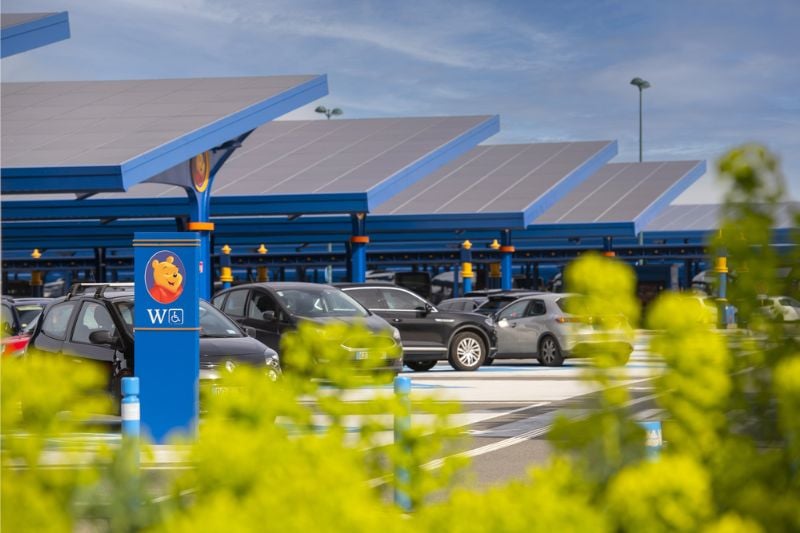
Solar canopies at Disneyland Paris. Image used courtesy of Disneyland Paris
Other large companies and institutions are also putting their lots to use.
Intel has several solar carports among its campuses, including a 7.7 MW canopy covering 3,200 parking spaces in Chandler, Arizona, and an 8.7 MW system at its Folsom, California site. FedEx also has several solar canopies among its sites nationwide.
At Rutgers University in New Jersey, 16 solar carports are installed across its campuses, with a total capacity of 14.5 MW. Michigan State University also uses solar canopies in five parking lots on its East Lansing campus, providing 10.5 MW.
Advantages of Solar Canopies
The major benefit of solar canopies is obviously reducing a business’ energy use, which can reduce costs and help companies meet emissions goals. Some companies have adjacent land they can develop. Earlier this year, Disney World in Florida announced it was using renewable energy to power 100% of the park's needs after its 484-acre land-based solar site (shaped like Mickey’s face) came online.
However, when nearby land is scarce, using the company’s existing space—the parking lot—offers several economic and ecological benefits.
Even if the business has enough land for solar arrays, it still needs preparation before construction can begin. Parking lots are already open, cleared, and leveled, with few obstacles to block the sun. The company can avoid delays and costs from permitting, land engineering, and environmental impact studies. Electrical infrastructure is already installed and connected.
The parking lots already have electrical infrastructure for lighting. The lots are also close to the buildings and facilities that will use the power, eliminating the need for long transmission lines. Shorter lines mean less energy loss during distribution.
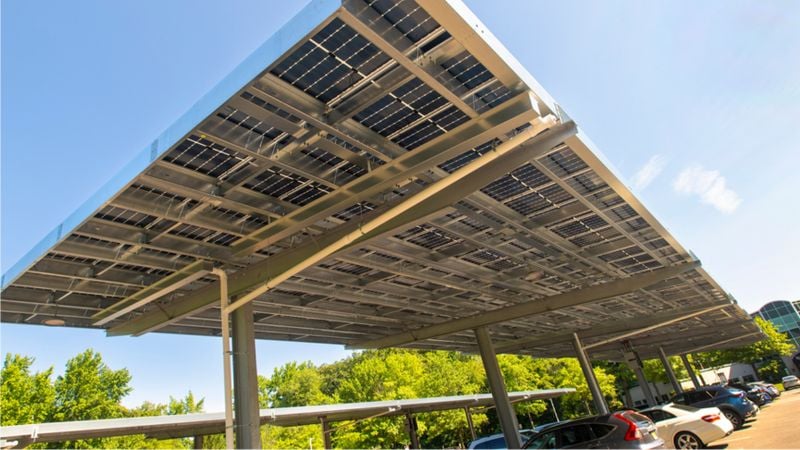
A solar canopy at Rutgers University. Image used courtesy of Rutgers University/Nick Romanenco
Rooftop solar may be an option for many companies, and the installation costs can be lower. However, roofs must be sturdy and spacious enough to support solar arrays alongside other equipment, such as HVAC. The building’s orientation and pitch can also limit how much sunlight it captures.
Canopy solar can be engineered with the exact direction and pitch needed to maximize solar radiation, resulting in 5-10% more energy per panel than a flat or pitched-roof design. In hot climates like Los Angeles, the ambient airflow around the carport panels provides natural cooling, which also increases efficiency.
However, solar carports are not practical or beneficial everywhere. Canopy structures require concrete footings 10 to 20 feet deep to withstand wind uplift. Parking lots with underground gas lines, utility pipes, or stormwater drains often lack sufficient soil depth. Shading from nearby buildings and extreme-weather risks are also factors to consider.