Facebook
 Google
 GitHub
 Linkedin
AI Solar Panels Follow the Sun to Maximize Energy Efficiency
The AI-enhanced dual-axis solar tracking system significantly outperformed other solar harvesters.
Solar cells remain among the most commercially feasible options for cheap and large amounts of renewable energy. However, solar tracking methods are required for maximizing the amount of sunlight that solar panels harvest. Solar panels on fixed tilts cannot move to optimal angles during the day to adapt to the variable weather conditions, such as cloudiness and shadows. As a result, they lose significant energy harvesting potential during the day when they are not optimally faced towards the sun.
Researchers from India and the U.S. have developed a hybrid AI solar dual-axis tracking system that uses convolutional neural networks (CNNs), long short-term memory (LSTM) networks, and reinforcement learning to optimize the prediction and control of solar irradiance to capture as much energy as possible.
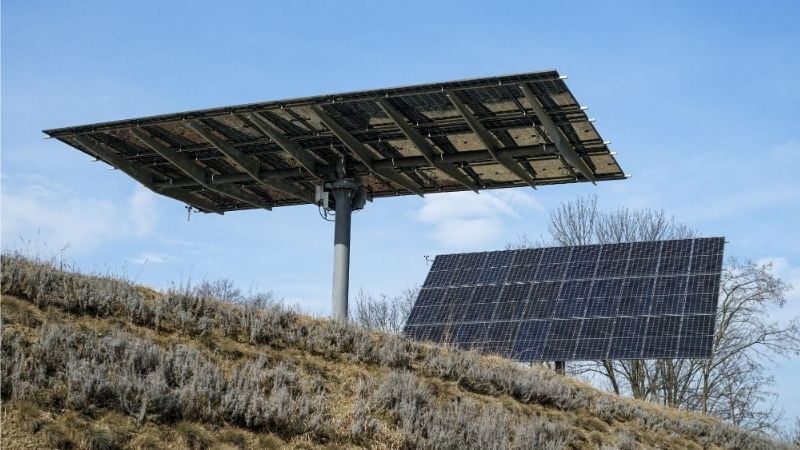
Solar panels with dual-axis tracking. Image used courtesy of Adobe Stock
The Hybrid Approach to Solar Tracking
The researchers used a solar tracking system featuring two 335 W photovoltaic (PV) panels, a dual-axis mechanical tracking system, a mechanical actuator system, a real-time analog performance measurement and datalogging system, a sensor, and a data acquisition unit containing a control system.
The CNN-LSTM model allowed for advanced forecasting and used reinforcement learning for real-time dual-axis tracking and edge AI to make low-latency control decisions. The AI-based energy management system enabled the system to dynamically switch between supercapacitor and lithium-ion storage based on the current supply and demand for power.
The researchers used adaptive perovskite-silicon PV cells that could dynamically tune the electrical properties of the cell (bandgap and voltage) based on the irradiance levels to achieve maximum power generation. The PV also contained phase change materials for improving light absorption and temperature regulation. The researchers also incorporated self-cleaning and anti-reflective nanocoatings onto the PVs to prevent degradation over time.
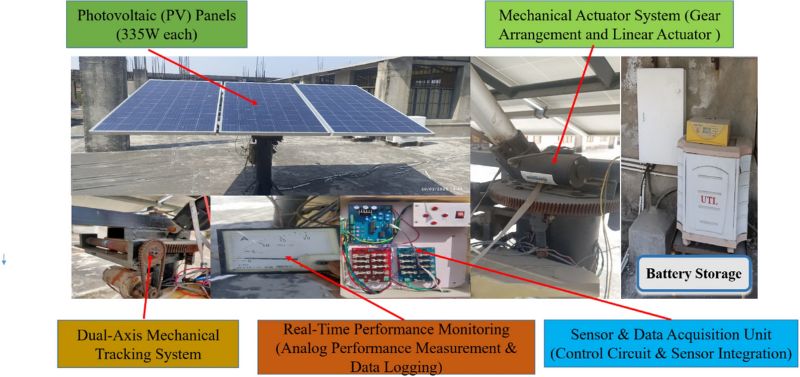
The researchers’ dual-axis system. Image used courtesy of Mamodiya et al.
Blockchain-secured energy management capabilities could communicate with blockchain-enabled smart grids for secure and decentralized energy trading. Smart contracts were used in the energy management framework for automating energy trading.
The study was conducted over 12 months, from January 2024 to January 2025, in Sitapura, Jaipur, India. The long period was used to assess all seasonal fluctuations so that the model could be more robustly trained. Compared to existing LSTM and maximum power point tracking (MPPT)-based solar tracking, this approach enabled multi-layered and AI-optimized strategies under real-world variability and dynamically changing weather scenarios.
Effectiveness of the System in Real-World Conditions
The hybrid AI solar tracking system helped to increase the amount of energy the solar cells could harvest because it could adapt to the ever-changing weather conditions by optimizing the solar cells’ position to solar irradiance.
The dual tracking system developed in this study showed some marked improvements in energy harvesting efficiencies over both fixed tilt PVs and MPPT-enhanced PVs, including:
- 41.1% increase in annual energy yield
- 18.7% increase in spectral absorption efficiency
- 11.9°C average reduction in panel temperature
- 60% improvement in the battery lifespan due to the more efficient energy management system
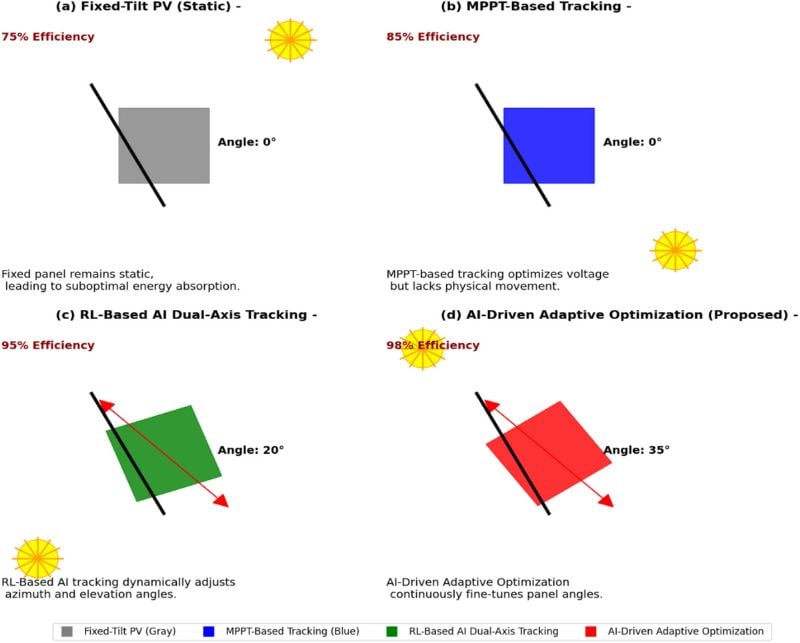
Comparing solar tracking efficiency. Image used courtesy of Mamodiya et al.
The dual-axis tracking system also showed better tracking capabilities than both fixed tilt PVs and MPPT-enhanced PVs. Examples of these improvements include:
- A solar tracking efficiency of 95%, compared to 75% for fixed tilt PV systems that suffer from static positioning, and 85% for MPPT-based tracking systems that lack physical movement despite being electrically optimized
- Highest solar tracking efficiency of around 98% when using AI-driven adaptive optimization
- Root mean square error in solar forecasting of 21.7 W/m2 compared to 35.2 W/m2 for MPPT-optimized PVs (lower is better)
- The reinforcement learning model improved tracking precision to 98.3%, much higher than other approaches
- A ± 0.5° precision in azimuth and elevation tracking to always maximize solar exposure
- Actuator response time below 1.2 s to allow a real-time adaptation to solar changes after tracking
Some other features and achievements of the hybrid tracking system include:
- A low sensor data processing latency of below 20 ms, by using AI modules that provide a near-instantaneous response to environmental variations
- 94.3% blockchain transaction success based on validated energy trading
- High power efficiency for the control unit, with an average power consumption of 5.2 W
- The integration of a blockchain energy management system reduced the energy dispatch latency from 180 to 48 ms
Tracking Platform’s Mechanical Aspects
Even though the main study focus was evaluating how the algorithms could help to optimize energy harvesting, the materials used also played a big role in the system’s success. The model used a high-strength and corrosion-resistant aluminum alloy for the panel mounting structure alongside a weather-resistant polymer coating. Key characteristics of the materials used in the hybrid PV system include:
- Resistant to wind and working forces, and an ability to withstand mechanical loads, confirmed by tensile strength tests
- High resistance to oxidation and environmental degradation after a 500-h accelerated salt spray test
- Thermal stability between −10 °C and 60 °C without deformation
- No mechanical degradation or wear on the actuators after 1000 + tracking cycles
Impacts and Uses
The researchers concluded that the AI-enhanced model could lead to more adaptable and unified solar energy systems. They recommended future research in AI swarm optimization, control logic, cloud-edge hybrid systems, and interaction with electric vehicle infrastructure. The study was published in Nature.