Facebook
 Google
 GitHub
 Linkedin
Solar Energy Future: Perovskite Challenges Silicon
Could 2025 could be the year of achieving record efficiency in solar cells?
As global energy demands surge and climate change concerns intensify, renewable technologies are under increasing pressure to deliver more efficient, sustainable solutions. The traditional silicon solar cell has long grappled with inherent efficiency limitations that challenge its widespread adoption, and the renewable energy sector has continuously sought after technologies that can bridge the gap between current performance and theoretical potential.
In 2024, researchers made significant breakthroughs in improving the efficiency of solar cells. In 2025, the same trend will continue, with perovskite ultimately replacing silicon to boost efficiency beyond 29%.
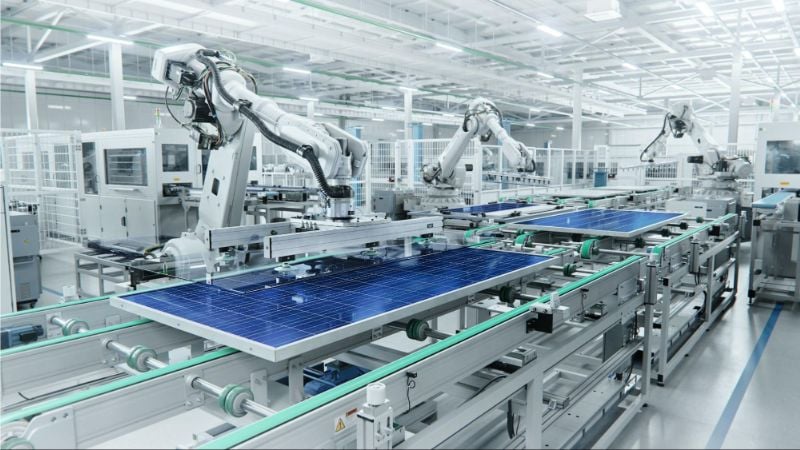
Solar cell manufacturing. Image used courtesy of Adobe Stock
Perovskite Versus Solar Cells
Solar cells function through the photovoltaic effect, in which photons excite electrons in a semiconductor and generate electron-hole pairs. An electric field then separates these pairs to create current.
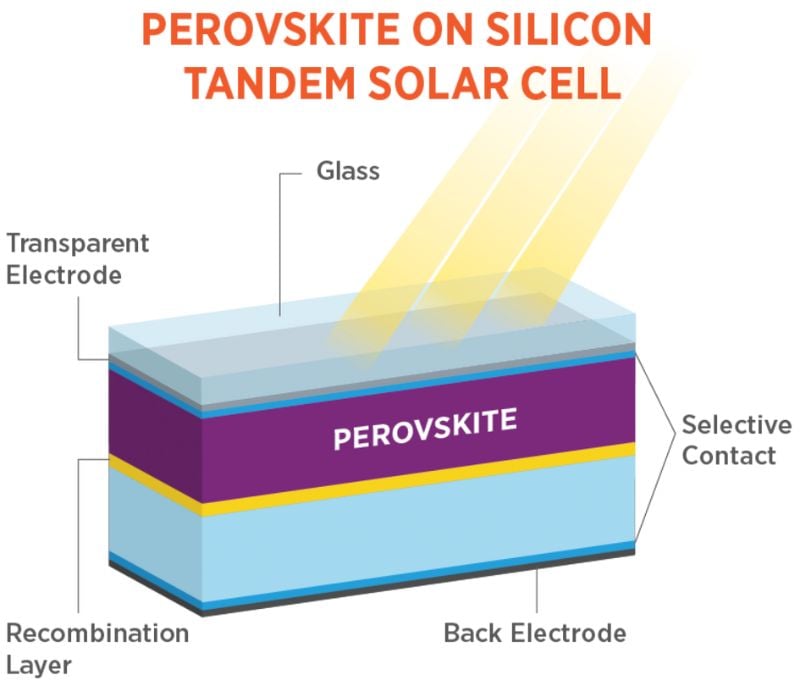
Perovskite on silicon tandem solar cell. Image used courtesy of the Department of Energy
So far, solar cell technology relies predominantly on silicon, the planet's second most prevalent element after oxygen. While silicon can be processed into amorphous or crystalline forms, the crystalline variant dominates due to its superior power conversion efficiency. Silicon's theoretical efficiency ceiling remains constrained at approximately 29%. In contrast, perovskite emerges as a more promising photovoltaic material, offering superior light absorption capabilities and the unique advantage of spectral adaptability.
Unlike silicon, which utilizes only a small portion of the solar spectrum, perovskite can be engineered to capture and convert a bigger range of electromagnetic radiation. This presents a potentially transformative approach to solar energy generation. In 2024, some breakthroughs were made in improving the efficiency of solar cells.
Perovskite in 2024
King Abdullah University of Science and Technology researchers have made advancements in silicon-perovskite tandem solar cells in 2024.
The researchers explored the potential of tandem solar cells combining perovskites with silicon. Perovskite/silicon tandems have achieved certified power conversion efficiencies exceeding 33%, surpassing the theoretical limit of single-junction cells. This advancement is due to the complementary absorption spectra of the materials, which maximize sunlight utilization and minimize energy losses.
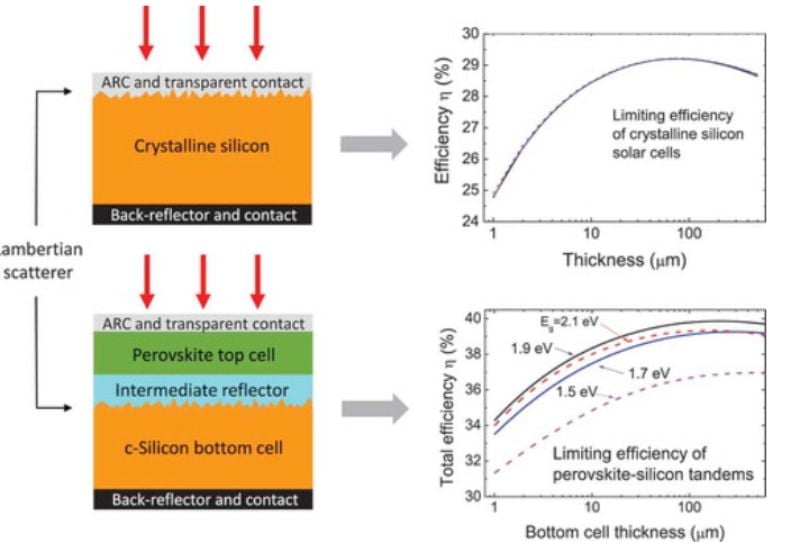
Efficiency comparison of both technologies. Image courtesy of Andreani et al.
However, major challenges include scaling up production for commercialization. The current lab methods used in research, such as spin coating with anti-solvent treatment, are inefficient for large-scale manufacturing due to material wastage and limited scalability. Promising alternatives, such as slot-die coating and physical vapor deposition, are being explored to address these issues.
Additionally, silicon’s surface topography can affect perovskite layer deposition, while environmental factors like moisture, heat, and light degrade perovskite sub-cells. Rigorous testing under accelerated aging and real-world conditions is critical to ensure reliability and longevity.
2025: The Year of the Perovskite Cell
Perovskite photovoltaic technology presents a promising path for solar energy. It offers low-temperature manufacturing processes, potential ink-based production, and remarkable versatility. Its unique properties include the ability to be stacked with silicon for enhanced energy conversion, engineerable light absorption through band gap modifications, and inherent tolerance to crystal structural imperfections.
Because of these benefits and the ongoing research efforts in the field, we expect 2025 to be the year of the perovskite cell.