Facebook
 Google
 GitHub
 Linkedin
Salty ‘Water Glue’ Helps Aqueous Batteries Live Longer
Researchers found that sulfate salts in aqueous batteries could create safer, more stable energy storage.
Reversible electrodeposition in aqueous batteries is key to developing safer, higher-density lithium, sodium, and zinc metal anodes. However, morphological instability and parasitic reactions at the metal anode interface have limited the capabilities of aqueous batteries.
King Abdullah University of Science and Technology (KAUST) researchers have discovered that aqueous batteries’ short lifespan is due to the electrolyte's presence of “free water” molecules. The researchers used sulfate salts—such as zinc sulfate—to act as a “water glue” to stabilize the water structure and prevent free water molecules from forming in the electrolyte. The discovery suggests that adding salt to aqueous batteries could produce more sustainable storage in microgrids and large-scale energy storage projects than lithium-ion batteries.
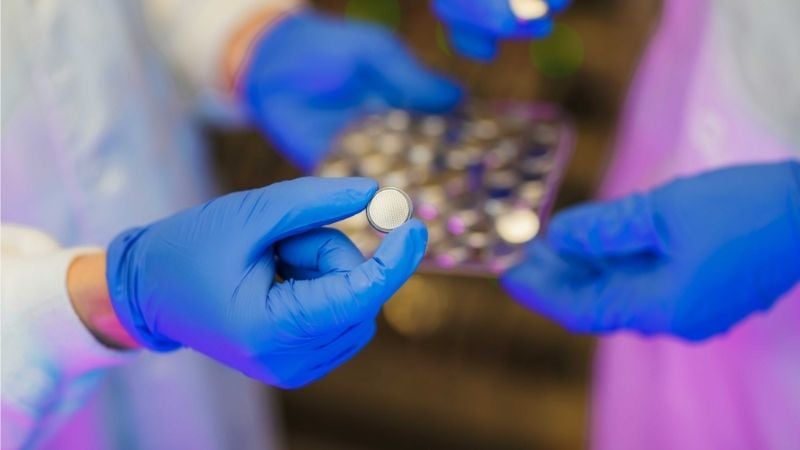
KAUST researchers with their aqueous batteries. Image used courtesy of KAUST
Anode Parasitic Reactions Challenge Aqueous Batteries
In liquid electrolytes, solvated metal cations capture electrons at the electrode-electrolyte interface. The cations are then reduced to a solid metallic form. However, uncontrolled metal deposition leads to irregular morphological evolution at the interface, resulting in metal dendrites. The dendrite formation and the irreversible metal electrodeposition at the interface lead to poor reversibility and shorten the battery’s lifetime. Dendrite formation often will short-circuit the battery, which is a serious safety issue.
Free water molecules cause the anode degradation in aqueous batteries. Typically, water molecules are tightly held together through intermolecular forces such as hydrogen bonding. However, free water molecules are not interlinked and can interact with more molecules than otherwise possible. This causes unwanted reactions that consume energy, destabilize the anode, and cause low reversibility.
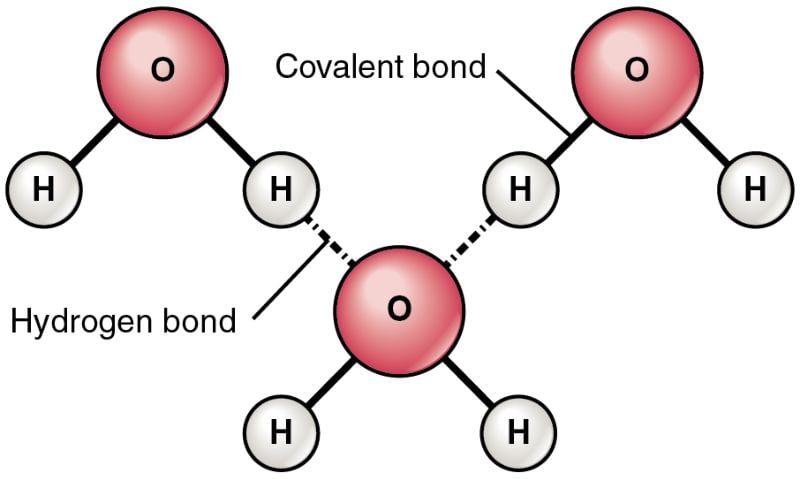
Hydrogen bonds in water molecules. Image used courtesy of Wikimedia Commons
Many aqueous electrolytes contain “structure-breaking” anions responsible for breaking the hydrogen bonds between water molecules using dipole-dipole interactions. This process generates free water molecules and Zn2+ ion-hydrated water with weak hydrogen-bond interactions. This occurs in many aqueous electrolytes, such as ZnCl2 and Zn(OTf)2.
The free water molecules have a higher dielectric permittivity than the structured water molecules, preventing them from forming long-range interactions with other water molecules. They can only form short-range hydration forces between the water molecules and other molecules in the battery. These short-term interactions, coupled with the free water’s higher affinity to reorient perpendicular to the electrode, promote the electron transfer at the electrode interface, leading to water dissociation and the continued production of side reactions that form into dendrites.
Stabilizing Water Molecules with a ‘Water Glue’
The KAUST researchers found that structure-making sulfate anions could act as a type of “water glue” to stabilize the free water bonds, changing the dynamics and reducing the number of parasitic reactions. Sulfate is cheap and widely available, so it could be an easy, scalable way to solve challenges in aqueous battery technology.
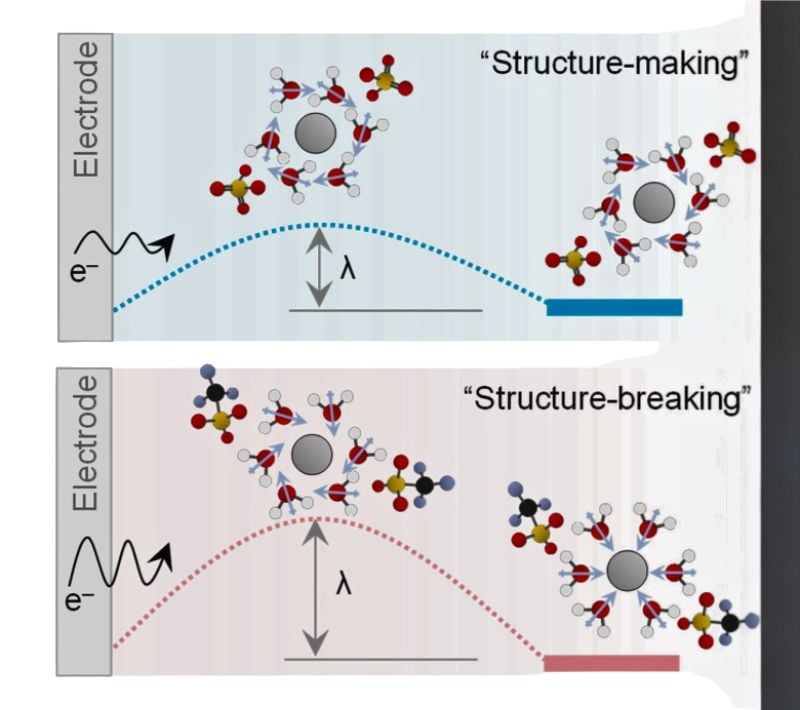
Structure-making vs. structure-breaking molecules. Image used courtesy of Zhu et al.
The study found that sulfate anions modulated electrolyte chemistry to suppress free water formation and influenced the electron transfer pathways at the electrode-electrolyte interface. This enabled a controlled electrodeposition process that prevented parasitic reactions.
This process occurred because the sulfate anion strongly regulated the water molecules’ hydrogen bonds and stopped the rotational motion responsible for them aligning at the electrode interface. The sulfate ions also stabilized and structured the water molecules by holding them together—like glue—using short-range hydration and long-range van der Waals intermolecular forces.
Well-structuring the water molecules enabled the electrode to transfer electrons to the zinc ions instead of the water molecules, meaning the parasitic reactions didn’t occur. This led to a highly reversible electrodeposition and a tenfold increase in battery life. It stopped the battery from wasting energy, minimized hydrogen evolution reactions, and gave superior cycling stability.
Proof of Concept Battery
To demonstrate sulfate anions’ water gluing capabilities in practical systems, the researchers fabricated a proof-of-concept battery by adding ZnSO4 into conventional aqueous electrolytes with structure-making anions. The battery showed a high reversibility and stability, even under harsh conditions of 10 mAh cm-2.
Adding a small amount of metal salt has shown that it can enable highly reversible zinc metal anodes and stable full-cell operation, suggesting that this approach could work for many different types of aqueous batteries.