 Facebook
 Google
 GitHub
 Linkedin
Powering Peak Demand With V2G: Q&A With Mike Calise, Tellus Power
In this interview, the CEO of Tellus Power discusses how vehicle-to-grid technology can turn electric vehicle fleets into reliable grid infrastructure.
Electric vehicle charging can strain local grids, especially when commuters plug in at home at the same time during peak evening hours. Yet, EV charging can also relieve grid stress when vehicle-to-grid technologies are implemented. The benefits are multiplied when EV fleets use V2G.
As V2G matures and grows more widespread, EV and fleet owners and utilities are paying close attention to the advantages and strategies for getting the most from it. In this virtual interview, Mike Calise, CEO of Tellus Power, discusses V2G technology, inverter-free systems, software, AI, and more.
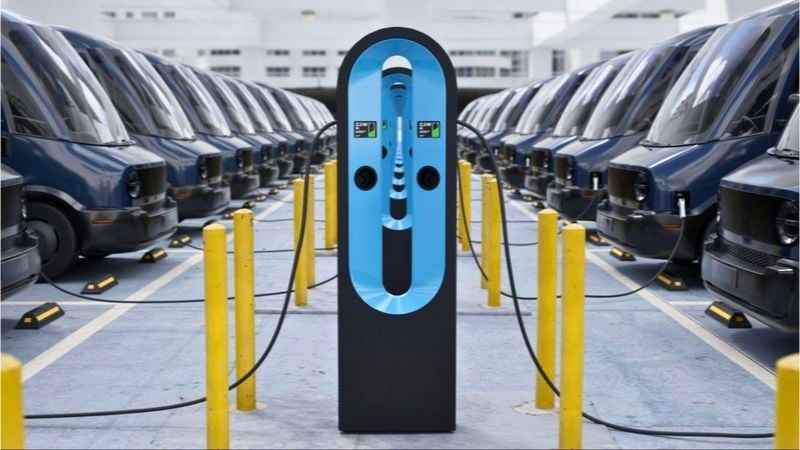
How can these delivery vans assist the local power grid? Image used courtesy of Adobe Stock
V2G Technologies and Inverter-Free Systems
EEPower: Let’s start by discussing bidirectional charging and vehicle-to-grid technologies. How does the choice of technologies affect efficiency, battery degradation, and other factors of V2G deployment? What are the advantages of inverter-free systems?
Mike Calise: The biggest choice is where the power conversion happens. Batteries store direct current (DC), but the grid runs on alternating current (AC), so something has to convert between the two. If the vehicle’s built-in charger does the conversion, you’re limited by a small, heat-sensitive piece of hardware that can’t move power quickly, and you lose roughly 15% of the energy on the round trip.
If powerful equipment outside the vehicle does the conversion, the charger connects straight to the battery and skips the onboard hardware entirely. That pushes efficiency above 95%, which matters when a fleet moves megawatts and sells power back at the best prices.
This is what we mean by an inverter-free vehicle: the conversion hardware stays in the ground-mounted charger instead of riding on the vehicle. That makes the vehicle lighter, which helps its range, and lowers the cost to build it.
A depot built around a shared DC line goes further. Solar panels, stationary batteries, and vehicles can swap power directly without repeated DC-to-AC conversions, which waste energy each time. It can also reduce the amount of large on-site transformer equipment a depot needs, which saves space, cost, and installation time. Conversion happens in one central system instead of in dozens of vehicle inverters pushing power onto the same line at once.
Standards keep all this safe and compatible. Standards are what turn this from a good idea into something a utility will approve. IEEE 1547 and UL 1741 SA/SB give the local electric company confidence that a depot won’t cause problems on the grid when it sends power back, which is often what decides how fast a project gets connected. For vehicles and chargers to exchange energy, they need ISO 15118-20, a communication standard that lets them talk directly. The vehicle reports how much power its battery can safely give or take, and the charger acts on that, the same way across vehicle brands.
Software and battery care come last. Automated dispatch treats departure times and minimum charge levels as hard limits, so the vehicles are always ready to roll. Batteries wear from sitting nearly full in the heat, not from controlled charging and discharging. Discharging a parked vehicle from 80 or 90% down to 40 or 50% during peak hours eases that strain, and with good temperature management, fleets can stay available more than 99% of the time.
Fleets and V2G
EEPower: Discuss how fleets and truck depots might utilize V2G technology. What are the advantages vs. passenger cars for the utilities? What benefits do fleet owners derive?
Mike Calise: What matters most is the vehicle’s duty cycle. Local grids usually see the most power use between 4 and 9 p.m., so the vehicles parked and plugged in during those hours are the ones that can help.
School buses are the ideal case. They drive about 53 miles a day, sit at the depot roughly 17 hours, and are free on weekends and all summer. They’re home before the evening peak with plenty of charge left. Refuse trucks are also a strong fit. They cover 80 to 150 miles a day and spend about 11 hours at the depot, though how much they can offer depends on the fleet’s shifts.
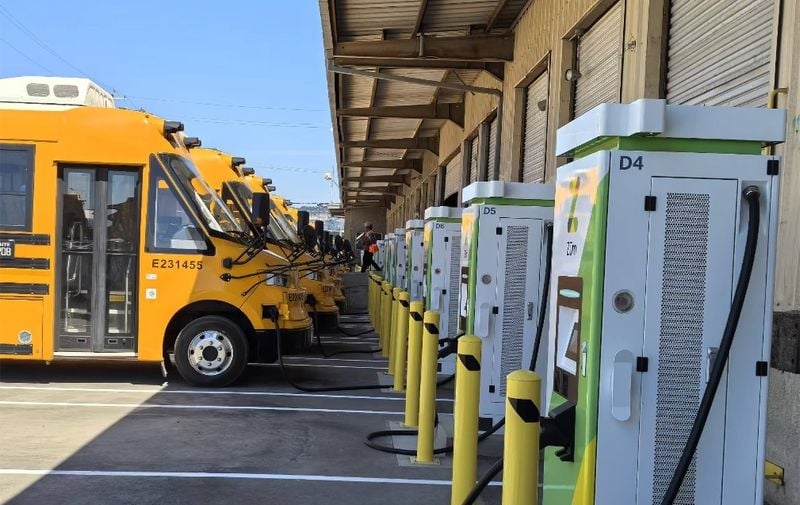
Electric school buses. Image used courtesy of Tellus Power
Passenger cars are parked about 95% of the time, mostly at home, so their availability is high. But it’s nearly impossible for utilities to know when exactly those vehicles will provide power back to the grid.
For utilities, a school bus or refuse depot puts dozens or hundreds of large batteries behind one connection point, giving them reliable power they can call on like a clean “peaker plant” to ease a strained substation. For fleet owners, the income from that parked time helps offset higher vehicle costs and utility demand charges, and can shorten infrastructure payback to as little as two to three years.
Benefits and Planning
EEPower: What positive effects does AI have on EV charging and V2G technology? How might AI be deployed? What are potential negatives to consider?
Mike Calise: Think of AI as the brain that makes two-way charging work at scale. Electricity prices, solar output, utility alerts, and fleet schedules change constantly, and a simple timer can’t keep up.
Our Energy Intelligence Agent watches all of them at once, along with vehicle and battery data, and adjusts within moments. Power goes back to the grid when prices peak, and every vehicle is still fully charged for its next departure. At the charger, it tracks each battery’s temperature and voltage to charge in a way that goes easy on the battery. It can also help depots cover surges from big neighbors like factories and data centers, without anyone stepping in.
Software-run energy networks come with a few things to plan for. Communication can drop out, and any connected system needs strong cybersecurity. If software controlling a large group of linked vehicles ever failed, it could affect nearby power lines. And software focused only on trading profit could cycle batteries harder than it should. That’s why we build in firm safety limits at the hardware level, so the AI works within boundaries no matter what.
A Case Study in V2G
EEPower: Can you give us a specific example (or case study) of how V2G provided grid stability?
Mike Calise: Our project with Zum and the Oakland Unified School District in California is a clear example. We paired 74 electric school buses with Tellus two-way DC chargers. Together, the buses hold 11.5 MWh of battery storage, and the depot can move roughly 2 to 2.7 MW of power at once. In more than two years of continuous operation, it has sent 1.7 GWh back to the local grid, and the buses are available 99.5% of the time.
The daily rhythm lines up with what the grid needs. The buses finish their morning routes and recharge between 9:00 a.m. and 2:00 p.m., when power is cheap and solar is plentiful. Between 4:00 p.m. and 8:30 p.m., when regional demand peaks and solar fades, the chargers automatically send stored energy back, releasing about 60 percent of what’s in the batteries. That’s enough to power roughly 1,000 California homes during the grid’s most strained hours.
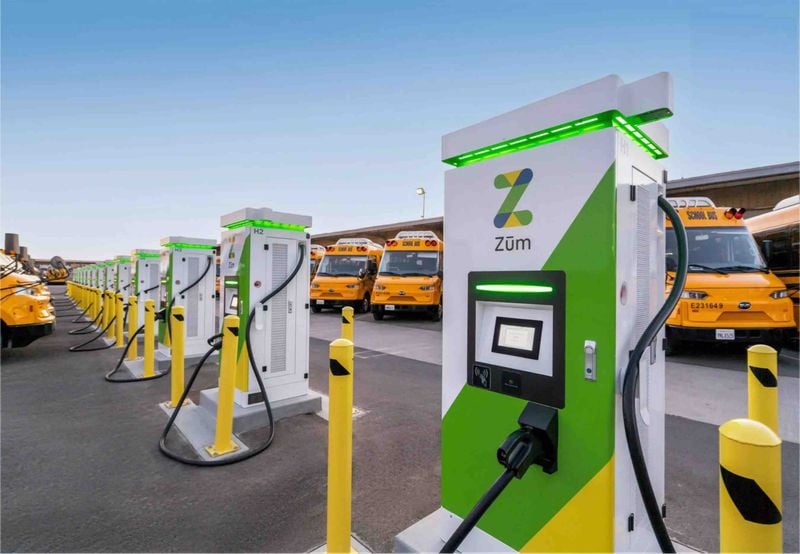
V2G chargers at the Oakland School District. Image used courtesy of Tellus Power
We see this as an opportunity for any school district. A school bus sits at its depot about 17 hours a day, and it’s idle on weekends and all summer. Any district with electric buses has the same pattern as Oakland: pairing the buses with two-way DC chargers and letting automated dispatch do the rest. Oakland shows that a school bus depot can become grid infrastructure without costing a single route.
Charging Standards and Grid Connection
EEPower: What other aspects of bidirectional charging and V2G should be considered? By fleet owners? By utilities?
Mike Calise: For fleet owners, the top priority is choosing equipment built on open standards, such as ISO 15118-20, so it works across vehicle brands and doesn’t lock the depot into one vendor. Dispatch software should also treat departure times and minimum charge as hard rules. A route should never be at risk for a little grid revenue.
For utilities, the biggest hurdle is how long it takes to connect to the grid. A two-way depot eases pressure on local lines, so electric companies can treat it like a small power station and offer faster approvals and pricing that rewards local power at peak hours.
Programs are already moving this way. California’s Emergency Load Reduction Program (ELRP) pays participants to support the grid during emergencies, and FERC Order 2222 opens wholesale power markets to groups of small batteries acting together.
There’s a big prize at stake. Pairing electric school buses with on-site solar and stationary batteries can create resilient power hubs that add capacity in months rather than years.