 Facebook
 Google
 GitHub
 Linkedin
P-DUKE Power Unveils Next-Gen Converters for Rail, Medical, and More at Electronica
At Electronica 2026, P-DUKE Power introduces next-gen DC-DC converters delivering high power density, insulation, and ultra-wide inputs for railway, medical, avionics, and datacenter applications.
This week, at Electronica 2026, P-DUKE Power is showcasing a formidable new lineup of power conversion solutions aimed at the industry's most demanding environments. Spanning from ultra-wide input industrial modules to high-voltage DC (HVDC) half-bricks, the new portfolio targets the strict regulatory, thermal, and electrical demands of modern railway, avionics, datacenter, and medical applications.
To get deeper insights on the company’s new offerings, we were pleased to speak with James Wang, Senior Field Application Engineer at P-DUKE.

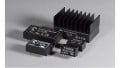
P-DUKE’s new DC-DC converters target a variety of applications, including railway, medical, avionics, and datacenters.
As system designers increasingly prioritize power density, enhanced electrical isolation, and simplified bill of materials (BOM) management, P-DUKE’s latest series—the HAE350-300, QBE150W/200W, MPD40W, and PDL10U—deliver significant upgrades over previous generations.
Bridging the HVDC Gap for Avionics and Datacenters: The HAE350-300 Series
As modern datacenters scale to meet advanced computing demands, and as the aerospace sector fully embraces eVTOLs and more-electric aircraft, power engineers are rapidly migrating toward HVDC distribution. To support 270 VDC aerospace buses and 380 VDC datacenter architectures, P-DUKE rolled out the HAE350-300 series.
“The HAE350-300 is designed for high-voltage DC power systems, such as 380 VDC power distribution architectures used in data centers and industrial applications,” said Wang. “With its wide input voltage range from 180 to 425 VDC, it can accept 380 VDC directly and convert it into the lower DC voltage required by downstream equipment. This approach helps reduce distribution current, minimize cable losses, and improve overall power distribution efficiency. It also offers up to 92% efficiency and reinforced insulation, making it a compact and reliable solution for high-voltage DC power systems.”
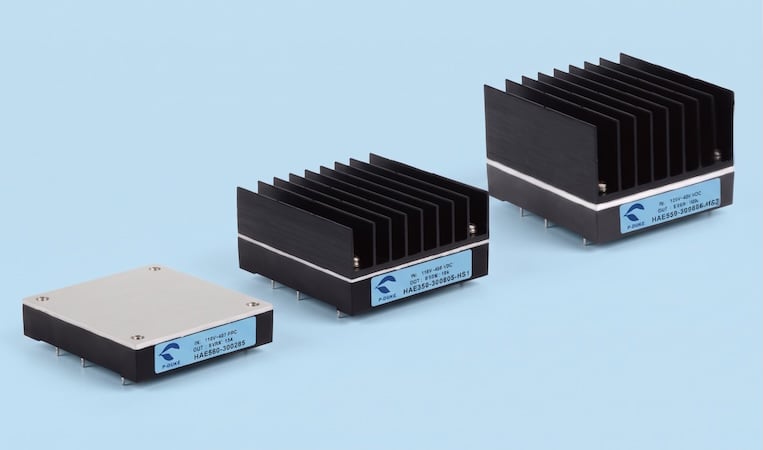
The HAE350-300 half-brick DC-DC converter series delivers up to 350 W.
As mentioned, this 350 W half-brick DC-DC converter features a wide 180 to 425 VDC input range and robust reinforced insulation rated up to 3000 VAC (or 2500 VAC from input to base-plate). According to P-DUKE, migrating to a 380 VDC distribution architecture can drastically simplify the power path. At equivalent power levels, a 380 VDC system reduces current by approximately 8x compared to legacy 48 VDC systems, enabling the use of significantly smaller cables, busbars, and protection devices. Furthermore, removing redundant AC-DC or DC-AC conversion stages in these architectures can improve end-to-end efficiency by 7% to 15%.
The HAE350-300 series operates at a 400 kHz switching frequency and delivers peak efficiencies of up to 92%. It is available with multiple single-output options, including 5, 12, 15, 24, 28, 48, and 54 VDC. The converter can also operate in a Constant Current (CC) mode, providing up to 425W of power, making it highly suitable for specialized loads or battery charging applications. Built for thermal resilience, the base-plate operating temperature ranges from -40°C to +105°C, and the module supports both 0.65-inch and 1-inch heatsink assembly options for natural or forced convection cooling.
Upgraded Power Density for the Rails: QBE150W & QBE200W
For rolling stock, ruggedized transit, and harsh industrial settings, P-DUKE announced the QBE150W and QBE200W quarter-brick converters. These modules offer 150 W and 200 W nominal outputs, respectively, representing a significant power density upgrade over the company's previous 132 W QAE150W and 90W QAE100W generations.
“The QBE series is designed to deliver high reliability and safety for demanding railway and industrial applications,” said Wang. “First, it provides reinforced insulation of up to 3,000 VAC for 110 V input models, helping ensure electrical safety and protect downstream equipment. Second, it incorporates comprehensive protection features, including over-current, over-voltage, short-circuit, under-voltage, and over-temperature protection."
"In addition, the QBE series is designed to meet demanding railway environmental requirements, including vibration, mechanical shock, and operation at altitudes up to 5,000 meters. Combined with its high efficiency of up to 92%, these features help reduce power losses, minimize thermal stress, and improve overall system reliability.“
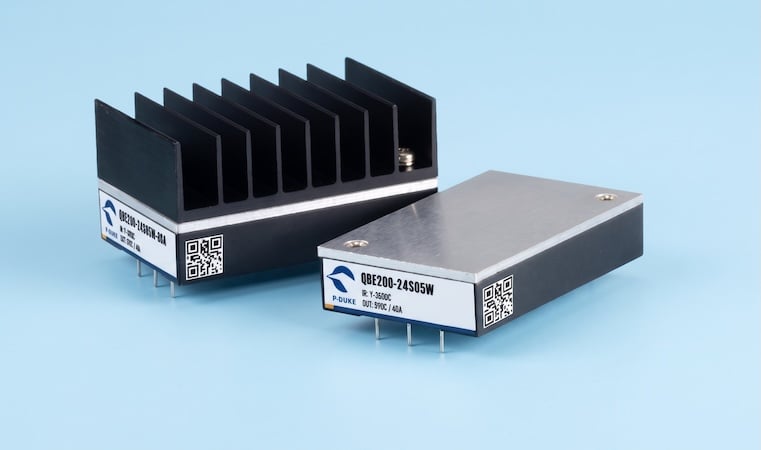
The QBE200W quarter-brick DC-DC converter series provides 200 W nominal output.
A primary advantage of the QBE series is its highly flexible 4:1 input voltage range. The converters are offered in three specific input bands: 9 to 36 VDC, 18 to 75 VDC, and 40 to 160 VDC. This exceptionally wide coverage ensures compatibility with all standard railway battery voltages, including 24 V, 48 V, 72 V, 96V, and 110V systems. Output options span from 3.3 VDC (available on the 150 W model) up to 54 VDC, accommodating a vast array of downstream loads.
Safety and environmental reliability are central to the QBE design. The 40-160 VDC input models provide 3000 VAC of reinforced insulation, while the lower voltage input models utilize 3000 VDC of basic insulation. Boasting peak efficiencies up to 92%, the converters feature a -40°C to +105°C operating base-plate temperature range and are certified for operation at altitudes up to 5000 meters.
Furthermore, the modules are fully compliant with EN50155 and EN45545-2 railway standards and incorporate comprehensive protection circuitry, including Under-Voltage Protection (UVP), Over-Voltage Protection (OVP), Over-Temperature Protection (OTP), Over-Current Protection (OCP), and Short-Circuit Protection (SCP). Thermal management is highly customizable, with optional heatsinks available in 0.24-inch, 0.65-inch, and 1-inch heights to optimize derating performance.
Mission-Critical Medical Power: The MPD40W Series
Patient-contact medical equipment, particularly those classified under Type CF (Cardiac Floating), requires the highest possible tiers of electrical isolation to prevent fatal shock hazards. Addressing this critical sector, P-DUKE debuted the MPD40W, a 40 W DC-DC converter housed in a compact 2” x 1” package.
“One of the key improvements in the MPD40W is its redesigned case structure,” said Wang. ”In the previous MPD30W, a gap at the bottom of the case required additional clearance and creepage distances, limiting PCB layout space. “The new design moves the gap to the middle of the case, freeing up more routing space and giving customers greater PCB layout flexibility.”
“In addition to this mechanical improvement, the MPD40W maintains key medical safety features, including 2 x MOPP insulation, 5,000 VAC isolation, and 8 mm creepage and clearance distances. With 40 W output power in a compact 2" × 1" package, the MPD40W provides a reliable and space-efficient power solution for medical equipment.”
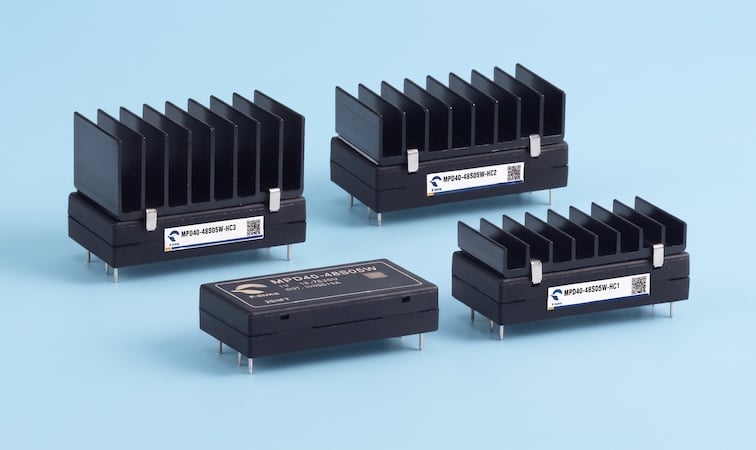
The MPD40W is a medical DC-DC converter providing up to 40 W.
Designers building sensitive medical arrays—such as ultrasound machines, patient monitors, or surgical robotics—will benefit from the module's strict 8 mm clearance and creepage distances, alongside an ultra-low leakage current of just 2 μA at 240 VAC.
The MPD40W accepts 4:1 input voltage ranges of either 9 to 36 VDC or 18 to 75 VDC. Output options are versatile, including single outputs of 5, 12, 15, and 24 VDC, as well as dual outputs of ±12 and ±15 VDC. To maintain its compact footprint without sacrificing thermal performance, P-DUKE implemented an improved internal mechanical design layout that increases the physical distance between the internal circuit and the PCB, yielding better thermal dissipation and safety spacing.
The series achieves up to 91% efficiency and operates from -40°C to +105°C, with multiple heatsink options (0.3-inch, 0.5-inch, and 0.8-inch heights) available for environments with constrained airflow. Pending safety approvals include IEC, EN, ANSI, and AAMI ES 60601-1 standards.
Ultra-Wide 8:1 Adaptability: The PDL10U Series
Rounding out the new offerings is the PDL10U series, a 10 W DC-DC converter that stands out for its massive 8:1 ultra-wide input voltage range. Accepting anywhere from 9 to 75 VDC, the PDL10U allows engineers to seamlessly cover 12 V, 24 V, 36 V, and 48 V nominal systems using a single part number.
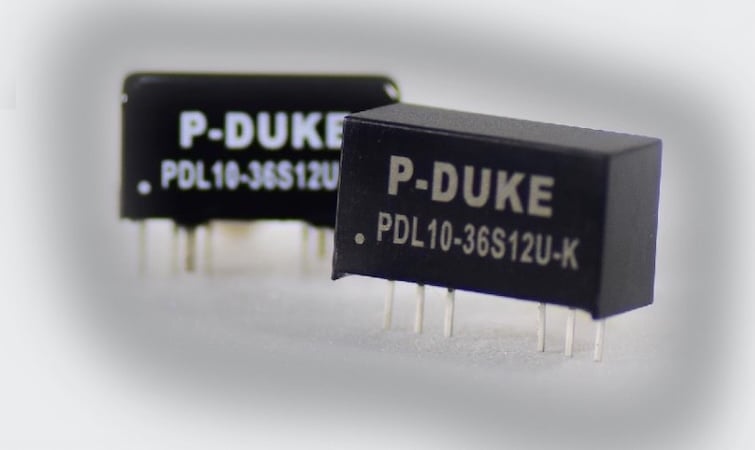
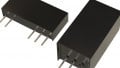
The PDL10U series is a 10 W DC-DC converter featuring 8:1 ultra-wide input voltage range.
This ultra-wide adaptability drastically simplifies inventory management and BOM complexity for industrial automation, datacom, measurement, and telecom designs where input sources may vary wildly or fluctuate significantly. The PDL10U requires no minimum load to operate and features exceptionally low standby power consumption, making it ideal for battery-powered, intermittent, or energy-harvesting applications.
P-DUKE provides extensive mechanical flexibility with the PDL10U series. It is available with both single outputs (3.3, 5, 12, 15, and 24 VDC) and dual outputs (±12 and ±15 VDC). Engineers can select between standard non-conductive plastic cases or enhanced metal cases for improved thermal dissipation. Furthermore, the modules are offered with two tiers of isolation: a standard 1600 VDC isolation rating or an upgraded 3000 VDC isolation rating (denoted by the "H" suffix for plastic cases and "T" suffix for metal cases).
The converters operate at switching frequencies of 250 kHz (for 3.3 Vout models) or 300 kHz (for all other models), achieving peak efficiencies up to 87%. Advanced functions such as Remote ON/OFF, voltage trim capability, and continuous short-circuit protection come standard, ensuring seamless integration into complex system architectures.
“The key advantage of the PDL10U is its ultra-wide input voltage range from 9 to 75 VDC,” said Wang. “Traditionally, industrial DC-DC converters often have separate input ranges, such as 9 to 36 VDC or 18 to 75 VDC.”
“With the PDL10U, we combine these ranges into one product input range. This gives customers more flexibility and allows them to use the same input-range model across different power systems. As a result, customers can simplify product selection, reduce the number of input voltage versions they need to stock, and make inventory management easier. The series also offers multiple output voltage options and an output trim function for single-output models.”
All images used courtesy of P-DUKE Power.