Facebook
 Google
 GitHub
 Linkedin
MIT Finds Chemical Weakening Causes Solid-State Battery Shorts
The study found that electrochemical embrittlement, rather than mechanical stress, primarily causes dendrite-induced short circuits in solid-state batteries.
Solid-state lithium-metal batteries promise higher energy density and improved safety, but internal short circuits caused by dendrites have limited their progress. These metallic filaments can penetrate the electrolyte and degrade performance, preventing reliable operation.
Researchers at MIT have shown that dendrites advance not only due to mechanical stress but also through electrochemically driven weakening of the electrolyte. This insight points to new material and interface designs that could reduce short circuits and enable longer electric vehicle driving ranges.

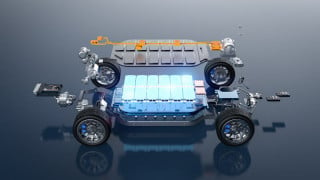
Solid-state battery. Image used courtesy of Adobe Stock
Dendrites Advance Under Lower, Not Higher, Stress
For decades, many research groups framed dendrite penetration as a mechanical problem. Lithium plating builds stress at the anode-electrolyte interface until the stress intensity reaches the fracture threshold, and a crack advances.
The MIT team directly measured stress fields during filament growth and observed the opposite trend: faster dendrites propagated when the locally measured stresses were smaller.
In tests on a widely used garnet electrolyte, cracks advanced at stress levels as low as about 25% of those expected from mechanical loading alone. At the same time, the stress required for propagation at high current was up to 75% lower than the material’s static fracture criterion.
This behavior is inconsistent with a purely mechanical origin and indicates a second driver acting in tandem with stress. The authors attribute the effect to electrochemically driven changes that weaken the electrolyte ahead of the crack tip, essentially making it fail too easily under load conditions that would otherwise be within normal operating limits.
Operando Photoelastic Mapping of Crack-Tip Fields
To see the stress evolution as dendrites grew, the group built a side-view solid-state “sandwich” cell that exposes the thickness of the ceramic electrolyte for optical interrogation. They then applied birefringence (photoelastic) microscopy to map, in real time, the stress distribution around a moving dendrite.
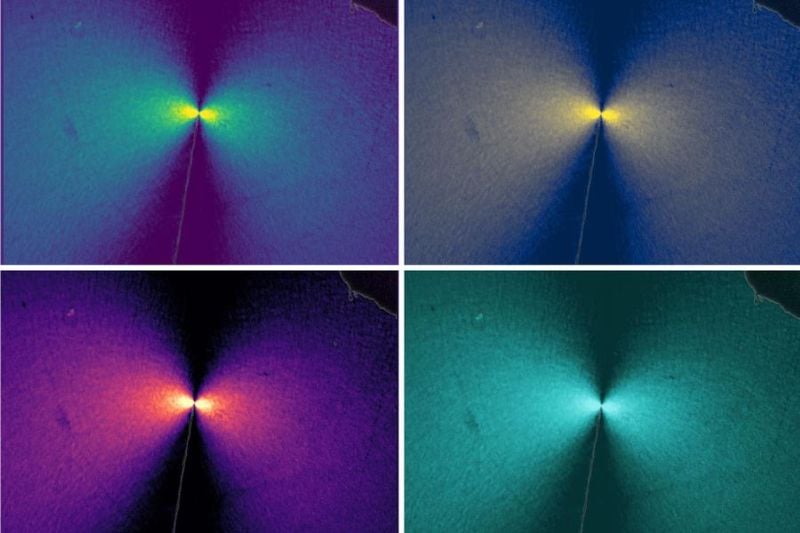
An advanced visualization technique measured stress in a battery material during dendrite crack growth. Image used courtesy of MIT News
Researchers used optical patterns with a characteristic bowtie-shaped field at the crack tip to calculate crack-driving parameters, such as the stress intensity factor K, during active cycling. This setup provided the first direct quantification of the stress–velocity relationship for dendrites under varying current densities in a working cell.
This measurement capability is significant for engineering because it distinguishes between materials that appear tough on the benchtop and those that retain toughness under electrochemical load. The methodology provides a practical screening tool for electrolyte developers evaluating performance under realistic fast‑charge conditions.
Cryo‑STEM Shows Chemical Reduction and Volume Contraction
To probe the root cause of this apparent embrittlement, the researchers turned to cryogenic scanning transmission electron microscopy (cryo‑STEM).
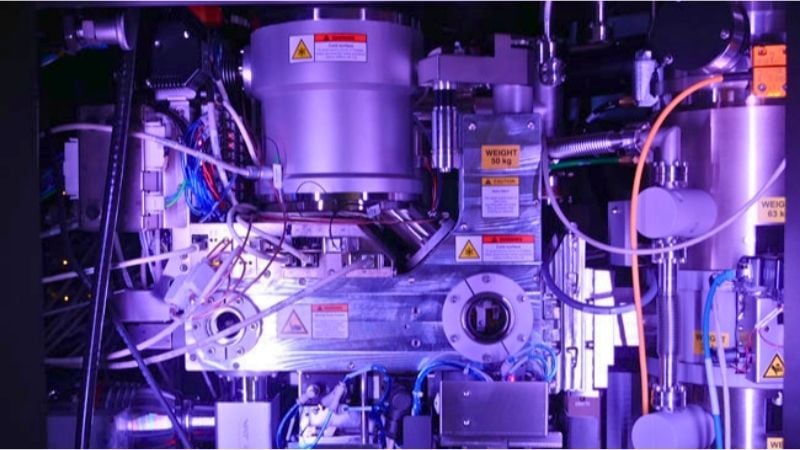
The cryo-STEM at MIT. Image used courtesy of MIT
Imaging near fast‑grown filaments revealed that ionic current concentrated at the dendrite tip drives chemical reduction and phase decomposition of the electrolyte. The new phases that form cause the material to shrink and weaken internally. This pre-existing damage means even a small amount of mechanical stress can cause the material to crack. In other words, current-induced chemistry pre‑damages the material, so much less mechanical stress is needed for a crack to run.
The MIT scientists found this weakening effect in a lithium-garnet electrolyte, LLZTO (Li6.6La3Zr1.6Ta0.4O12 ), a material often regarded as a robust option for stability and high conductivity.
Design Priorities Shift: Chemical Stability First, Stiffness Second
The practical takeaway is that bulk stiffness or static fracture toughness alone is an incomplete design metric for solid electrolytes. Materials and interfaces must also resist electrochemical reduction and electron leakage that can trigger phase changes under high current.
The study suggests that engineers may need to select electrolyte chemistries with high reduction resistance when they come in contact with lithium metal. They may need to test it while the current is actually operating, rather than only in the laboratory.
Additionally, researchers should consider using electron-blocking interlayers, such as salt-based films, to smooth lithium flux and prevent the injection of excess electrons, which can accelerate crack-tip spread.
Finally, engineers need to improve their management of surface contamination when the material is exposed to air. This buildup can cause current crowding and intensify the degradation.
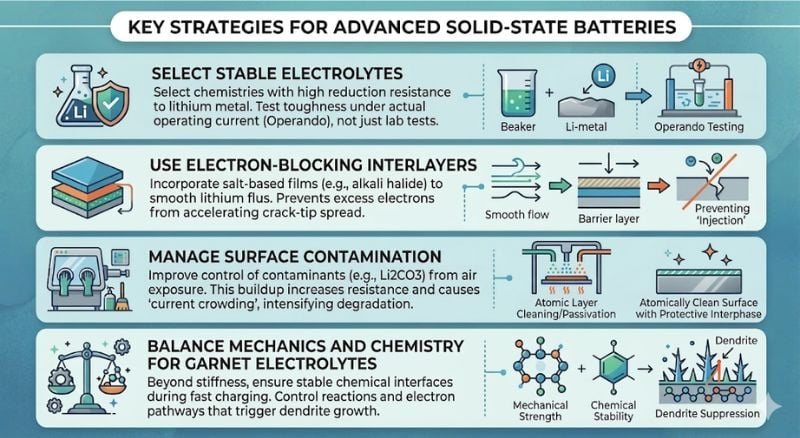
Recommendations for engineers. AI graphic created by Gemini
For garnet electrolytes specifically, the results suggest that progress depends on more than mechanics. The researchers must also balance mechanical strength with the chemical interfaces that remain stable during fast charging. Recent studies confirm that controlling the chemical reactions and electron transport pathways that enable dendrite growth is also essential.
Implications and Applications
The work argues for revised qualification protocols. Researchers should complement traditional metrics, such as critical current density and benchtop fracture toughness, with operando measures of crack-tip fields during cycling. Ideally, this should occur across a broad range of current densities to capture the material's response from a slow trickle to the high-intensity demands of fast charging.
Using photoelastic mapping or similar probes can help identify hidden embrittlement in electrolytes before they reach large-scale production. This same strategy can be applied to other solid-ion devices prone to combined electrochemical and mechanical wear, such as solid-oxide fuel cells and ceramic-based electrolyzers.
The promise of lithium‑metal anodes—maximizing anode‑specific capacity—remains compelling for portable electronics and electric vehicles, where higher energy density translates to longer runtime or extended driving range without a weight penalty. By showing that electrochemical corrosion can pre‑weaken even comparatively stable garnet electrolytes under high current, the MIT study offers a target for materials discovery and interface engineering, aligning R&D with the conditions most relevant to fast‑charge and high‑power operation.
Conclusion
MIT’s operando stress mapping and cryo-STEM analysis provide the strongest experimental evidence to date that coupled mechano-chemical processes, rather than just mechanical overloading, govern dendrite propagation in solid electrolytes.
The insight that high currents can chemically weaken electrolytes, slashing their fracture resistance by up to 75%, explains why "stronger" ceramics have previously failed and highlights the need for materials that stay durable during charging. By focusing on electron-blocking layers, contamination control, and stable electrolytes, developers can use this framework to accelerate the transition of lithium-metal solid-state batteries from the lab to product.