Facebook
 Google
 GitHub
 Linkedin
Solid-State Battery Breakthrough for Ships and Aircraft
SOLiTHOR’s solid-state battery achieves 1,000 charge cycles with 80% capacity retention.
The aviation and maritime industries have faced growing pressure to reduce emissions and transition to sustainable energy sources. Traditional fuel-based systems have long been the standard, but rising environmental concerns and regulations are prompting a shift toward electrification.
However, these sectors face unique challenges in adopting electric technology, as aircraft and ships require high energy density, long-lasting battery life, and lightweight designs to operate efficiently over extended distances. SOLiTHOR could have a solution with its lithium metal solid-state battery (SSB) for aviation and maritime applications.
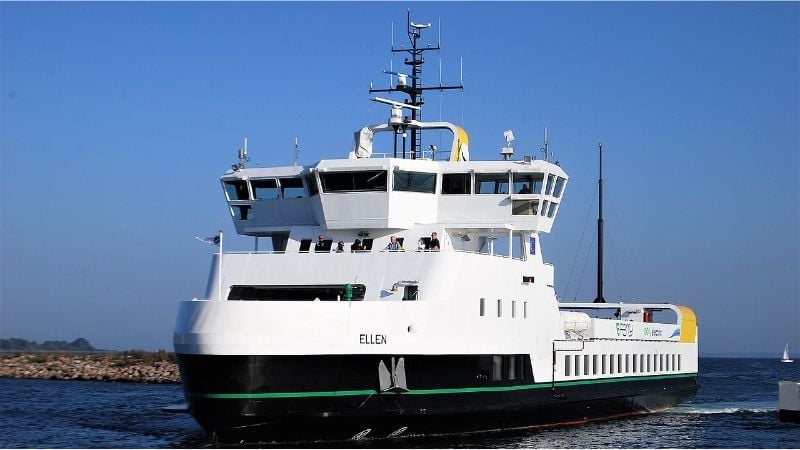
An electric ferry. Image used courtesy of Wikimedia Commons
Solid-State Batteries for Aviation
Aviation and maritime applications face unique battery demands. For example, aircraft need high energy during take-offs and landings, requiring batteries with high discharge rates and large energy storage capacity. Meanwhile, marine vessels need sustained power and batteries offering reliably long cycles without significant capacity degradation.
In lithium-ion batteries, lithium ions flow from the anode to the cathode through a liquid electrolyte, creating chemical reactions that produce electrons, which flow in reverse through an external circuit to power the vehicle. One limitation of lithium-ion batteries is that meeting maritime and aviation demands requires heavy batteries that impact the craft’s range.
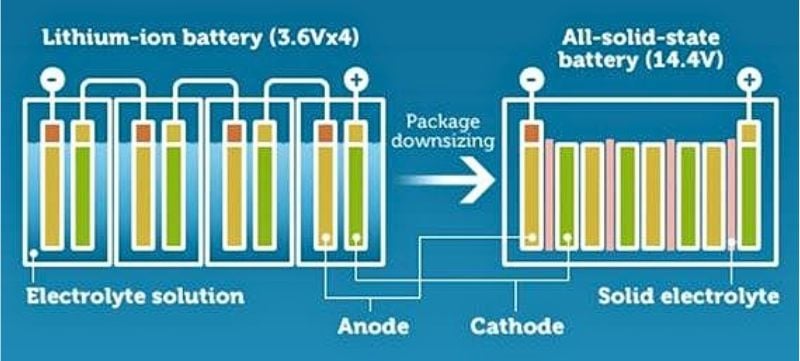
Lithium-ion battery vs. solid-state battery. Image used courtesy of Kartini et al.
Solid-state batteries, however, use a solid lithium metal anode and ceramic electrolyte, which doubles as the separator, allowing ions to move within this solid medium. When charging, ions form a lithium layer on the anode, minimizing volume and enabling greater energy density in a smaller battery than lithium-ion. These batteries also offer enhanced safety since their liquid electrolyte cannot catalyze combustion.
SOLiTHOR’s Solid-State Battery
SOLiTHOR has developed a lithium metal SSB showcasing a cutting-edge architecture designed for high-demand applications in aviation and maritime sectors.
The technology’s core is a Gen-1 Solid Electrolyte paired with thin lithium metal and high-loading nickel manganese cobalt cathode. This advanced design achieves energy densities of 384 Wh/kg and 1,026 Wh/l at stack level and allows the battery to complete 1,000 full charge-discharge cycles at 25°C under external pressure below 72 psi (4.9 atm). Meanwhile, it presents a remarkable Coulombic efficiency of over 99.2%, indicating minimal capacity loss and long-term stability.
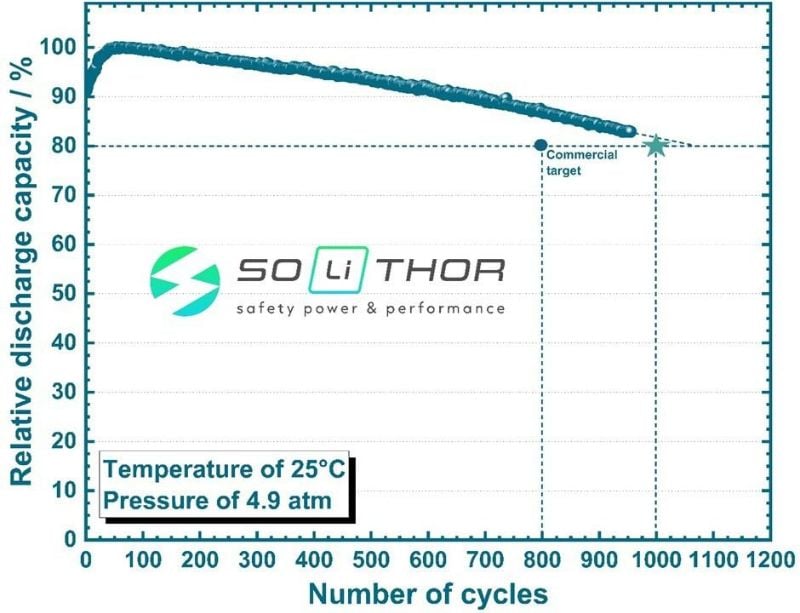
Relative discharge capacity of SOLiTHOR’s battery. Image used courtesy of SOLiTHOR
So far, SOLiTHOR has successfully fabricated 3Ah pouch cell prototypes. These prototypes are currently undergoing internal performance and safety testing, with plans for external validation.
Looking Ahead
SOLiTHOR’s strides have great potential to redefine battery standards for maritime and aviation applications. As global transportation seeks safer and more reliable energy solutions, advancements in solid-state battery technology could fundamentally reshape the capabilities and efficiency of electrified fleets.