Facebook
 Google
 GitHub
 Linkedin
Envelio’s Grid Connection Navigator Eases DER Project Planning
Envelio's tool uses continuously updated, interactive maps to streamline planning and grid connection of distributed energy resources.
Envelio has added a Grid Connection Navigator (GCN) to its Intelligent Grid Platform (IGP) to streamline interconnection processes for distributed energy resources (DERs), such as renewables and electric vehicles.
The GCN creates interactive maps to visualize grid infrastructure, enabling project developers and utilities to select suitable locations, estimate costs, and accelerate project development.
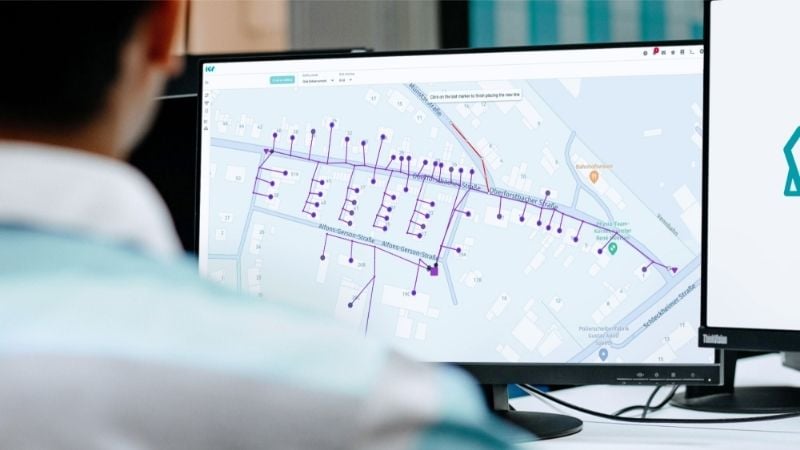
Intelligent Grid Platform. Image used courtesy of Envelio
What Is the Grid Connector Navigator?
As the modern grid expands quickly, DERs and electrification technology are becoming essential components. The growing number of large, localized loads creates bottlenecks that delay operations, increase costs, and make effective grid planning more difficult.
Utility companies must often review incomplete or speculative interconnection requests. Envelio developed the GCN as a planning tool for both project developers and utility operators to handle complex interconnections, including solar and wind farms, large-scale battery energy storage systems (BESS), data centers, and other large-scale power consumption projects.
The GCN’s interactive map shows available hosting capacity at both medium- and high-voltage levels. This approach enables developers to identify suitable locations in a project’s early stages, allowing efficient planning of interconnections before requests are submitted.
How the GCN Works
The GCN evaluates the available capacity using hosting capacity and flow-based calculations. This is then used to determine how much additional power can be integrated at specific grid locations without exceeding predefined local limits that would make the local grid more susceptible to bottlenecks. The GCN also calculates load and generation capacity separately.
Using the data and subsequent calculations, the GCN provides an interactive map rather than a static one. This provides a real-time view using the latest available data, which automatically and continuously updates based on the latest calculations, without assuming any approximate values.
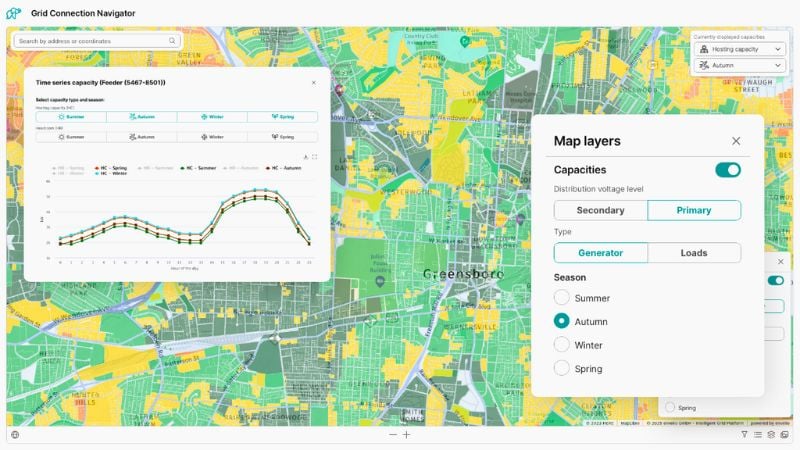
Time-series capacity. Image used courtesy of Envelio
Developers can access the latest information when planning new interconnections, and utility companies can focus resources on feasible interconnection requests. For those involved with BESS and EV charging systems, the GCN also considers seasonal and time-series-based hosting capacities.
Overall, the GCN provides greater operational flexibility and enables users to evaluate grid capacity and identify the best construction sites, helping deploy DERs, EV charging infrastructure, and other large-scale energy projects much faster than before.
The GCN Interactive Map
The GCN interactive map is powered by continuously updated data. This is different from many hosting capacity maps, which only refresh their data after long time periods, sometimes annually, making the maps out of date when people are trying to find the best site with free grid space.
In the GCN, the interactive map continually updates the data and hosting capacity assessment. In practice, this means users have real-time visibility into grid conditions.
The map can be viewed in a consolidated view or as a parcel-based map, and users can directly compare multiple locations using the map to determine which location(s) best suit their needs. This approach allows project developers to conduct feasibility studies at locations before choosing them, reducing investment risk and saving utility companies time spent assessing unfeasible interconnection requests.
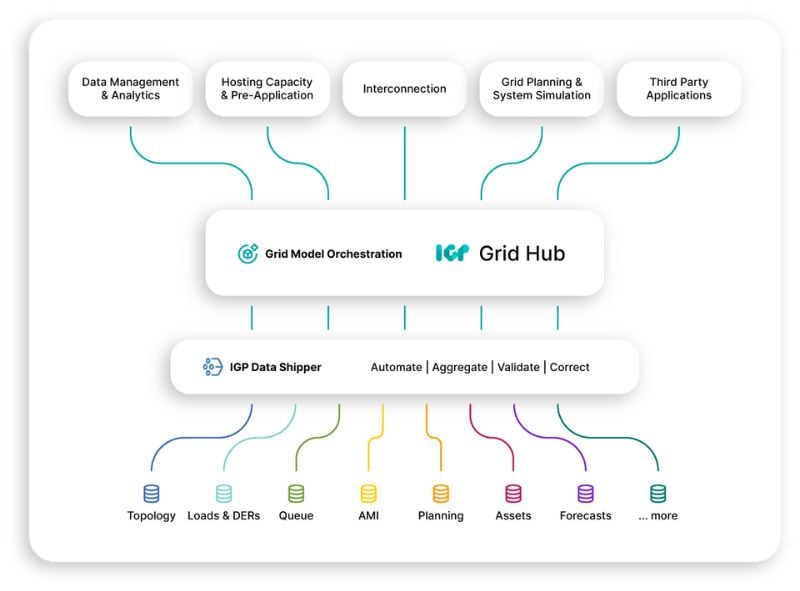
The Grid Hub. Image used courtesy of Envelio
GCN Advantages
The GCN brings several advantages for project managers, DER investors, and utility companies:
- Lower costs through more accurate connection cost estimates at potential siting locations
- Full transparency into what sites could be used for new interconnection requests before making requests
- Reduced effort in planning and evaluating potential sites
- The ability to more effectively review different sites in the early stages of a project leads to faster interconnections
- More data and information for all parties involved with siting new interconnection requests, leading to better decision-making and streamlined planning
- Reduction in manual efforts required by project planners
How the GCN Differs from Envelio’s Online Connection Check
The GCN is not the only advanced software tool in Envelio’s arsenal. The company also offers the Online Connection Check (OCC) tool. This simpler web-based tool is designed for less technical audiences (individuals and small businesses) to determine whether small-scale DER assets can be interconnected with the secondary distribution network.
The OCC focuses more on a DER’s ability to connect than on where it can connect. In contrast, the GCN is intended for professional project developers with higher levels of technical expertise and larger-scale commercial projects. It involves more detailed information than the OCC and prioritizes identifying the best locations to site new interconnection requests.