Facebook
 Google
 GitHub
 Linkedin
Choosing Between Gas-Insulated and Air-Insulated Substations
This article compares gas-insulated (GIS) and air-insulated substations (AIS), outlining their design principles, performance characteristics, and the factors that drive the choice between the two technologies.
The choice between gas-insulated substations (GIS) and air-insulated substations (AIS) is a tradeoff between space, lifecycle cost, maintainability, and environmental/regulatory constraints. In this article, we'll compare the advantages and disadvantages of both substation types from all of these perspectives. First, though, let's go over some basic information about GIS and AIS.
GIS vs. AIS: The Basics
Gas-insulated substations (GIS) enclose high-voltage live parts in metal housings filled with an insulating gas. Traditionally, this gas has been SF6. However, alternative mixtures are increasingly in use as well. The interior of a gas-insulated substation can be seen in the left-hand portion of Figure 1.
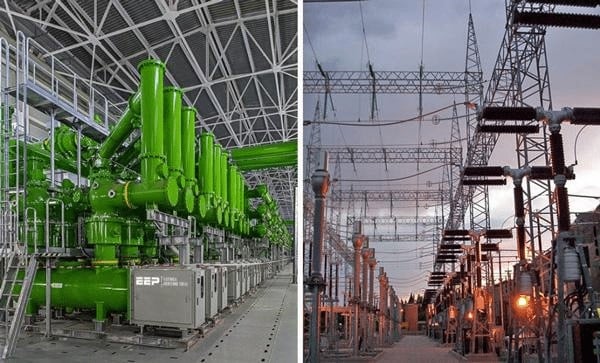
Figure 1. Gas-insulated substation (left) and air-insulated substation (right). Image used courtesy of Delixi
The enclosed design of a gas-insulated substation allows components to be arranged in compact, modular compartments. GIS is therefore the default choice where site footprint is constrained, such as in urban areas or industrial plants. It's also used where environmental exposure is harsh, or where very high reliability with low maintenance is required.
The right half of Figure 1 shows an example of AIS. These substations use clearances in ambient air as the dielectric and rely on larger physical spacing between live parts. They are simple and lower-cost than GIS for land-abundant greenfield sites.
Electrical and Dielectric Performance
The dielectric performance of GIS is dominated by the properties of the insulating gas and the tightly controlled geometry inside the metal enclosure. Historically, sulfur hexafluoride (SF6) has been preferred because of its very high dielectric strength, arc-quenching ability, and chemical inertness. These properties allow very small clearances and compact switchgear.
AIS dielectric performance depends on atmospheric pressure, humidity, pollution, and required creepage/clearance distances. Phase spacing grows rapidly with voltage and environmental severity.
From an electrical performance viewpoint, GIS typically offers:
- Higher transient withstand due to enclosed, shielded structure and controlled dielectric.
- Lower corona onset and reduced radio-frequency emission because of smooth metallic enclosures and controlled gas.
- Less sensitivity to pollution and contamination.
AIS can suffer from higher corona and more pronounced field non-uniformities at high voltages and in polluted environments. These substations demand larger conductor separations and insulator strings to meet the same BIL or switching impulse requirements. Outdoor AIS insulators require larger creepage and more maintenance.
Footprint and Installation Complexity
Compactness is the single most important practical advantage of GIS. Because SF6 provides much higher dielectric strength than air, GIS substations can shrink the required phase space dramatically. Typical space reductions are on the order of 70–90% compared with conventional AIS at the same voltage and functional capability. That translates into smaller buildings, shallower foundations, shorter cable trenches, and reduced land acquisition costs in urban or constrained sites.
The enclosure also protects live parts from adverse conditions and vandalism, improving long-term reliability in hostile environments. However, the metal enclosures required by GIS make both civil and mechanical integration more complex. Site work is therefore more skilled and labor-intensive, at least initially.
Factory pre-assembly and modular delivery can offset some site labor. However, the heavy, packaged modules raise potential new issues with logistics and transport. AIS installation is more straightforward and tolerant of incremental expansion and on-site modification.
Reliability and Maintenance
GIS is often promoted for its higher initial reliability and lower routine maintenance. As mentioned above, enclosed components are less susceptible to pollution, humidity, and wildlife ingress. Fewer field visits are required for cleaning or replacement of insulators, and outage frequency due to environmental factors is typically lower in GIS.
That said, when failures do occur in GIS, they tend to be more complex to diagnose and repair. Gas handling and compartment pressurization procedures are required prior to access, and any leak implies immediate corrective action. Once again, specialized test equipment and trained personnel are essential.
AIS faults are often more visible and easier to remedy quickly with routine tools. The net result is that GIS often yields lower operational failure rates and lower routine O&M frequency, but higher technical complexity and specialist logistic needs for repairs and major overhauls.
Total Cost of Ownership
Capital expenditure (CAPEX) for GIS is typically higher. This cost increase is driven by the gas-tight enclosures, SF6 gas handling equipment, modular assembly, and more elaborate factory testing. However, the total cost of ownership can be competitive in dense or high-value sites because GIS reduces land, infrastructure, and outage-related costs.
In addition, GIS often has lower long-term maintenance costs and longer refurbishment intervals. For greenfield sites where land is cheap, AIS often wins on upfront cost and simplicity.
Project economics therefore hinge on the following:
- Land cost.
- Schedule (GIS delivers more prefabrication and quicker on-site commissioning).
- Allowed downtime.
- Environmental/regulatory compliance cost (SF6 handling and future replacement costs).
- The importance of reliability and compactness.
Detailed asset-level life-cycle cost models are normally used by utilities to choose between GIS and AIS for a given substation.
Environmental and Regulatory Constraints
SF6 is a highly potent greenhouse gas with an exceptionally high Global Warming Potential (GWP), estimated to be around 23,500 times that of CO2 over a 100-year period. SF6 emissions, even in small absolute mass, translate to very large CO2-equivalent values. Therefore, utilities must incorporate leak mitigation, gas-recovery systems, monitoring, and end-of-life reclamation into their environmental compliance and TCO calculations.
Furthermore, regulatory pressure—notably EU F-gas regulations and other national policies—is rapidly raising the cost and restricting the use of SF6 in new equipment. This is especially the case at medium voltage. In some jurisdictions, procurement of SF6 equipment is restricted or subject to phase-out schedules. The environmental driver thus increasingly favors AIS in new low-voltage/medium-voltage projects where space permits, or SF6-free GIS variants where compactness is mandatory.
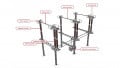
It's worth noting that SF6 alternatives—new gas mixtures, fluoronitrile-based gases, and dry air hybrid designs—are maturing. Many vendors now offer SF6-reduced or SF6-free GIS solutions. Nevertheless, gas alternatives often change switching characteristics or slightly alter insulation clearances. They also require new handling protocols and may increase equipment cost. Figure 2 shows one example of a hybrid system.
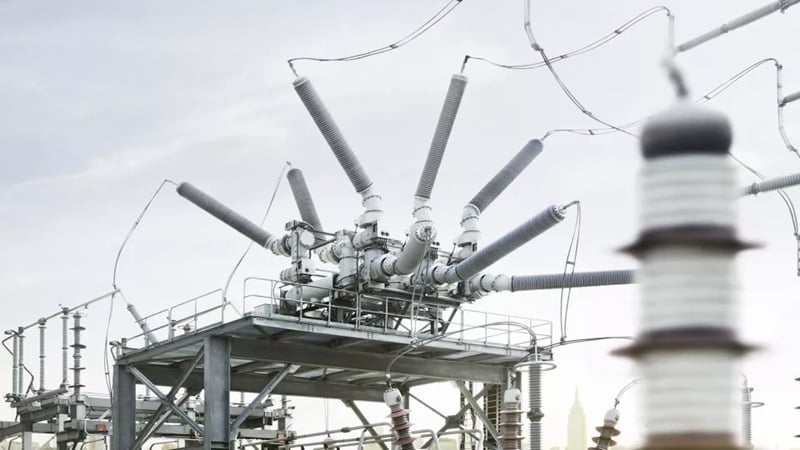
Figure 2. AIS/GIS hybrid system. Image used courtesy of Hitachi Energy
Safety, Testing, and Partial-Discharge Behavior
GIS compartments can be tested in factory for tightness and impulse withstand prior to delivery, and on-site commissioning includes gas-density monitoring and pressure testing. Ultra-high frequency (UHF) and partial-discharge (PD) monitoring are widely used in GIS because internal voids or defective joints can lead to PD activity. However, the metal enclosure attenuates external noise and allows precise PD detection.
Because AIS is not enclosed, PD monitoring is more challenging. In an outdoors environment, corona and surface discharges are more variable and noise-prone.
Both technologies require rigorous testing per IEC/IEEE standards, but the diagnostics and failure modes differ. The relevant safety procedures are therefore different as well. GIS maintenance requires gas handling certification, leak-proof procedures, and gas reclamation. In AIS maintenance, the primary concerns are working-at-height, arc-flash protection, and contamination control.
Application Suitability and Practical Selection Criteria
To help you with the selection process, Table 1 provides a summary of the attributes we discussed above.
Table 1. Comparison of GIS and AIS attributes
| Attribute | GIS | AIS |
| Footprint | Very small (70–90% reduction vs AIS) | Large (depends on voltage & clearances) |
| Initial CAPEX | High | Low to moderate |
| O&M Frequency | Low (sealed compartments) | Higher (cleaning, insulator checks) |
| Repair Complexity | High (specialist, gas handling) | Lower (field-serviceable parts) |
| Reliability | High (sealed) | Lower in polluted/coastal areas |
| Expansion | Difficult, costly | Easier, modular |
| SF6 GWP / Regulatory Risk | Significant (must mitigate) | None (ambient air) |
| Suitability | Urban, indoor, offshore, harsh environment | Rural/greenfield, low-cost projects |
Use GIS when any of these are true:
- The site is space-constrained or indoors.
- Environmental exposure would cause rapid deterioration of AIS insulators.
- Very high reliability and low outage frequency are essential.
- Multi-voltage compact installations are desired.
Use AIS when:
- Land is available and inexpensive.
- Future expansion/flexibility is required.
- Lower CAPEX is crucial.
- SF6 regulatory constraints or lifecycle emissions make GIS less attractive.
Hybrid approaches also exist. These mix GIS for high-voltage, space-sensitive parts and AIS for other bays to try and balance cost, footprint, and environmental risk.
Featured image used courtesy of Adobe Stock