Facebook
 Google
 GitHub
 Linkedin
Boosting Microgrids: Smart Algorithms Unlock Hybrid Storage Potential
How can a simple algorithm solve hybrid energy storage problems?
In the coming years, the power grid will increasingly rely on distributed energy resources (DER), including wind and solar. As energy demands rise, more localized energy through microgrids is needed to combat disruptions and facilitate the switch to decarbonized energy.
How are microgrids tested and managed? Video used courtesy of the National Renewable Energy Laboratory
With intermittent renewable energy sources, energy storage mediums are crucial for storing energy for later use. Battery storage is the most common energy storage medium for microgrids. However, batteries degrade faster when handling transient power demands, and the energy balance between generation and consumption is often challenging in microgrid setups.
Hybrid energy storage systems (HESS) may be a way forward for microgrids as they can handle the transient power demands better than conventional batteries. These systems also need efficient energy management algorithms to effectively manage power storage and distribution.
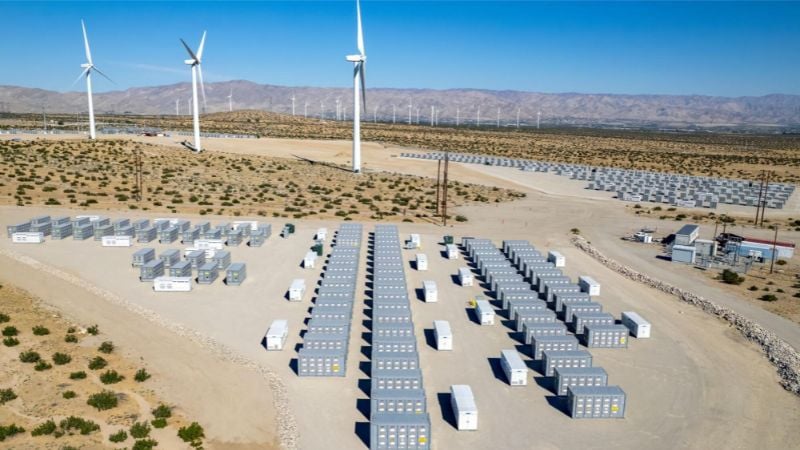
Renewable energy with energy storage. Image used courtesy of Adobe Stock
Hybrid Energy Storage as a Microgrid Option
Combining batteries with another energy storage medium to create HESS units can address the transient power demands of DERs in microgrid environments. The system enables one high-power device to handle the transient power demand while another high-energy device handles the microgrid’s average energy requirements. While many potential HESS configurations exist, coupling batteries with supercapacitors could be the most promising option. In these configurations, the battery is responsible for handling the everyday energy requirements of the grid, while the supercapacitor handles the fluctuating power demands.

Diagram of battery plus supercapacitor storage used to power a motor. Image used courtesy of Njema et al.
When multiple hybrid storage units are connected to store and distribute large amounts of power, energy management algorithms are needed. Control strategies ensure that power is efficiently distributed, a consistent power flow occurs between microgenerators, and operations are safe. The batteries must avoid high currents, deep discharging, and overcharging, while the supercapacitors need to prevent overcharging.
Adaptive Energy Management
In a paper in Scientific Reports, researchers described an adaptive energy management algorithm for microgrids. The DC microgrid in the study involved connecting a solar photovoltaic unit to a battery-supercapacitor HESS. The management approach uses a frequency separation strategy with a rule-based algorithm to ensure the energy storage units are safe but provide optimal power sharing. The algorithm was tested under different load and energy generation scenarios.
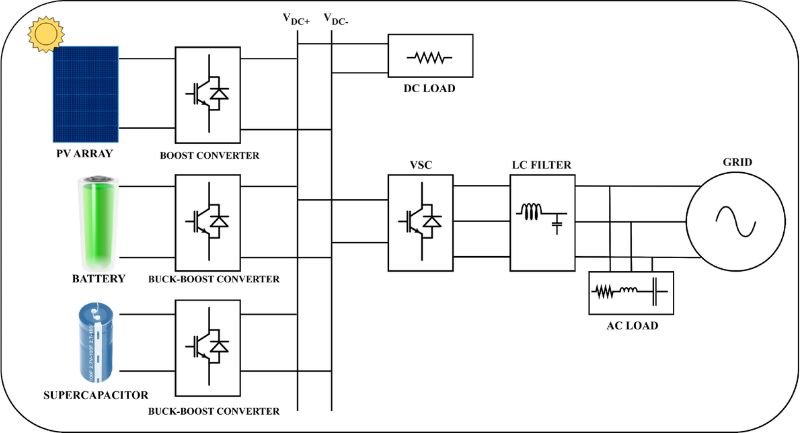
The microgrid configuration. Image used courtesy of Kamagaté and Shah
The algorithm used a simple battery state of charge-based coefficient to allocate power between the battery and the grid. The algorithm also used a dq reference frame technique to control the grid inverter, leading to a fast DC link voltage regardless of the load or generation variations. The algorithm provided a seamless transition between operations and enhanced safety—including preventing the battery from high currents, deep discharging and overcharging, and the supercapacitor from overcharging.
The energy management algorithm could deliver good power management while regulating the DC bus voltage, reducing battery stress, safely operating the different energy storage elements, and ensuring a smooth transition between different energy load and distribution scenarios. The algorithm also helped to improve power quality by maintaining a unity power factor for the AC grid.
Different Factors Underpin Algorithm Performance
Specific factors were behind the algorithm’s success in managing the HESS within a microgrid environment. The algorithm analyzed and managed these factors so the microgrid environment functions optimally. First, the fast DC bus voltage regulation enabled rapid adjustments and stabilization of the DC bus voltage to its desired setpoint of 700 V. This was achieved in milliseconds to reduce voltage deviation during transient power conditions.
The next factor was that the algorithm allowed for effective power sharing and provided optimal power distribution among different energy sources and loads to balance energy generation and consumption. This is vital for DC microgrids, which have multiple DERs attached.
The third factor was stability. The algorithm allowed the microgrid to operate under normal and abnormal conditions by maintaining the voltage, frequency, and transient stability when subjected to different disturbances, such as load changes, generation fluctuations, and other transient events. The algorithm also enabled the various energy storage devices to operate within safe limits and avoid high currents to ensure they wouldn’t undergo premature degradation.
The final factor was total harmonic distortion (THD), an important power quality metric for assessing the distortion level in a signal. A high THD can cause inefficiencies, overheating, and system damage, so maintaining a low THD is crucial for maintaining power quality, reliability, and long equipment lifetimes. The algorithm was able to keep the THD low across different scenarios.
A Simple and Practical Approach to HESS Management
Many past studies have considered how different control techniques can manage HESS devices in microgrids. Still, these have typically suffered from limitation ranges, including load disconnection based on the battery’s SOC or poor switching abilities. The studies have also overlooked the SOC, which can lead to insufficient power and a high computational complexity that limits their use. The researchers’ method is simple to implement for microgrids. It can optimize the performance and stability of DC microgrids without falling prey to some of the pitfalls that have been present in other algorithms.