Facebook
 Google
 GitHub
 Linkedin
Ford Shifts Gears: Ends Lightning, Steps Up Hybrids and Storage
Ford pulls back from large battery-only electric vehicles to concentrate on hybrids, smaller, affordable EVs, and grid-scale battery storage.
Ford Motor Company is adjusting its electric vehicle strategy as cost pressures and slow adoption expose the limits of scaling battery-electric vehicles (BEVs). The Michigan-based automaker is redirecting capital away from some full BEVs and toward a broader mix of hybrids, extended-range EVs (EREVs), and new grid-scale energy storage systems. It will also expand its gas-powered truck lineup, while concentrating on smaller, more affordable electric models on its forthcoming Universal EV platform, with the first mid-size pickup expected in 2027.
As part of the reset, Ford is also leveraging its manufacturing footprint to launch a battery storage business using its licensed lithium iron phosphate technology.
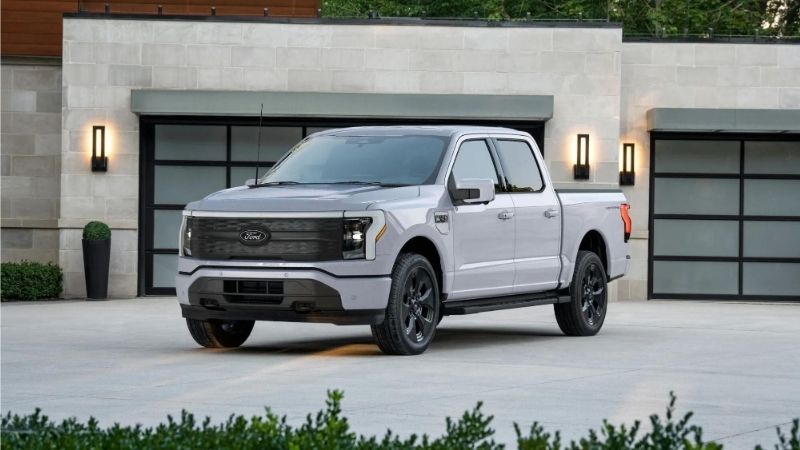
A 2025 F-150 Lightning electric truck. Image used courtesy of Ford
Rethinking the F-150 Lightning
Ford aims to increase the share of hybrids, EREVs, and BEVs in its global portfolio from about 17% today to 50% by the end of the decade. The company has acknowledged that BEV economics remain particularly challenging for larger vehicles, where high battery costs, slower sales, and evolving regulatory conditions complicate the ability to scale.
Ford’s move comes amid softer-than-expected consumer demand for large BEVs in the U.S. and the rollback of federal incentives. The pivot follows earlier capacity reductions, including a previously disclosed 35% cut to planned battery production two years ago, and continued losses in Ford’s Model e division. According to Ford's third-quarter 2025 earnings, year-to-date losses in the Model e division hit $3.6 billion through Q3 2025, mostly from first-generation Mach-E, Lightning, and Explorer EVs, among other earlier models.
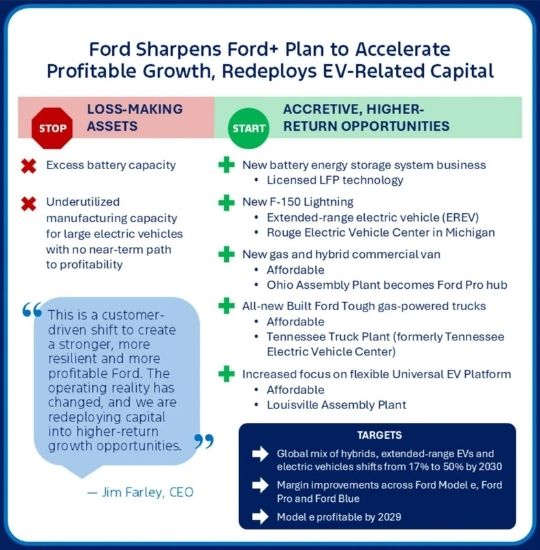
Overview of Ford's EV pivot. Image used courtesy of Ford
One of the biggest changes in Ford's EV strategy involves the F-150 Lightning electric pickup truck. Ford will cease producing the current BEV version after the 2025 model year and shift to an extended-range EV architecture for future Lightnings, featuring over 700 miles of range (via a high-power generator) and acceleration in under five seconds.
Ford has indicated that future electric trucks will move toward extended-range designs intended to preserve electric-first driving while addressing the steep range gaps seen under towing and long-distance routes. The approach aims to supplement battery energy with onboard combustion-based generation to avoid the cost, mass, and packaging challenges of oversized battery packs.
For truck duty cycles that demand predictable long-distance capability and high continuous power, the strategy can address the current limits of battery energy density and charging infrastructure. EREVs can mitigate range anxiety without incurring the high manufacturing costs and weight limitations of massive battery packs.
The next-generation F-150 extended-range vehicle will include an exportable electricity feature, offering backup power during outages or for remote sites. Complementing the EREV approach, Ford also plans to expand hybrid systems across virtually its entire portfolio by 2030.
Ford will also use its BlueOval Michigan battery facility to manufacture smaller LFP prismatic cells for residential energy storage and future EVs, including a mid-size electric pickup planned to launch on the new Universal EV platform. According to Ford, the platform has 20% fewer parts and can be assembled 15% faster than previous vehicles.
Expanding into Battery Energy Storage Systems
Another major pivot is Ford’s entrance into battery energy storage systems. The company intends to repurpose underutilized battery production capacity to develop systems for grid and commercial applications, targeting 20 GWh of annual deployments by 2027 to serve data centers, utilities, and large industrial customers. Ford expects to bring initial production online in about 18 months.
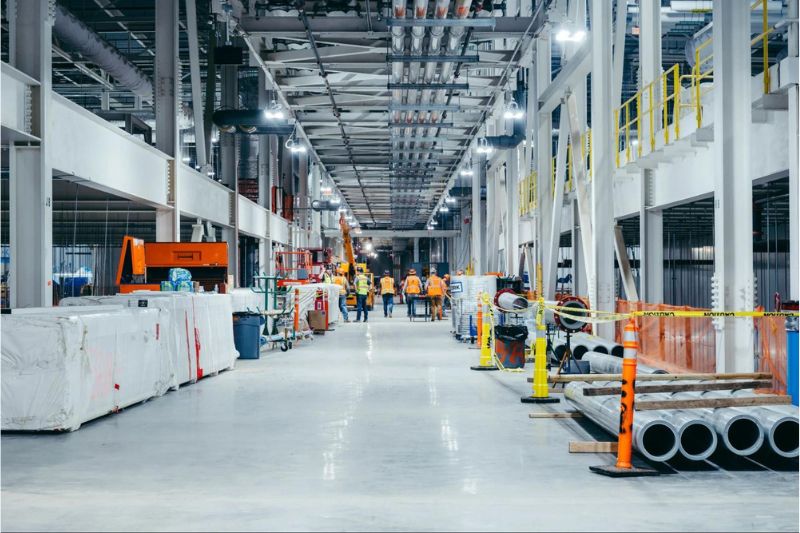
Ford's battery manufacturing facility in Michigan. Image used courtesy of Ford
Ford will tap into its Kentucky battery facility to produce large-scale lithium iron phosphate storage systems, including prismatic cells, modular battery packs, and DC container units designed for utilities and data centers.
The effort is backed by an expected $2 billion investment over the next two years and follows a restructuring of Ford’s battery joint ventures with Ford, SK On, SK Battery America, and BlueOval SK, involving plants in Tennessee and Kentucky.