Facebook
 Google
 GitHub
 Linkedin
BESS Trends Amidst Data Centers, Supply Woes, and Tech Changes
Battery energy storage systems are rapidly expanding across all levels, while manufacturers adapt to changes in energy demand, battery chemistries, and supply chains
Battery energy storage in the U.S. is growing at a record rate, with utility-scale storage leading the way. New capacity increased by 20.2 GWh in Q2 of this year, representing 11% year-over-year growth.
Utility-scale deployments made up 18 GWh of the new capacity. The total capacity added so far this year reached 30.8 GWh, according to a report released by the Solar Energy Industries Association (SEIA) and Benchmark Minerals.
Their report, the U.S. Energy Storage Market Outlook Q3 2026 (ESMO), reviews growing trends in the energy storage market and the influence of supply chains, manufacturing, and alternative chemistries.
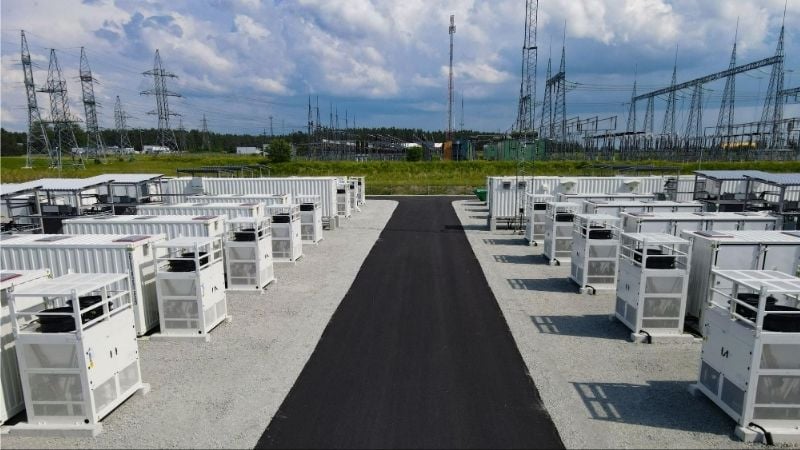
Battery energy storage system. Image used courtesy of Adobe Stock
Utility-Scale and Behind-the-Meter Storage
Within the first eight months of 2026, battery energy storage systems (BESS) delivered more power to the grid than all of 2025, according to ESMO. Utility-scale storage surged by 26 GWh and 8.1 GW of installed capacity. Standalone battery systems comprised 56% of utility-scale additions, while solar-plus-storage accounted for 44%.
Ten states brought over 500 MWh of utility-scale capacity online, including seven projects totaling 1,000 GW. Four states—California, Arizona, Utah, and Texas—led state deployment, with each state individually adding over 2.5 GWh during the quarter. Texas and California, which experience extreme heat in addition to unprecedented demand, installed 3.8 GWh and 3.6 GWh, respectively.
Combining behind-the-meter resources, the first half of 2026 added almost 31 GW of BESS, a 23% increase in GWh year-over-year.
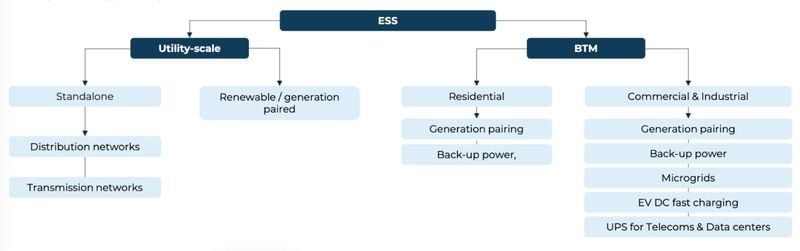
Energy storage system uses. Image used courtesy of SEIA/Benchmark
Utility-scale BESS are also growing in duration, and manufacturers are expected to implement more sodium-based technologies and flow batteries.
Overall, SEIA and Benchmark reported that planned capacity has dropped from 90 GWh at the beginning of 2026 to around 75 GWh due to project delays and cancellations. Still, taking a long view, a 9% growth is expected by 2030.
AI Data Centers, Commercial, and Residential Storage
AI data centers are driving the power electronics industry today, including BESS technologies. Developers often create independent power sources for data centers, either to bridge the gap until grid connection, to supplement renewable energy, or to provide backup power. Other industries are also investing in BESS, especially mission-critical services, such as hospitals, which need uninterruptible power supplies (UPS).
While Q2 BESS deployments were down, overall data shows an upward trend.
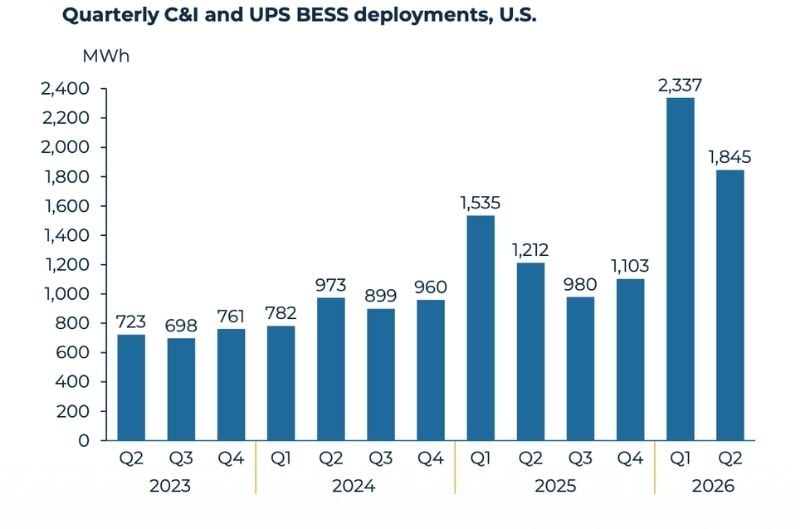
Quarterly trends in commercial and industrial BESS deployments. Image used courtesy of SEIA/Benchmark
Residential storage batteries can help provide grid stabilization, especially when paired with home solar, but sales sank in Q2, dropping 657 MWh, a 27% year-over-year decrease. The elimination of tax credits may have been a driving factor, according to the ESMO report.
However, the SEIA and Benchmark remain optimistic about the future of residential storage, citing rising electricity costs, state support of virtual power plants, and fears of frequent power outages.
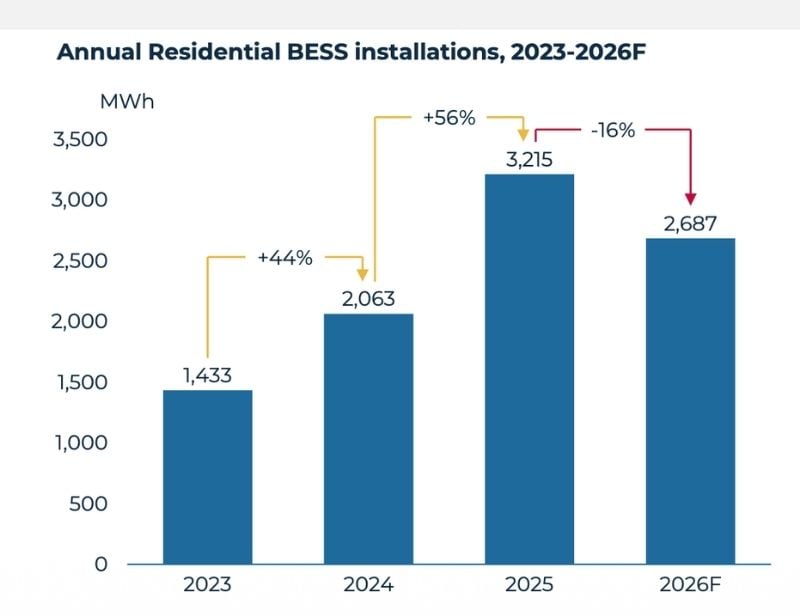
Annual residential BESS deployments by year. Image used courtesy of SEIA/Benchmark
Supply Chain and Manufacturing
BESS manufacturing in North America is steadily rising, with capacity anticipated to pass 250 GWh.
Tesla continues to dominate the BESS market with its Powerwall and Megapack technologies, despite the emergence of multiple serious competitors. The company marked several milestones in Q2, including shipping its first Megapack units using domestically produced lithium-iron-phosphate (LFP) batteries. It also opened its third Megafactory in Texas, with a capacity to produce 50 GWh of Megapacks per year.
Meanwhile, LG Energy Solutions (LGES) is rising as a major player, with 44 GWh of nameplate capacity planned by the year’s end. The company stated it plans to exceed 100 GWh by 2030.
The LGES and Honda partnership, L-H Battery Company, has produced its first battery cells for LGES’s energy storage systems. The factory previously manufactured electric vehicle batteries.
Samsung SDI is developing prismatic LFP battery cells and plans to begin production in October.
Supply chains are changing, as manufacturers turn to domestically sourced batteries. Battery imports from China declined 25% since the beginning of 2026, according to SEIA and Benchmark Materials.
Alternative Battery Chemistries
Battery technology is evolving as engineers seek increased energy density and improved safety. Developing domestically sourced materials and reducing reliance on rare metals are also concerns.
The EMOS report shows that lithium-ion batteries, including LFP designs, still dominate in BESS technologies, but sodium-ion batteries are present. Additionally, manufacturers are moving toward synthetic anodes.
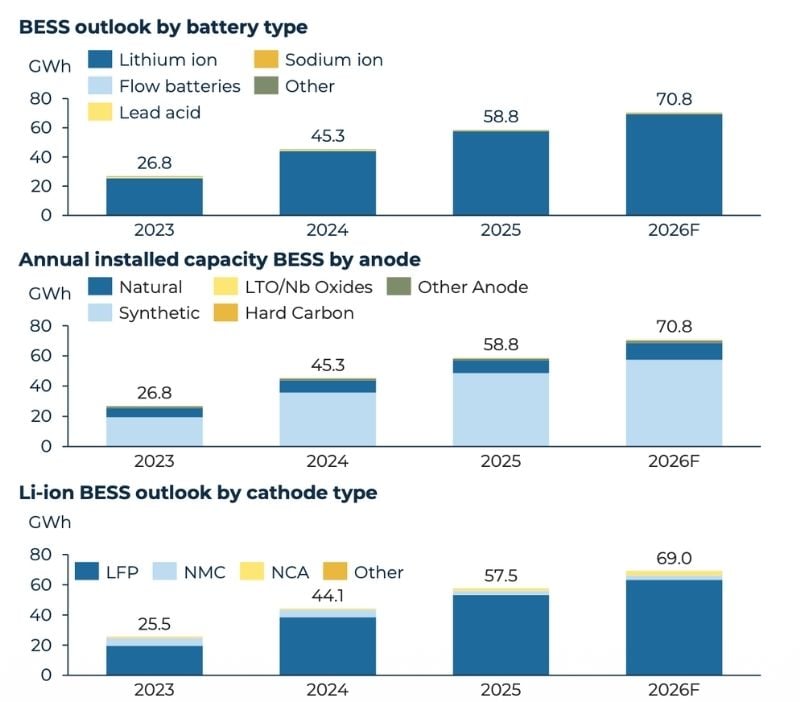
Trends in battery technology types. Image used courtesy of SEIA/Benchmark
SEIA and Benchmark also investigated the impact of U.S. policies, such as regulations, financial incentives, tariffs, and domestic manufacturing programs. These policies affect BESS development on both federal and state levels, yet they are subject to geopolitical events.
A Trend to Watch
Energy storage is anticipated to keep growing as the need for steady, reliable power shows no signs of slowing. The full report details potential obstacles, regional differences, financial considerations, and changing policies in the near future. It is available at SEIA.