Facebook
 Google
 GitHub
 Linkedin
Briefs: Advancing Power Technology in Data Centers and EVs
Navitas, Claros, Infineon, C2i Semiconductors, Asahi Kasei, Hyundai Motor Group, and Kaluza are tackling energy challenges in AI data centers and electric vehicles.
Technology companies are deploying artificial intelligence and other advanced technology to meet the evolving power needs of AI data centers and electric vehicles. Two acquisitions will address next-generation data center power architecture. Navitas has acquired Claros, which has vertical power delivery and integrated voltage regulator technologies, and Infineon Technologies will acquire C2i Semiconductors for power management solutions.
In EVs, Asahi Kasei is aiming to increase lithium-ion battery life with a pre-doping technology for silicon anodes, and Hyundai is partnering with Kaluza to streamline smart charging and prepare for vehicle-to-grid technologies.
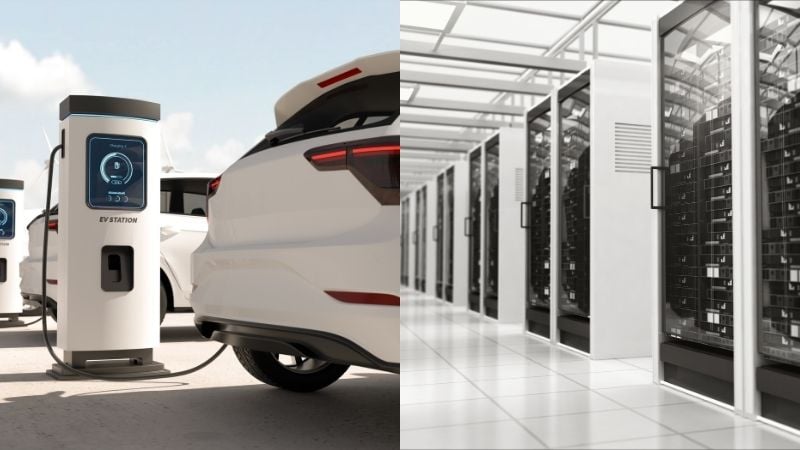
AI data centers and EVs. Image used courtesy of Canva
Navitas Acquires Claros to Bolster AI Infrastructure Technology
Navitas Semiconductor has made a $232.8 million deal to acquire power management developer Claros. The move aims to eliminate the power wall in artificial intelligence infrastructure by extending power delivery from the grid down to the core processor.
Claros offers vertical power delivery and integrated voltage regulator technologies that combine drive, digital control, passives, and power conversion into single compact packages. When placed beneath or on the printed circuit board, the power travels only millimeters rather than inches, resulting in reduced line impedance, faster transient response, and decreased distribution heat losses.
Navitas states the solution will complement its GaN and high-voltage SiC portfolio intended to meet the needs of 800 V HVDC data center architecture.
The transaction includes $216 million paid at closing via cash and Class A common stock, with the remainder tied to post-closing business milestones. Navitas expects the integration to double its identified 2030 serviceable addressable market to over $8 billion, adding at least $3.5 billion from vertical power delivery and integrated voltage regulator sectors.
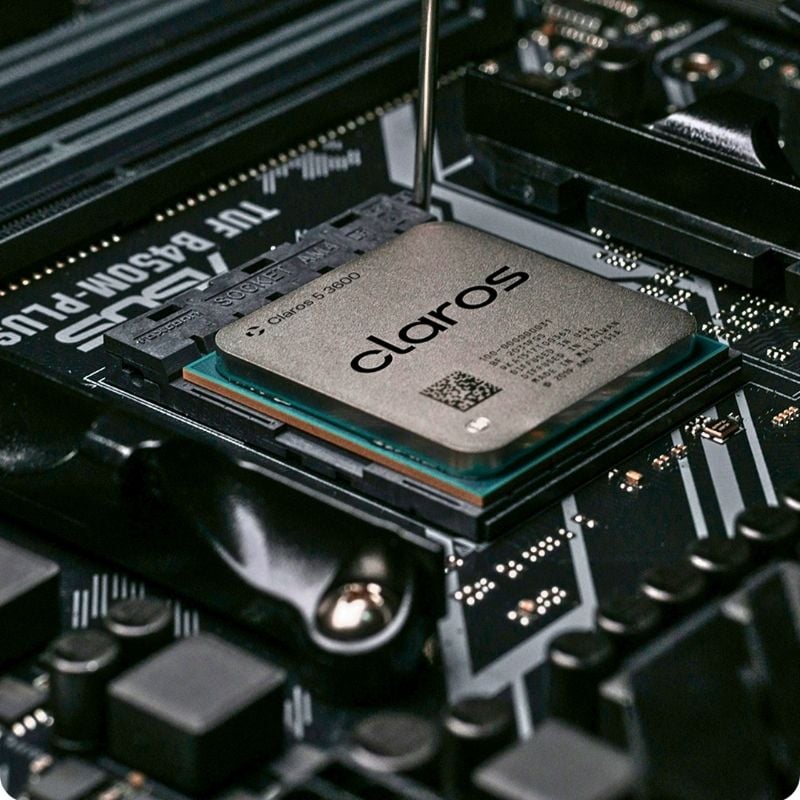
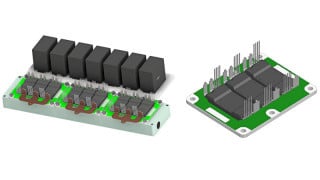
An Integrated Voltage Regulator from Claros. Image used courtesy of Claros
The transaction has received unanimous approval from the boards of directors of both entities. Subject to customary regulatory approvals, the acquisition will close before the end of 2026.
Infineon Acquires C2i Semiconductors, Aiming at AI Data Center Power Management
Infineon Technologies will acquire C2i Semiconductors, which specializes in software-defined multiphase controllers, smart power stages, and system-level power architectures, to expand its power management solutions for AI data centers.
C2i’s designs target vertical power delivery through substrate-integrated voltage regulators. These power architectures handle conversion from intermediate bus voltages of 4 V to 16 V down to precise processor core voltages. Currents supported reach up to 4 kA for graphics processing units and accelerators.
Infineon will combine these software-defined technologies with its silicon, SiC, and GaN semiconductor portfolios. The company stated that adding intelligence to power delivery architecture in data centers can reduce conversion losses, optimize switching speeds, and meet power density requirements.
The transaction will close in the third quarter of calendar year 2026.
Asahi Kasei Creates Pre-Doping Tech for Lithium-Ion Battery Anodes
Asahi Kasei has developed a lithium pre-doping technology for high-voltage lithium-ion batteries containing silicon-rich anodes. The process can boost cell energy density by 10%, lengthen cycle life, and reduce production costs for EVs and robotics.
Silicon-based anodes experience permanent capacity loss during the first charge-discharge cycle. This reduces the battery’s lifespan and energy density. Battery makers typically compensate by adding extra cathode material, which raises production costs.
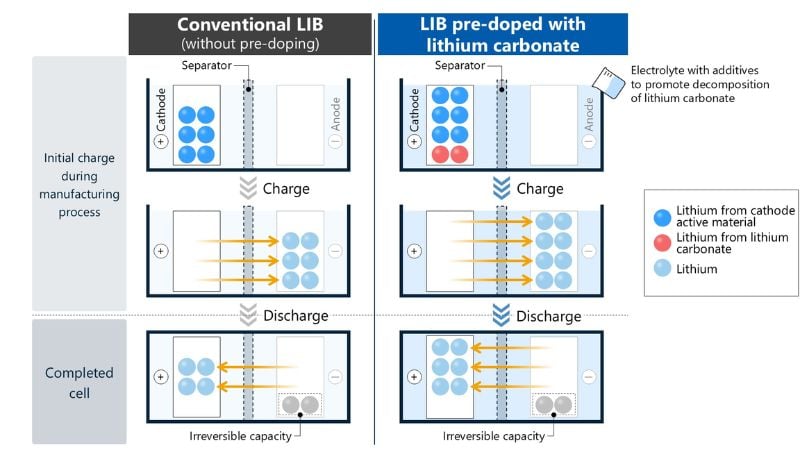
Concept of the pre-doping technology. Image used courtesy of Asahi Kasei
Instead, Asahi Kasei used special additives to lower the voltage needed to break down lithium carbonate inside the cell. The lithium carbonate decomposes during the first charge cycle, supplying the extra lithium required to offset initial losses without additional cathode material.
In tests using a nickel-manganese-cobalt cathode and an anode with 10% silicon oxide and 90% graphite, the pre-doping technology demonstrated a 10% increase in energy density.
Asahi Kasei plans to license the design globally through proof-of-concept evaluations.
Hyundai, Kaluza Partner for EV Smart Charging and V2G
Hyundai Motor Group and software firm Kaluza have partnered to integrate automated EV smart charging directly into vehicle applications. The technology could reduce charging fees and lower carbon footprints by automatically scheduling power draws during optimal grid conditions.
Technical teams integrated software controls directly into the Kia App and myHyundai App platforms. The unified codebase replaces fragmented third-party solutions with direct, reliable hardware connections. Initial deployment starts in August 2026 across the U.K., followed by an expansion into Australia.
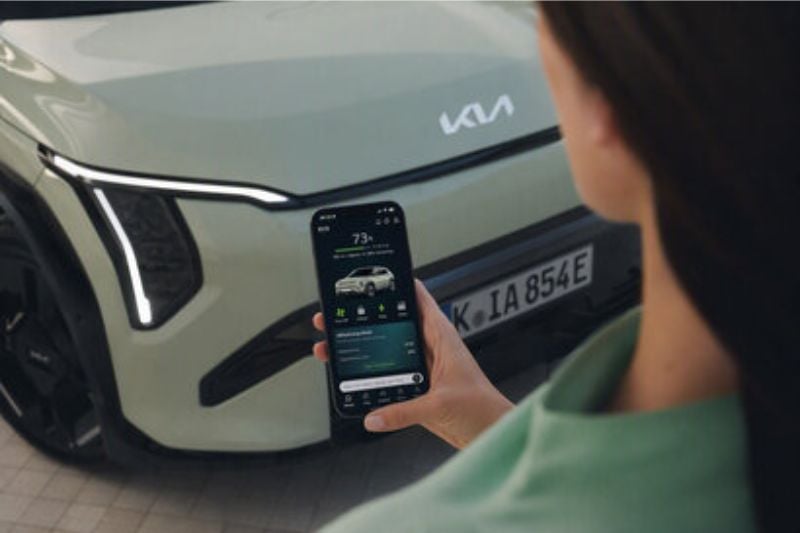
Smart charging app. Image used courtesy of Kaluza
The software architecture establishes baseline connection standards for bidirectional energy exchange. Engineers plan to roll out full vehicle-to-grid capabilities starting in 2027. This will allow drivers to sell stored battery power back to distribution networks to help stabilize grid loads during peak-demand hours.