Facebook
 Google
 GitHub
 Linkedin
Our 2025 Top Trend: AI Assimilates
Do you remember when supercomputers were described by their processing power? That was so 2024. Today, we talk about the power for processing. Goodbye terraops, hello terrawatt-hours!
At All About Circuits and EEPower, we weren’t only talking about using AI during 2025; we were also talking, a LOT, about the foundational technologies that make AI possible.
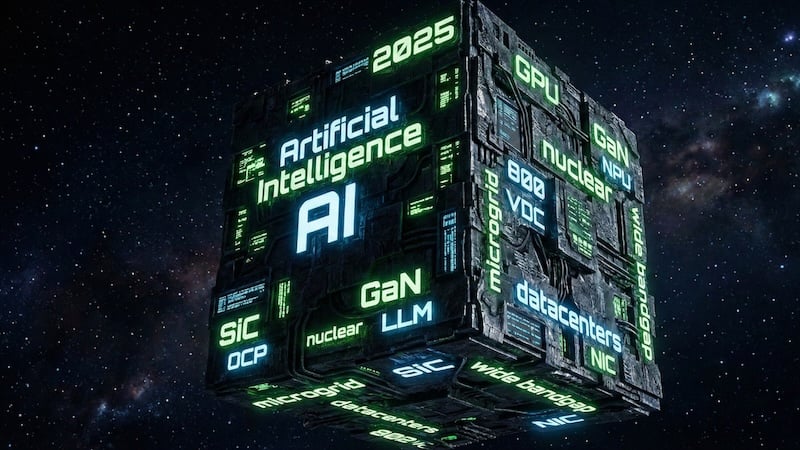
Like the Borg, AI was assimilating every electron, every dollar, and everyone’s attention to feed the insatiable beast. That is why we are choosing the tech that enables AI as our top trend of 2025. In this article, we highlight some of the year’s top AI tech stories—from chips and semiconductor technology, to data centers and nuclear reactors.
The Silicon Foundation
Any discussion of AI in 2025 has to begin with Nvidia. The company ends the year as the world’s most valuable company on the strength of its AI technology. Following directly behind them in the top 10 are the other semiconductor companies driving the AI revolution by investing in everything from chips to renewable energy: Apple, Google, Microsoft, Amazon, Meta, Broadcom, and TSMC.
Nvidia Launches First GPU Purpose-Built for Million-Token AI Inference
The Rubin CPX GPU sits at the heart of Nvidia's new Vera Rubin NVL144 CPX platform. A single rack combines 144 GPUs to deliver an 8 exaflops of AI compute—about 7.5 times more performance than the previous generation. With 100 terabytes of memory and bandwidth peaking at 1.7 petabytes per second, the platform is built to handle million-token inference for codebases and long-form video.

Rubin CPX combines specialized hardware, full-stack software, and ecosystem support to make long-context AI practical and economically viable.
Nvidia Starts Shipping ‘World’s Smallest AI Supercomputer’
While AI for data centers was the biggest news, Nvidia also started shipping the DGX Spark, which they touted as the ‘world’s smallest AI supercomputer.’
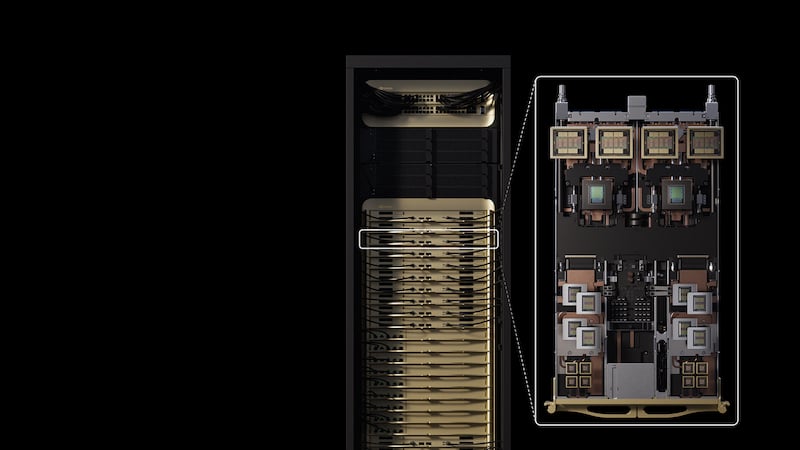
A DGX Spark AI supercomputer workstation setup. Image used courtesy of Nvidia.
Here are some of the other interesting developments in AI circuit technology from 2025:
- Broadcom Thor Ultra, the industry’s first 800G AI Ethernet Network Interface Card (NIC)
- IBM brings AI inside the mainframe with the Spyre AI accelerator
- Intel unwraps Panther Lake, the first AI PC platform built on 18A
- AWS touts Its ‘most powerful and efficient’ CPU yet
- Using a fabric architecture, startup claims most energy-efficient processor
GaN and SiC Take Center Stage
Moving from the logic gates to the power delivery network, 2025 was the year wide bandgap semiconductors became non-negotiable. As AI server racks climbed toward 100 kW and beyond, traditional silicon MOSFETs simply could not handle the heat or the switching speed required for 98%+ efficiency.
Navitas Unveils 12 kW GaN and SiC PSU Targeting AI Data Centers
Designed in compliance with Open Rack v3 and Open Compute Project specifications to meet the needs of hyperscale data centers.
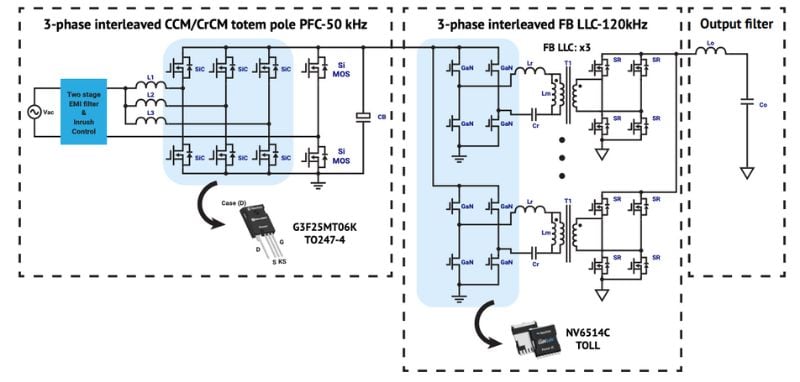
12 kW PSU diagram. Image used courtesy of Navitas
Onsemi Unveils Vertical GaN ICs for AI
The vertical GaN (vGaN) power semiconductors claim to boost performance and efficiency in data centers, EVs, and renewables.
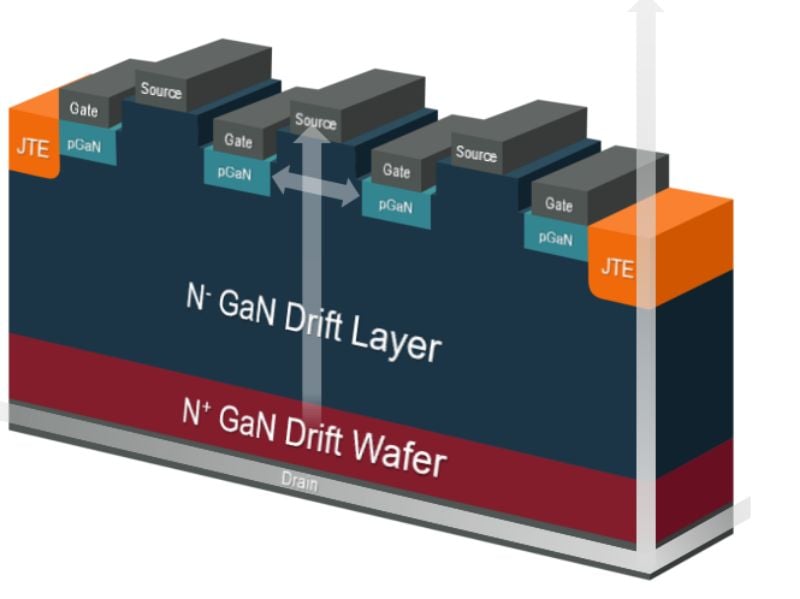
Vertical GaN device structure. Image used courtesy of Onsemi
A few other interesting articles about GaN and SiC:
- EPC releases 5 kW GaN AC-DC reference design for data centers
- Navitas and GigaDevice join GaN and SiC for high-power AI
- Renesas unveils 650 V GaN FETs for power Conversion
Inside the Data Center: The Shift to 800 VDC
To minimize I2R conduction losses in megawatt-scale facilities, the industry, led by NVIDIA, announced plans to move toward 800 VDC distribution. This architectural change reduces the amount of copper required for cabling and enables more direct conversion from high-voltage transmission lines to the processor.
Infineon, Nvidia Team Up for 800 V Power in AI Data Centers
Infineon and Nvidia announced a collaboration to reimagine power delivery in AI data centers. The two semiconductor giants will work together to transition from traditional decentralized AC architectures to centralized 800 V high-voltage direct current (HVDC) distribution. This was one of many 800 VDC announcements in 2025.
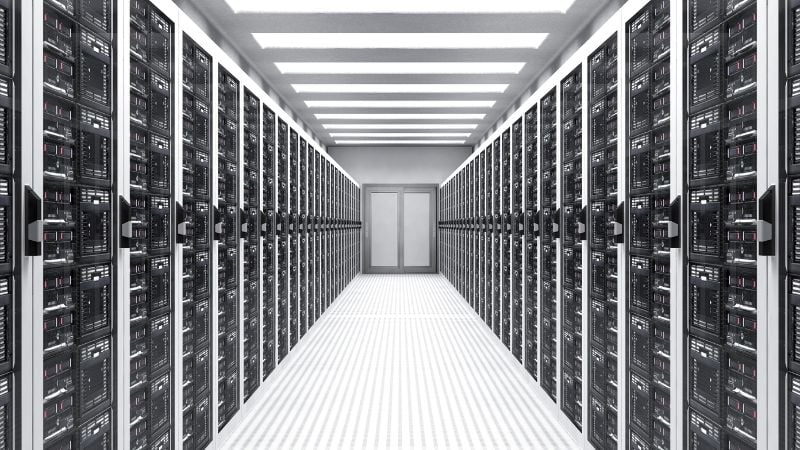
Infineon and Nvidia are reimagining the data center power architecture. Image used courtesy of Infineon.
TI Debuts ‘One-Stop Shop’ Solutions for Next-Gen Data Centers
Getting all of that power from the grid to the AI chip requires power modules, reference designs, GaN bus converters, and more. Texas Instruments’ new solutions address the growing power needs of data centers, particularly as they migrate to 800 VDC.
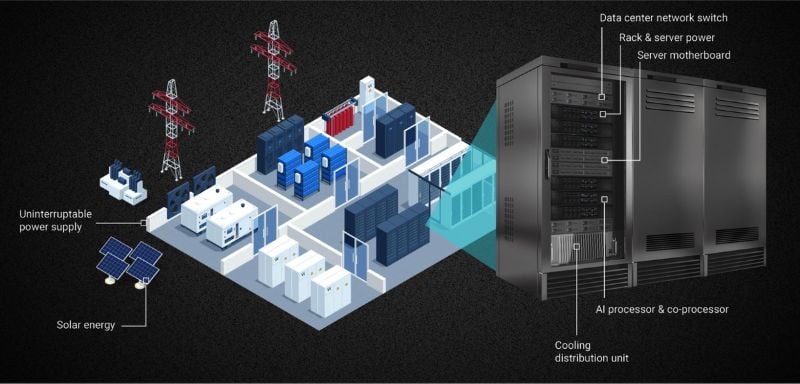
TI’s “grid-to-gate” concept for AI data centers. Image used courtesy of Texas Instruments
Here are a few of our other favorite data center technology articles from 2025:
- 3 steps to turning data center energy hogs into grid assets
- Data centers in space?
- Digital future-proofing: microgrids and DERs in data centers
AI Power Goes Nuclear
The big players in AI data centers, like Amazon, Google, and Meta, left no stone unturned as they sought to feed their insatiable appetite for more power. Traditional solar, wind, and hydroelectric power were obviously popular. They were even securing power capacity years before their AI data centers are scheduled to come online.
While jet engines are also interesting, it was the big investments in nuclear power that really caught our attention in 2025. The transition from gigawatt-scale plants to modular units (SMRs/MMRs) is seen as essential for the data center industry because they can be scaled in increments to match facility expansion. In addition, the ability to put reactors "behind-the-meter" at the data center site helps operators bypass grid congestion and transmission build-out delays.
Are Small Nuclear Reactors the Answer to Modern Energy Needs?
Multiple companies are on the brink of commercializing compact nuclear reactors that can be quickly deployed.
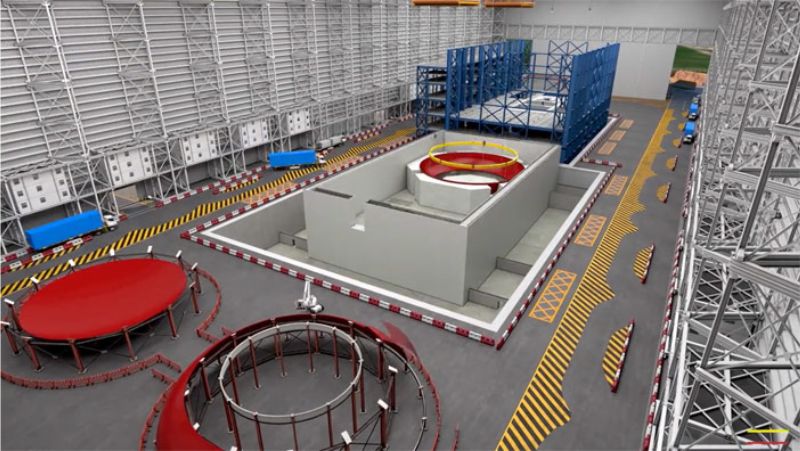
Small modular reactors. Image used courtesy of Rolls-Royce SMR
Hadron Energy Set to Produce ‘Plug and Play’ Nuclear Energy
In this interview, Hadron Energy CEO Samuel Gibson discusses nuclear micro modular reactors, AI data centers, and Hadron’s plans to take the company public.
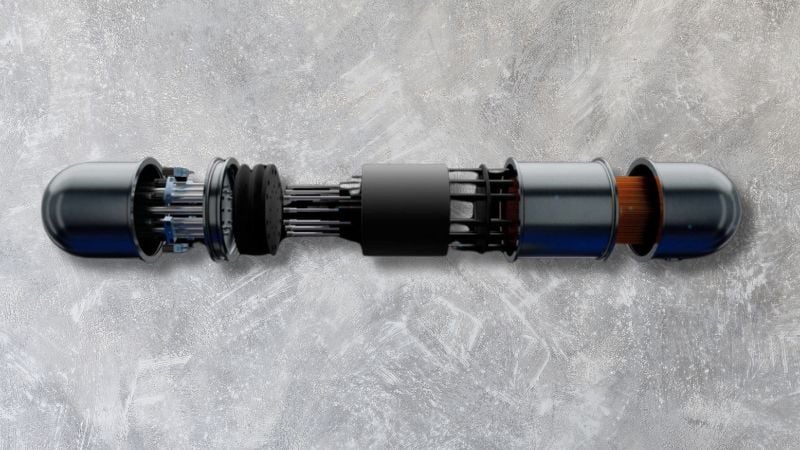
Hadron's micro reactor unit. Image used courtesy of Hadron Energy
Google Gambles on Future Nuclear Fusion Power Plant
In a move Google called “a bet” and a “moonshot,” the tech giant agreed to purchase 200 MW of nuclear fusion energy from Commercial Fusion Systems (CFS) even though the technology is still in development.
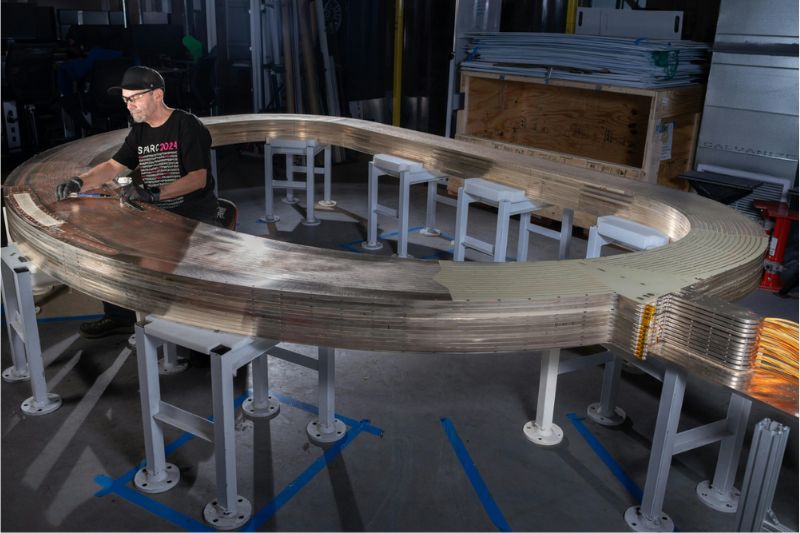
High-temperature superconducting (HTS) magnets for a fusion reactor. Image used courtesy of CFS
Your Turn
Did we miss any key tech trends in 2025, or do you have any predictions for 2026? Let us know in the comments below! We would love to hear from you.