Facebook
 Google
 GitHub
 Linkedin
MPPT Methods Keep Blades Turning
Maximum power point tracking can maximize wind energy output under variable and unpredictable conditions.
Modern society requires more energy than ever before, and as the move away from fossil fuels increases, additional renewable energy resources need to be integrated into the grid.
Wind turbines have been developed and implemented on large scales worldwide. Wind power is among the biggest renewable energy sources today, with numbers growing yearly. However, wind turbines operate in environments with variable wind amounts, depending on the local weather conditions. Maximum power point tracking (MPPT) is required to ensure wind turbines produce as much power as possible in these variable scenarios.

Wind turbines on a hillside. Image used courtesy of Adobe Stock
Why Wind Turbines Need MPPTs
Wind turbines convert wind into mechanical energy. The two key components are the turbine blades that catch the wind and the wind turbine generator (WTG), which converts the turbine blades’ mechanical motion into electrical energy. The WTG’s output is connected to the power grid or supplied directly to consumers.
MPPT algorithms are among the most important control processes in wind power generation because they enable wind turbines to maintain their maximum power input when the wind speed is lower than the rated wind speed. The rated wind speed is the speed at which the turbine starts generating power from the rotational motion. MPPTs help improve wind turbines’ efficiency under different wind speeds.
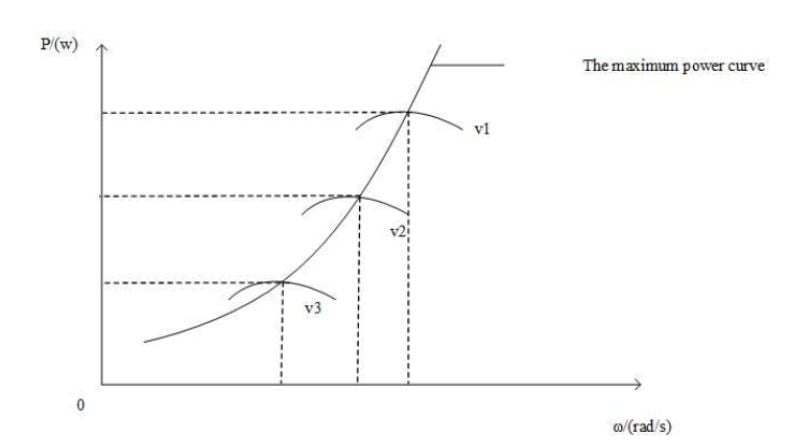
MPPTs regulate turbine power output at different wind speeds. Image used courtesy of the authors
MPPT is used to control the turbine blades’ rotation speed as the wind speed changes to ensure maximum power supply. When the wind speed is below the rated wind speed, MPPT is used to find the wind energy utilization coefficient, which relates to the blade pitch angle and the turbine blades’ tip-speed ratio. The MPPT uses this information to maintain the maximum output power. Because the coefficient is related to the blade pitch angle and the tip-speed ratio, collating the maximum power points at different wind speeds can determine the maximum power-rotating speed. The MPPT can then regulate the WTG’s rotation speed based on the optimal power curve and maintain maximum power output.
MPPT Methods
Various MPPT methods can be used, including methods specific to wind turbines, such as tip speed ratio (TSR) control, hill climbing search (HCS), and optimal torque (OT) control methods.
Tip Speed Ratio Control Method
TSR control methods compare the optimal TSR value with its actual value during the operation to ensure the turbine always operates at its best. The controller manages the inverter’s output based on the error between the optimal and actual TSR values. The MPPT then performs feedback adjustments using the generator to alter the speed and keep the TSR optimal. TSR is used because the process is simple, the controller design is flexible, and the speed-tracking performance is easy to improve.

Tip-speed ratio control. Image used courtesy of the authors
Hill Climbing Search Method
HCS is an MPPT control method to deduce the turbine's rotational speed search direction and step size. This is achieved by examining the changes in output power from applied disturbances changing the turbine’s rotational speed. The optimal rotation speed is achieved by perturbing and adjusting the turbine’s rotational speed. When the wind speed increases or decreases, the operating point changes, but the electromagnetic torque stays at its previous value. The operating point’s climb can then be deduced. HCS does not need to accurately capture wind turbine parameters and energy capture characteristics, so it is versatile and adaptable to changing scenarios.
Optimal Torque Method
OT methods enable the electromagnetic torque and rotational speed to have a special relationship, keeping the rotational speed at an optimal value. When the wind speed changes, the electromagnetic torque is monitored and adjusted based on its reference value. This allows greater control over the turbine while avoiding the need to take real-time wind speed measurements.
Combining Control Methods
Wind speeds tend to be stochastic and unknown, so converting the energy of a non-linear power system is a complex process. A single control method is not often enough to accurately apply the expected control effect, and multiple methods are often used simultaneously.
Looking to the Future: Next-Gen MPPTs and Wind
MPPTs ensure WTGs produce the maximum output power under different wind conditions and when the wind speed falls below the rated wind speed. MPPTs are already playing an important role in optimizing wind turbines and improving their efficiencies. The next generation of MPPTs integrated with wind turbines will be intelligent MPPTs that utilize artificial intelligence. Some methods likely to become more prominent in the near future include neural network control, swarm intelligent algorithms, fuzzy control, expert control, and chaos control MPPT algorithms.