Facebook
 Google
 GitHub
 Linkedin
What Will Power the Space Race in 2025?
Missions to the Moon and Mars are on the horizon. What will supply power for human space explorers?
Interest in space exploration—particularly the Moon and Mars—has soared in the past year. NASA wants to send people back to the Moon through the Artemis program by 2026. China has successfully landed on the Moon's far side, returned samples, and is targeting a crewed lunar mission by 2030. China also is planning the Tianwen-3 Mars sample return mission for launch in 2028. India, Russia, Japan, South Korea, and the European Space Agency have all announced lunar and Martian missions with robotic missions and plans for human presence, focusing on sustainable, long-term exploration and potential colonization.
NASA’s plans for the Moon and Mars. Video used courtesy of NASA
If humans ever want to establish a presence on the Moon or Mars, they will require significant amounts of energy. Unlike Earth, where fossil fuels resulting from decaying organic matter have powered the development of modern society, neither the Moon nor Mars has ever had the kind of abundant life resulting in coal, oil, and natural gas reserves. Several power sources with terrestrial origins are being considered for habitation of the lunar and Martian surfaces.
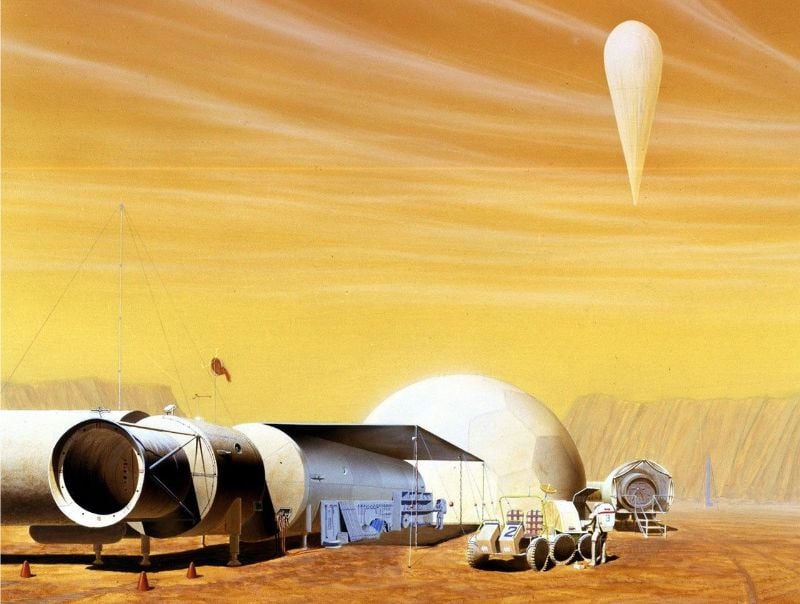
Artist’s concept of a Martian outpost. Image used courtesy of NASA
Solar Power in Space
Solar energy remains a key power source for space exploration. Using solar power in space began shortly after the first artificial satellites launched. In March 1958, the United States launched Vanguard 1, the first solar-powered spacecraft. This satellite was equipped with 108 silicon solar cells, with one powering its radio transmitters for six years.
Following Vanguard I’s success, solar panels quickly became the standard power source for spacecraft. In 1958, Pioneer 1 used solar cells developed by Spectrolab, a company that also created the first solar cells to reach the Moon during the Apollo 11 mission. By the 1970s, Spectrolab had improved the efficiency of their silicon cells to around 12%.
As space missions became more ambitious, solar technology continued to evolve. Multi-junction cells were developed, increasing efficiency from 12% to about 30% for gallium arsenide cells. Advanced solar technologies like perovskite solar cells show promise for improved efficiency, potentially reaching up to 39%. Flexible, paper-thin solar cells were created through a NASA partnership with Iowa Thin Film Technologies in 1989, reportedly converting as much as 90% of captured light into energy.
The Juno mission, launched in 2011, became the first solar-powered spacecraft to reach Jupiter. It used 50 square meters of solar panels. Closer to home, the International Space Station relies on eight 114-foot-long solar array wings, each containing about 33,000 solar cells, to power its systems.
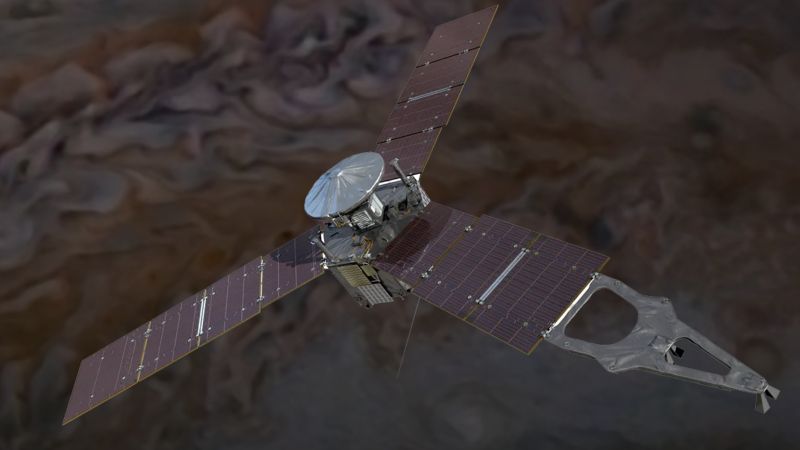
The Juno spacecraft equipped with solar panels. Image used courtesy of NASA
Space Solar Challenges: On the Moon and Mars
Solar power will provide electrical energy on future lunar bases, but it is not without its challenges. The Moon experiences a day-night cycle lasting 29.5 Earth days, with about 14.5 days of continuous darkness during the lunar night. Solar panels cannot generate power during this extended period, necessitating energy storage systems like batteries or alternative power sources such as nuclear to sustain operations.
The Moon's surface also undergoes drastic temperature swings, ranging from over 260°F (127°C) in direct sunlight to -280°F (-173°C) during the lunar night. These extremes can damage solar panels and associated electronics, requiring advanced thermal protection and insulation systems. The Moon lacks an atmosphere, exposing solar panels to high levels of radiation and charged particles that can degrade their efficiency over time. Additionally, lunar dust (regolith) can accumulate on panels, reducing their energy output and posing maintenance challenges.
Solar panels are most effective near the lunar poles, where sunlight is more constant due to the Sun's low angle above the horizon. In contrast, equatorial regions experience complete darkness during the lunar night, limiting solar power's reliability in those areas. Vertical Solar Array Technology (VSAT) is an autonomous system with a 10-meter mast designed to capture near-continuous sunlight at the lunar south pole.
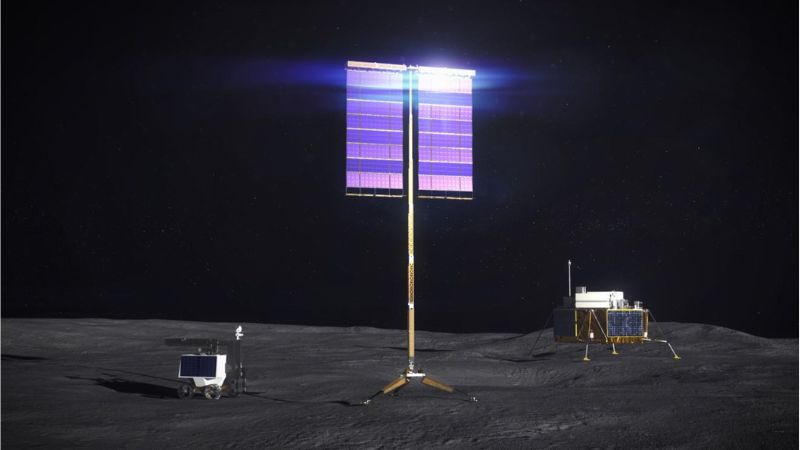
VSAT solar. Image used courtesy of NASA
Using solar power on Mars presents some additional challenges. Due to its greater distance from the Sun, Mars receives only about 43% of the solar irradiance of Earth. In addition, dust storms can severely reduce solar panel efficiency, sometimes forcing rovers or other surface-based solar arrays into a low-power "hibernation" mode. The Martian atmosphere's optical depth affects solar radiation, with surface radiation up to 30% lower near the poles. Seasonal variations are also more extreme on Mars, affecting solar power generation.
Photovoltaic arrays are currently used on Mars on the Spirit and Opportunity rovers, with Opportunity operating for nearly 15 years. The Ingenuity helicopter, the first flying rover on Mars, is also solar-powered.
Solar power will continue to be an important energy source as Moon and Mars exploration begins, but additional energy sources will be required for long-term habitation.
Nuclear Power
Nuclear energy could be a reliable power source for long-term Moon and Mars missions. Nuclear reactors can provide a constant, reliable power source regardless of environmental conditions, unlike solar panels, which are affected by day-night cycles and dust storms. Nuclear generators can operate for extended periods without refueling, with some designs running for at least 10 years without human intervention. Nuclear reactors can be placed in permanently shadowed areas or regions without access to sunlight, such as near the lunar poles or in lava tubes.
NASA and the Department of Energy are developing fission surface power systems intending to provide at least 40 kW of electricity, enough to power equipment and outposts. Nuclear power could be crucial for areas with limited sunlight, like the lunar south pole.
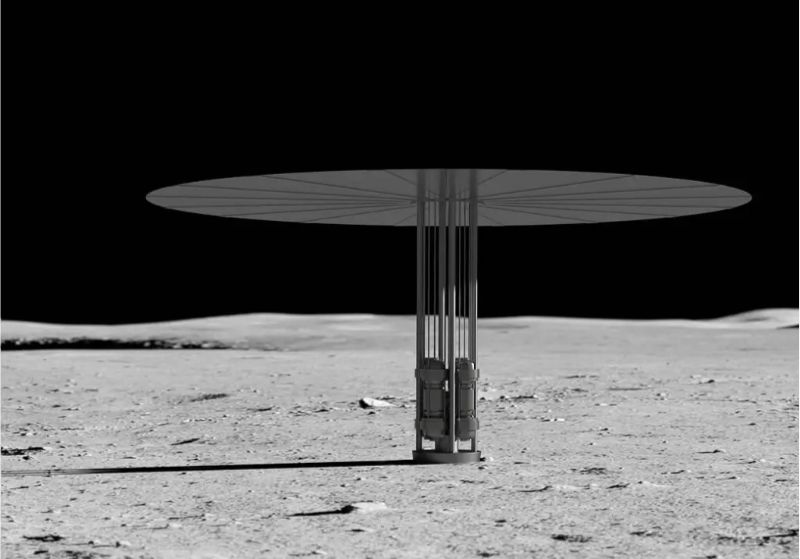
Concept of surface fission nuclear reactor. Image courtesy of NASA
Nuclear power for space missions is not without its challenges. Launch safety could be a major issue, as accidents during liftoff could release radioactive materials into Earth's environment.
Using nuclear power in space raises complex regulatory and governance issues, particularly regarding international space law and environmental protection. Highly enriched uranium in space reactors conflicts with policies discouraging its use in civil activities, and some have concerns that nuclear materials in space could be repurposed for weapons, raising security and proliferation risks. Decommissioning reactors and storing nuclear waste on celestial bodies also present environmental and safety concerns. The Outer Space Treaty prohibits harmful contamination of celestial bodies, potentially limiting options for in-situ storage of radioactive materials.
Should nuclear fusion reactors become feasible, they will undoubtedly find use in space exploration.
Radioisotope Thermoelectric Generators
Radioisotope thermoelectric generators (RTGs) have already powered scientific experiments and instruments that do not require large amounts of power. RTGs, including the Perseverance rover on Mars, have been used in various space missions.
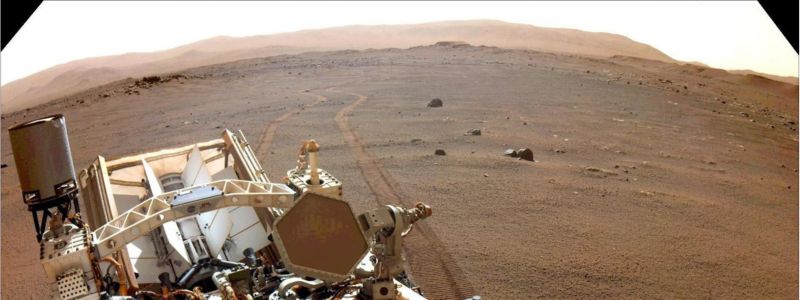
Perseverance’s RTG on Mars. Image courtesy of NASA/JPL-Caltech
RTGs are nuclear power devices that convert heat from radioactive decay into electricity. A radioactive fuel source, typically plutonium-238, generates heat through radioactive decay. Arrays of thermocouples convert the heat into electricity using the Seebeck effect. RTGs can operate for decades without refueling or maintenance, and with no moving parts, they reduce the risk of mechanical failure.
Conversion efficiency is typically low for RTGs, around 5-9%. When freshly fueled, the Multi-Mission Radioisotope Thermoelectric Generator can only produce about 110 W of electrical power. Still, in locations far from home, every bit of energy generation can help reduce the load on other, more mainstream sources.
Wind Power on Mars
While obviously not applicable for lunar missions, wind power shows potential for Mars. Studies suggest wind turbines could provide enough energy for up to six people to live and work on Mars year-round. Wind power could complement solar energy, especially during nights and dust storms. The strongest wind potential is found along Martian crater rims and volcanic highlands.

Artist’s concept of wind on Mars. Image courtesy of NASA
Martian winds have about 99% less force than Earth’s winds due to the thin atmosphere. The average wind speed on Mars is relatively weak, ranging from 1-4 m/s (4-15 km/h), though it can exceed 30 m/s (110 km/h) during dust storms. Practical challenges include designing efficient turbines for Martian conditions and transporting equipment to Mars.
While wind power on Mars faces challenges, it shows significant potential as a complementary or stand-alone energy source. This could expand the range of viable locations for future Mars missions and long-term habitation.
Hydrogen-Based Systems
Hydrogen fuel cells have been a cornerstone of space energy systems since the early days of space exploration. Hydrogen generated electricity on Apollo, Gemini, and space shuttle missions. An electrochemical reaction of hydrogen and water can provide continuous electrical power for spacecraft systems and equipment. The byproduct of hydrogen generation is water, which can be used for life support systems.
A photovoltaic array using compressed hydrogen for energy storage could be effective for Mars missions, especially near the equator. Such a system could provide power during nighttime and dust storms, making it competitive with nuclear options in some regions.
The Mars Battery
Chinese scientists have developed a battery that utilizes Mars’ atmospheric gases as fuel. The Mars atmosphere is 95.32% carbon dioxide (CO2). The Mars battery can be charged using external solar and nuclear energy sources. During discharge, the battery's electrodes come into contact with Martian gases, creating an electrochemical reaction between CO2 and oxygen to produce electricity. The system has protective measures to handle extreme temperatures, including thermal insulation, preheating methods, and thermal radiation management. It is designed to operate efficiently in Mars' extreme temperature range, from 70°F to -225°F.