Facebook
 Google
 GitHub
 Linkedin
Urban Hot Spots: Vibro Truck Locates Geothermal in Cities
The Urban Vibro truck can locate sites under city streets that are conducive to geothermal development.
Earth’s natural heat is an abundant, renewable, and consistent energy source. However, finding geothermal locations isn’t always easy, especially in urban areas. Buildings, utilities, and other infrastructure make exploration difficult. Conventional equipment is bulky and could cause damage in an urban environment.
Herrenkecht AG addresses these issues with the Urban Vibro truck, which is customized for geothermal exploration beneath cities. The Urban Vibro is designed to cruise city streets, stopping periodically to vibrate the pavement with seismic waves to explore the underground terrain and discover heat pockets.
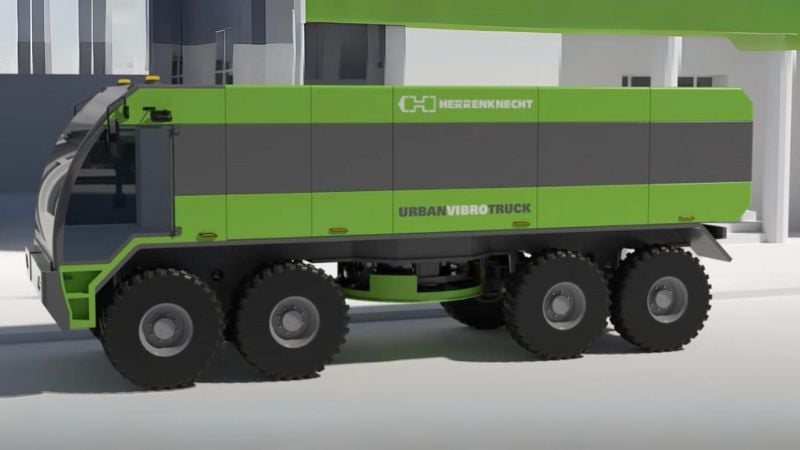
Urban Vibro truck. Image used courtesy of Herrenknect AG
What Are Seismic Vibrators?
The Urban Vibro is a seismic vibrator, sometimes called a vibro truck. Developed in the 1950s, vibro trucks have been used to locate oil, gas, water, and other resources. The trucks use a process called vibroeseis to generate seismic waves to survey and create geological maps of an area.
The trucks deploy a device called a shaker or thumper from the truck's center directly to the ground. The shaker emits controlled-frequency vibrations called P-waves (P short for primary or pressure). These travel quickly through the ground and bounce off features below. The machine measures the time the vibrations take to reflect back to the surface. The seismic echoes are used to create maps of the subsoil’s density and features.
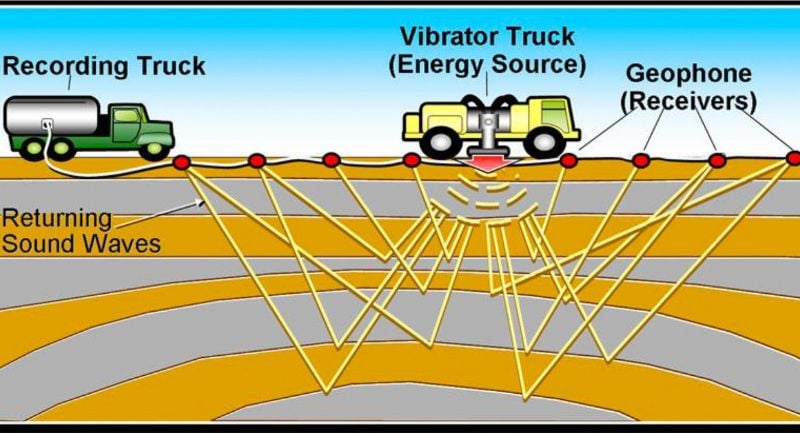
How a vibro truck works. Image used courtesy of the University of Texas
The process involves sweeping the area to measure starting and ending frequencies. A complex system of hydraulic servo valves powers the shaker’s piston. The frequency varies depending on the terrain’s features, but most vibrators operate between 20 and 150 Hz. Higher frequencies reveal more details but tend to be less accurate than maps created at lower frequencies.
A less common technology is the electromagnetic (EM) voice coil transducer, which uses frequencies ranging from 2 to 125 Hz to generate 60,000 pounds of pressure. The EM device could yield high-quality results faster.
Most vibro trucks are designed for rugged terrain and undeveloped land, where oil and gas are typically found. However, seismic vibrators are also used in marine environments without the truck.
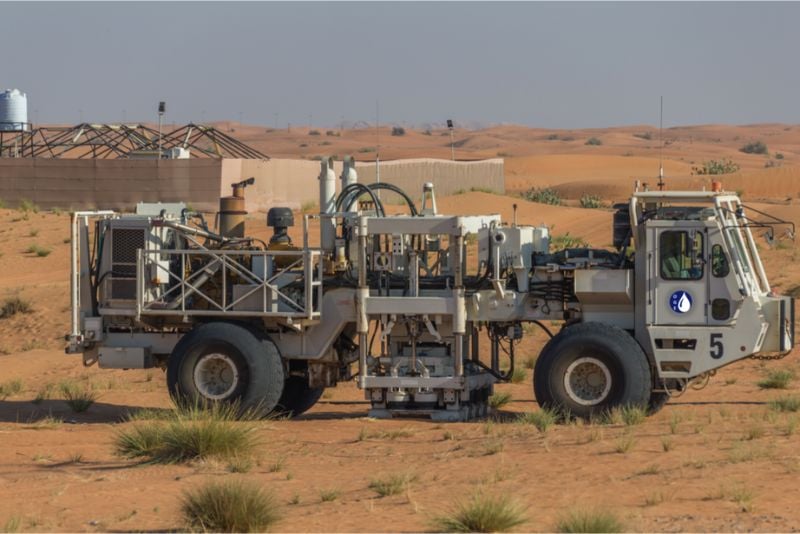
Vibro truck. Image used courtesy of Wikimedia Commons
How the Urban Vibro Works
Herrenknecht AG designed the Urban Vibro with a sleek, compact body for city streets. The company also adapted the shaker technology to work without disrupting or damaging city infrastructure.
The shaker’s P-Wave technology generates high peak force with frequencies ranging from 1 Hz to 150 Hz. At full force, it operates at 3 to 150 Hz with a ground peak force of 280 kN. The goal is to penetrate deeply into the ground while producing high-quality images.
The truck is 2.5 meters wide and drives at a 40 km/h high speed. When operating, it produces a noise level of 65 decibels, compared to garbage trucks, which typically measure 85 to 100 decibels. The Urban Vibro also has all-wheel steering, collision awareness, and a camera system.
After the Urban Vibro maps an area, experts will determine which locations can be developed for geothermal energy.
Herrenknecht AG designed the truck in collaboration with the Karlsruhe Institute of Technology’s Geophysical Institute.
Developing Geothermal in Urban Areas
Heating and cooling are the most common uses of geothermal energy in urban areas. To create a heat pump, a closed-loop pipe system is buried beneath or near a building. The fluid is heated below ground, and the heat pump distributes the heat throughout the building.
Cooling works the opposite way. Rather than absorbing the heat, the heat pump removes it and sends it underground.
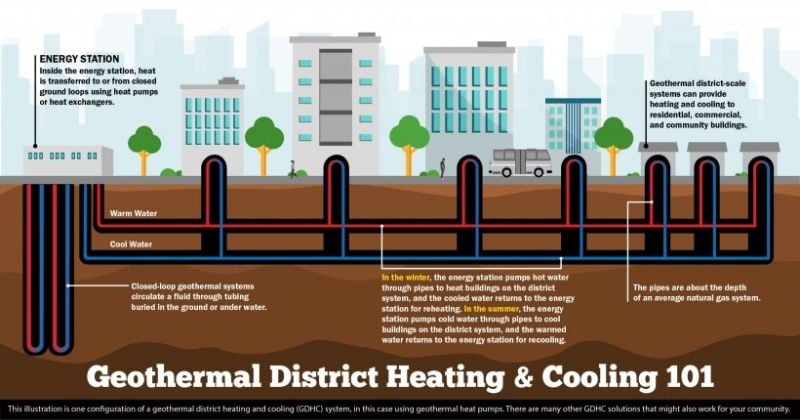
Geothermal heating and cooling process. Image used courtesy of Department of Energy
The heat island effect in cities makes underground rocks and water warmer than surrounding rural areas. The steel, asphalt, and brick surfaces of roads and buildings absorb and retain more of the sun’s heat. The phenomenon also affects the soil, rocks, and underground water. Temperatures can be 2°C higher in rock and 5°C higher in aquifers compared to similar geological features in rural areas.
The U.S. Department of Energy calculates using geothermal heating instead of electric could eliminate the need for about 24,500 miles of power grid transmission lines by 2050.