Facebook
 Google
 GitHub
 Linkedin
TI, Delta Supercharge EV Performance
A Texas Instruments and Delta Electronics collaboration will deliver more efficient components, enabling faster onboard chargers.
Two power electronics giants have teamed up to deliver a highly sought-after capability in the EV industry: more efficient components enabling faster charging without compromising size and weight.
Texas Instruments (TI) and Taiwan-based Delta Electronics will work together to optimize electric vehicle charging systems’ power density, size, and performance. Utilizing TI’s advanced semiconductors, Delta aims to develop smaller and more efficient DC/DC converters and onboard chargers.
The partnership comes as automakers demand industry-leading device efficiency to convert alternating current (AC) voltages to direct current (DC) for vehicle-to-grid and vehicle-to-home applications. Maximizing the power transferred from a load source reduces energy losses and extends the life of components.
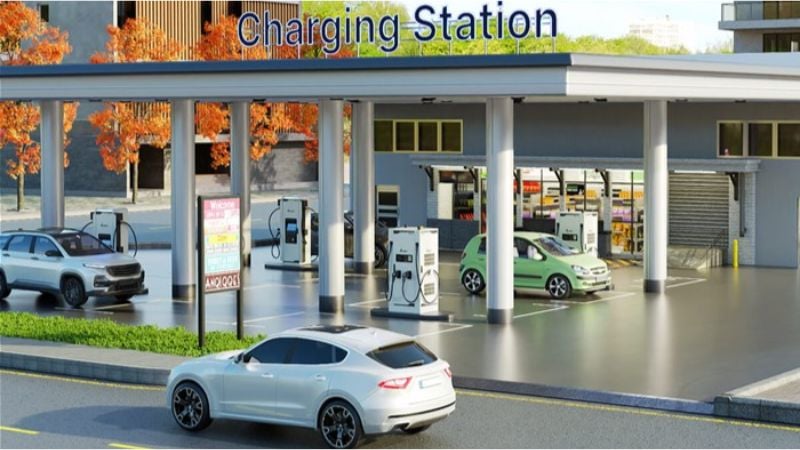
Electric vehicle charging station. Image used courtesy of Delta Electronics
Onboard Chargers
Onboard chargers convert AC power from public charging stations or in-home devices like Tesla’s Wall Connector to DC power stored in battery electric vehicles (BEVs). Expanding onboard chargers’ power rating is essential to unlocking higher driving range, a major sticking point among consumers considering switching to EVs.
With battery voltages rising from 400 V to 800 V across the market, more companies are using high-density silicon carbide (SiC) and gallium nitride (GaN) devices rather than conventional insulated-gate bipolar transistors to achieve faster charging times. Increasing power density requires trimming dimensions or pushing the power output higher within the same form factor.
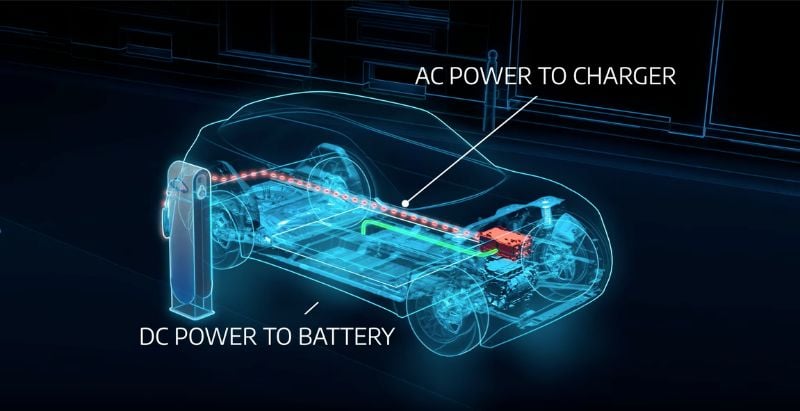
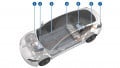
Internal rendering of an EV’s onboard charging system. Image used courtesy of Stellantis
TI to Contribute Tech for Onboard Charging
The partnership’s first phase will use TI’s new C2000 real-time microcontrollers and active electromagnetic interference filters to shave 30% off the size of Delta’s 11 kW onboard charger and reach up to 95% power conversion efficiency.
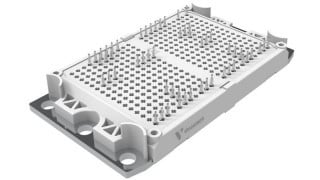
Delta already markets onboard charging modules boasting a 93% output power efficiency from 3.3 kW to 22 kW. The 400 V and 800 V options weigh about 39 pounds, with 350x260x130 mm dimensions. The product converts utility power to a higher voltage for charging battery packs in BEVs and plug-in hybrid EVs.
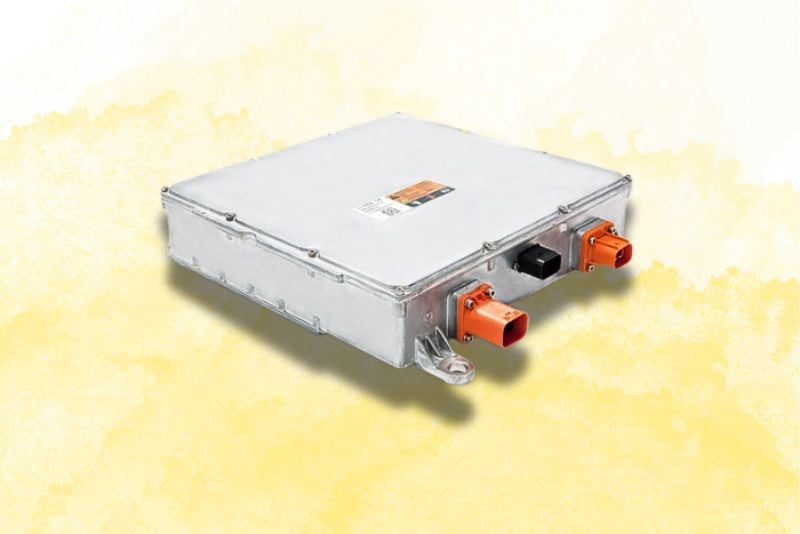
Delta’s onboard charging module. Image used courtesy of Delta Electronics
The partners will also work on reducing the size of Delta’s 400 V and 800 V DC/DC converters, which offer 94-95% efficiency, weigh 4.8 and 7.7 pounds, and come in 186x158x56 and 195x171x58 dimensions, respectively.
These advancements will meet the growing demand among automakers for highly efficient converters at a fraction of the weight and size, with less electromagnetic interference.
Advancing EV Power Capabilities and Functional Safety
Delta expects TI’s C2000 microcontrollers will secure critical safety requirements for vehicles’ electrical systems. The product is certified to meet ASIL D, the highest functional safety classification level.
From temperature monitoring to advanced testing, more than 300 safety mechanisms are built into C2000 devices to provide diagnostic coverage and minimize interference between components.
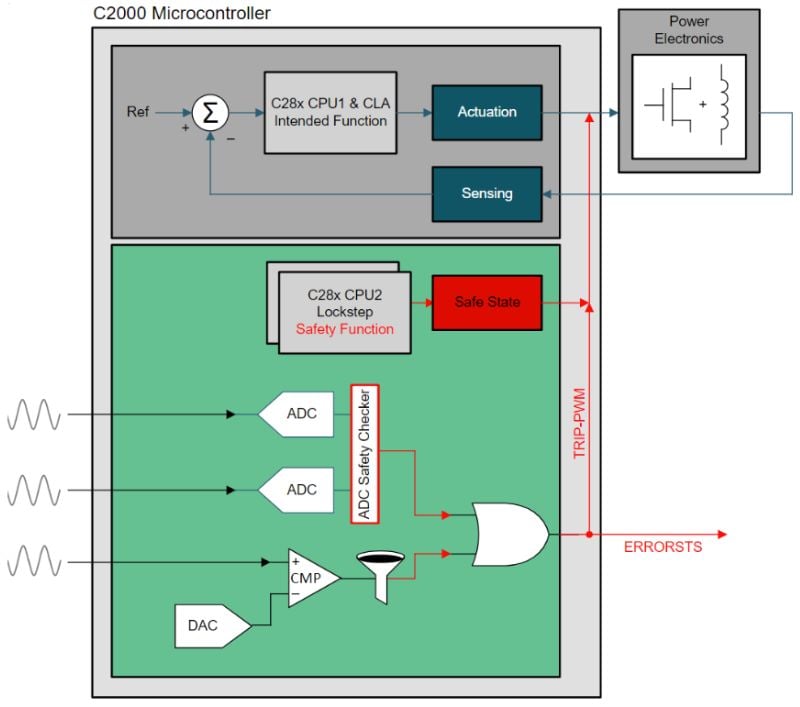
An example of the C2000 microcontroller’s safety functions for onboard charger power control applications. Image used courtesy of TI (Page 3, Figure 1)
The two companies also anticipate that highly integrated isolated gate drivers will improve power density and minimize the size of onboard chargers. TI’s C2000 microcontrollers can pair with GaN integrated circuits and SiC power devices to support high switching frequencies, power density, and other design needs.
The partnership’s last phase involves building next-generation automotive power products leveraging TI’s GaN technology expertise.
Delta already has experience using SiC semiconductor technology in its new 500 kW DC fast-charging system for buses and trucks. The product can charge heavy-duty EVs at 460 kW power in two hours, enabling a full day of driving range.