 Facebook
 Google
 GitHub
 Linkedin
Extreme Field Stop IGBT for Variable Frequency Drives
The Littelfuse XFS IGBT delivers lower semiconductor losses, enhanced robustness, and reduced gate charge, offering an efficient silicon solution for Variable Frequency Drives.
This article is published by EEPower as part of an exclusive digital content partnership with Bodo’s Power Systems.
Arrticle co-authored by Rohan Phadke, Pablo Cortes, and Yavuz Gürlek, all of Littlefuse.
Variable Frequency Drives (VFDs) remain one of the largest application areas for IGBTs. While SiC MOSFETs continue to gain market share, their high dV/dt, increased EMI challenges, and shorter short-circuit withstand times remain critical considerations for motor drive designers. The Littelfuse XFS IGBT addresses these challenges while delivering high efficiency and robustness.
Variable Frequency Drives (VFDs) remain one of the largest application areas for IGBTs. While SiC MOSFETs continue to gain market share, their high dV/dt, increased EMI challenges, and shorter short-circuit withstand times remain critical considerations for motor drive designers. The Littelfuse XFS IGBT addresses these challenges while delivering high efficiency and robustness.
The XFS short-circuit-rated trench IGBT combines Narrow-Mesa (NM, Figure 1) and reduced trench-pitch technology to achieve an optimized balance of performance and robustness that delivers the best combination of performance and robustness.
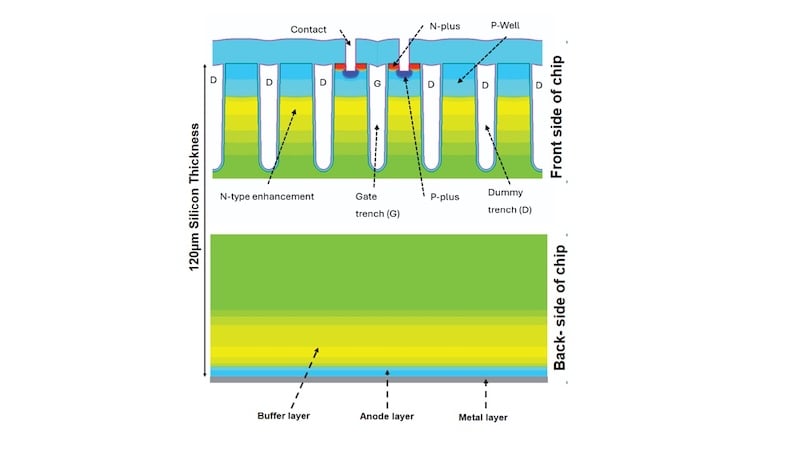
Figure 1. NM reduced trench pitch. Image used courtesy of Bodo’s Power Systems [PDF]
It features an excellent VCE(sat)/EOFF tradeoff, making it one of the best silicon IGBT solutions for VFD applications in the 4-8 kHz operating range, enabling up to 10 % lower overall semiconductor losses.
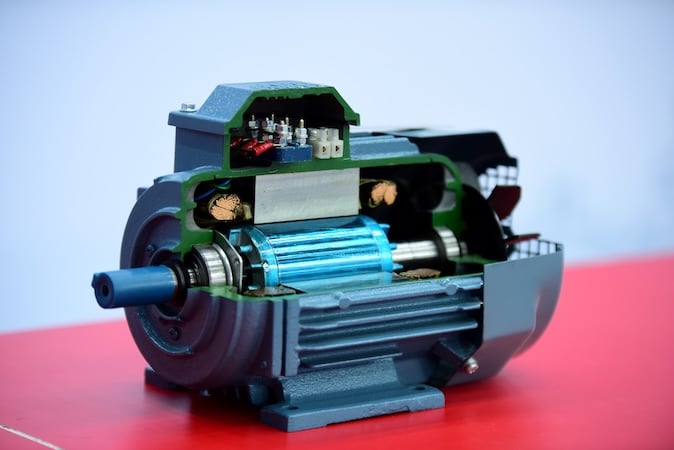
Image used courtesy of Freepik
These switching frequencies are widely used in pumps, compressors, fans, data center cooling systems, and other industrial motor-drive applications. Switching frequencies above 16 kHz are often employed in systems where acoustic noise is a critical consideration, such as elevator drives and industrial motor systems operating near personnel. In addition to its efficiency benefits, XFS provides the robustness required for demanding industrial motor-drive applications, as shown in Figure 2.
XFS IGBT – Lower Losses, Smarter Design: A Performance Comparison Against GEN4 and GEN7 Products
The IGBT trade-off in Figure 3 (left) highlights the compromise between conduction losses and turn-off switching losses. Stronger carrier injection lowers the VCE(sat) and conduction losses but increases stored charge and turn-off losses. Quantitative characterization of XFS at 150 °C, 600 V and 50 A confirms that VCE(sat) is approximately 12 % lower than that of the competitor’s Gen4, while EOFF is 17 % lower than that of the competitor’s Gen7. Migrating from Gen4 technology to XFS IGBT therefore enhances efficiency and lowers energy consumption for VFD applications.
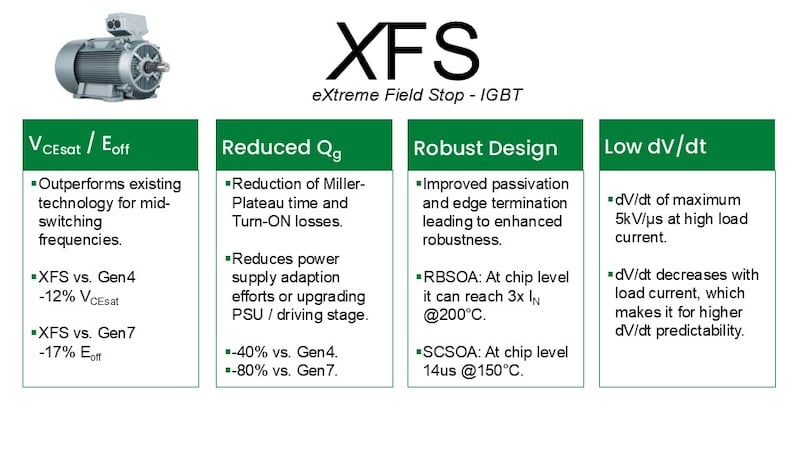
Figure 2. XFS IGBT in comparison to other IGBT generations. Image used courtesy of Bodo’s Power Systems [PDF]
Figure 3 (center and right) shows the system-level benefits of the XFS IGBT in a 650 VDC B6 inverter operating at 37 A (RMS), cos φ = 0.85 and Tc = 40 °C. All three devices use gate resistors chosen to keep the turn-on dV/dt below 5 kV/µs, with switching energies taken from double-pulse measurements at 150 °C. The XFS module contains a SiC Schottky freewheeling diode. At 4 kHz, where conduction losses dominate, the three devices lie within 7 % of each other (XFS 289 W, Gen7 272 W, Gen4 292 W). At 8 kHz, the XFS-based inverter dissipates about 424 W, compared with 440 W for Gen4 and 451 W for Gen7, and from about 8 kHz upwards, XFS shows the lowest losses and the highest efficiency of the three devices. At 18 kHz, the gap widens to 853 W (Gen4) and 1118 W (Gen7) against 795 W for XFS.
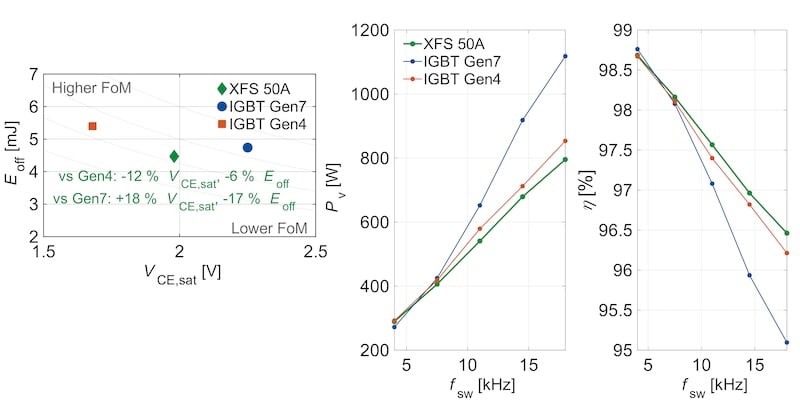
Figure 3. Trade-off curve and loss comparison. Image used courtesy of Bodo’s Power Systems [PDF]
Leveraging Low Gate Charge (QG) for Enhanced Switching Efficiency and Gate Driver Optimization in VFDs
One key benefit of XFS is its reduced QG, which helps industrial motor drives reduce turn-on/off losses, gate driver sizing, power requirements, and voltage transition time for the same gate current. With about 130 nC at VGE = 15 V, the Littelfuse XFS offers roughly 60 % and 85 % lower gate charge than the competitor Gen4 and Gen7 devices, translating to lower gate-driver current and power requirements while enabling faster voltage transitions and, in many cases, allowing migration from Gen4 platforms to XFS without upgrading the gate-driver power supply.
Improved Edge Termination and Passivation Design for Robust IGBTs in VFD Applications
Littelfuse’s XFS introduces an advanced edge-termination design and passivation stack, enhancing device reliability and ensuring long-term operation of motor drives, even under harsh climatic conditions. Under HV-H3TRB stress at 960 V (80 % of the nominal blocking voltage), XFS demonstrates consistently low leakage current across the full test duration, and it remains nearly at the same level, indicating the absence of stress-induced leakage paths and passivation degradation.
Controlling VFD dV/dt Voltage Slopes Within Industry Limits Using XFS IGBT Technology
Maintaining voltage rise rates dV/dt below the industry standard limit of 5 kV/µs is critical to prevent motor degradation. Long cable runs typically installed between the VFD and the motor trigger elevated voltage rise rates, placing high stress on winding insulation and generating electromagnetic interference (EMI). Over time, unmitigated dV/dt induces partial discharge and accelerates insulation breakdown, increasing the risk of full dielectric failure and compromising system safety.
Energy Savings and Total Cost of Ownership
At 8 kHz, total semiconductor losses of XFS are 424 W, 16 W (4 %) lower than the 440 W of the competitor Gen4 and 27 W (6 %) lower than the 451 W of the competitor Gen7. The advantage grows with switching frequency: at 18 kHz, XFS saves 58 W (7 %) against Gen4 and 323 W (29 %) against Gen7, because its lower EOFF and the negligible reverse-recovery loss of its diode outweigh the higher EON caused by the dV/dt -limited turn-on.
Figure 4 translates the losses at 8 kHz into the energy cost of a ten-year mission profile with 4000 operating hours per year at 0.25 €/ kWh. Over this period, the XFS-based inverter accumulates about 4 240 € of loss-related energy cost, 160 € (4 %) less than with the competitor Gen4 and 270 € (6 %) less than with the competitor Gen7. At higher switching frequencies, the difference grows accordingly.
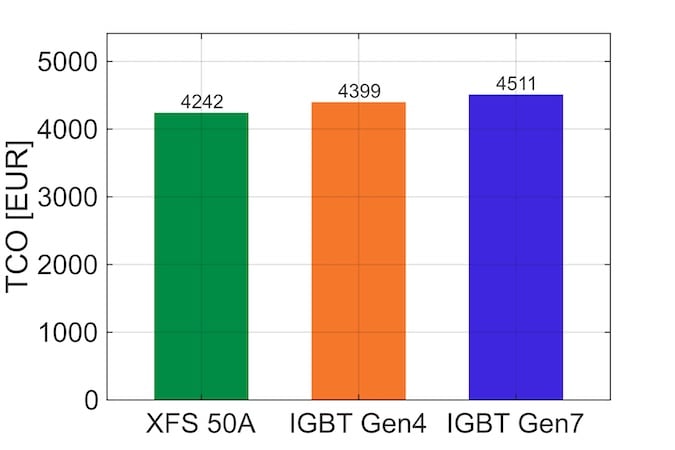
Figure 4. Ten-year total cost of ownership (TCO) comparison based on inverter losses at 8 kHz switching frequency. Image used courtesy of Bodo’s Power Systems [PDF]
Summary
Littelfuse’s XFS Narrow-Mesa trench IGBT combines high efficiency with the robustness required for Variable Frequency Drive applications. Compared with competing solutions, XFS provides 12 % lower conduction losses than the competitor Gen4 and 17 % lower turn-off losses than the competitor Gen7, resulting in equal total semiconductor losses in the 4–8 kHz range and the lowest losses of the compared devices above 8 kHz – even when its turn-on is slowed down to meet the 5 kV/µs motor-drive dV/dt limit.
The significantly reduced gate charge, up to 85 % lower than competing devices, lowers gate-driver current and power requirements, allowing easier integration into existing designs.
XFS also offers strong robustness, including excellent HV-H3TRB performance, RBSOA capability up to 3× Inom at 200 °C, short-circuit withstand capability up to 14 μs at 150 °C, and motor-friendly voltage slopes below 5 kV/μs. By combining low VCE(sat), low EOFF, reduced QG, and proven reliability, XFS provides an optimized silicon IGBT platform for next-generation industrial motor drives.
Moreover, Littelfuse is currently developing innovative top-side-cooled packages capable of integrating the required functionality, electrical isolation, and robust operation for Variable Frequency Drives, as well as other applications such as Battery Energy Storage Systems (BESS) and data center power conversion. Customers interested in these solutions are encouraged to contact the authors of this article.
This article originally appeared in Bodo’s Power Systems [PDF] magazine and is co-authored by Rohan Phadke, Technology and System Application Engineer, Pablo Cortes, Technology and System Application Engineering Manager, and Yavuz Gürlek, Senior System Application Engineer, Littelfuse