Facebook
 Google
 GitHub
 Linkedin
TI Debuts ‘One-Stop Shop’ Solutions for Next-Gen Data Centers
From power modules and reference designs to GaN bus converters, Texas Instruments’ new solutions address data centers’ growing power usage.
As AI data centers develop more complex power needs, energy efficiency and management are key. Texas Instruments is addressing these needs with a suite of new solutions in power management architecture.
To explain TI’s strategy, Chris Suchoski, data center general manager, and Pradeep Shenoy, computer power technologist, briefed the media about TI’s new power management products, including a 30 kW AI server power supply unit reference design, a dual-phase smart power stage and module, and a gallium-nitride intermediate bus converter.

TI is tackling data centers’ power needs.
AI Data Centers and Power Needs
Suchoski pointed out that AI computer demands have rapidly driven power management architectures from 12 V to 48 V and 800 VDC. Rack power could reach 1 MW within two or three years. TI wants to provide solutions from the component to the system level, he said.
“Data centers are very complex systems,” Suchoski explained. “They’re running very power intensive workloads that demand a perfect balance of multiple critical factors. Most important are power density, performance, safety, grid to gate efficiency, reliability, and robustness.”
Understanding these factors is essential when developing the next generation of AI data centers, which are more “power hungry” than ever before, he explained.
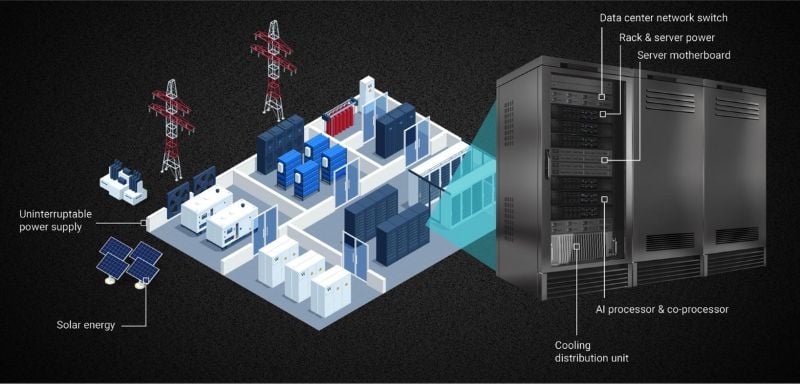
TI’s “grid-to-gate” concept for AI data centers.
“TI is really focused on all the building blocks for all the key systems within the modern data center,” Suchoski continued. “This spans from the infrastructures, which include systems like solar energy, uninterruptable power supplies, and energy storage systems, to the IT rack, which includes functions like AC power supplies, top-of-rack network switches, and of course, the AI processors.”
He explained that IT’s solutions provide a “one-stop shop” for designers wanting scalable infrastructure and enhanced density.
Nvidia Collaboration for AI Computing Growth
To support the 800 VDC data center power architecture, TI has collaborated with Nvidia to develop power management devices. The companies’ joint white paper, “Power Delivery Trade-offs when Preparing for the Next Wave of AI Computing Growth,” addresses design challenges and opportunities at the system level.
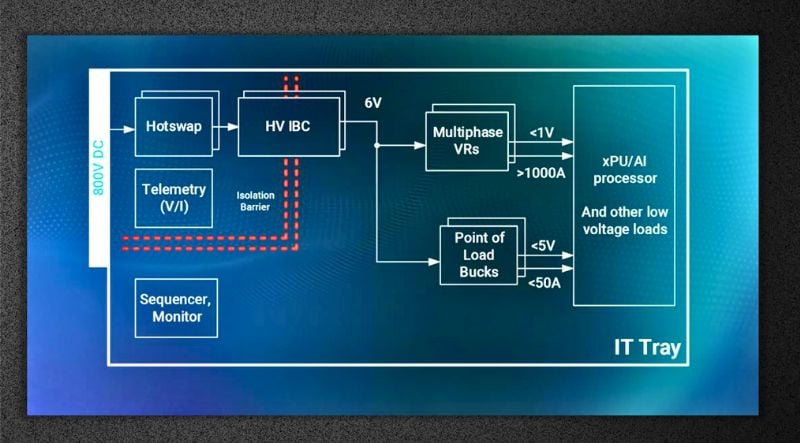
Supporting the 800 VDC architecture.
“In that white paper, we examine some of the power delivery architectures in the IT rack and some of the challenges and opportunities for achieving high efficiency and high-powered density,” Shenoy said. “We’re really looking at the system level: what are some of the different tradeoffs of different architectures?”
Dual-Phase Smart Power
Shenoy said a major trend in data centers is the move from a single-phase to a dual-phase power system.
TI’s CSD965203B is a dual-phase smart power stage offering 100 A of peak current per phase, the highest peak power density available.
The two power phases are encased in a single 5 mm x 5 mm QFN package. Designers can use the CSD965203B to boost the phase count and power output within a compact printed circuit board footprint.
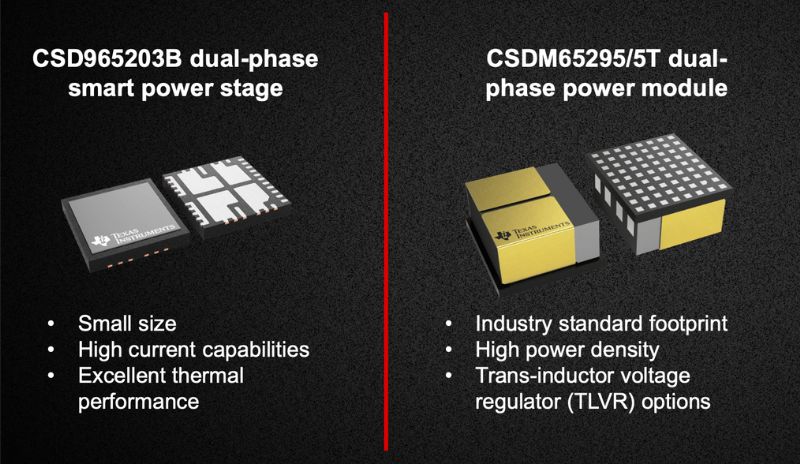
TI’s dual-phase solutions for AI data centers.
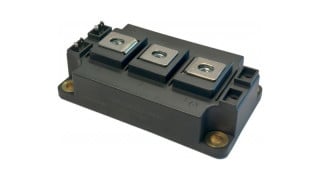
The CSDM65295 is a compact power module aimed at increasing data center power density without negatively affecting thermal management. It incorporates two power stages and two inductors with trans-inductor voltage regulation capabilities. The module measures 9 mm x 10 mm x 5 mm, packing high efficiency and dependable performance in a small package.
AI Server Power Supply Reference Design
Shenoy discussed TI’s new reference design for a 30 kW dual-stage power supply for AI servers.
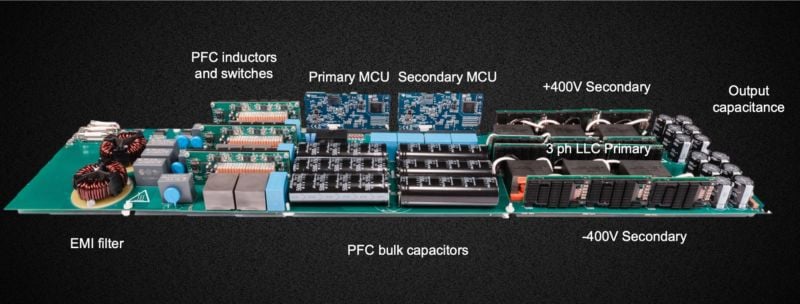
The 30 kW reference design.
“It features a three-level flying capacitor topology for the PSC stage that converts from AC to DC,” he explained. “Then it has a delta-delta connected three-phrase LLC stage that converts from DC to DC. So this design has a lot of TI components—over 20 different devices ranging from sensing, control, power switches, bias supplies, and cage drivers.”
The flexible power supply allows configuration as two separate +400 V and -400 V output supplies, or as a single 800 V output.
GaN Intermediate Bus Converter
TI’s LMM104RM0 gallium nitride (GaN) converter module can deliver up to 1.6 kW of output power. The module boasts up to 97.5% input-to-output power-conversion efficiency and strong light-load efficiency. Packaged in a quarter brick form factor of 58.4 mm x 36.8 mm, the module enables active current sharing among multiple modules.
Suchoski explained that the GaN module can reduce switching losses, and the packaging innovations enable top-side cooling.
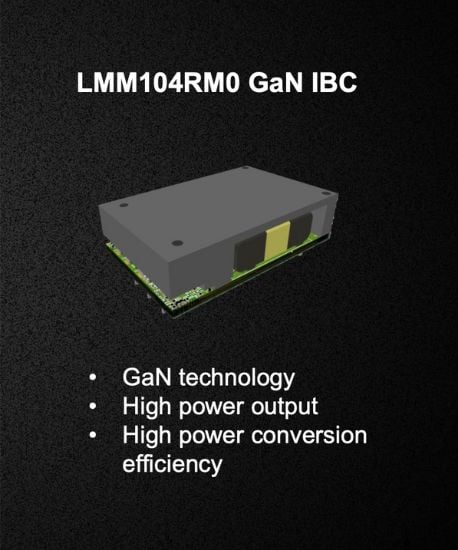
GaN bus converter.
The Data Center Power Future
Suchoski expects data centers will transition to 800 V architectures within two to three years. TI plans to continue collaborations with Nvidia and other partners while drawing from their expertise in the other fields they service.
“We’re really excited to be developing new products, new reference designs, spanning from AC-DC power conversion for three-phase to 800 V conversion to some of the protection circuitry,” he said. “Fundamentally, we want to leverage our exhaustive portfolio to service these new requirements and leverage a lot of the learning we’ve taken from the automotive, BMS space as well as the grid space, which operate in similar voltage domains, to deliver the most comprehensive solutions we can for our customers making this transition.”
TI will display its new solutions at the Open Compute Summit, Oct. 13-16, in San Jose, California.