Facebook
 Google
 GitHub
 Linkedin
Precision Power: Danisense and CERN Collaborate on Current Sensor
Danisense’s DM1200 zero-flux DC transducer will enhance CERN’s POLARIS power converters.
CERN’s North Area plays a pivotal role in particle physics experiments, relying on magnet systems to accurately guide particle beams. These magnetic fields must be carefully regulated to ensure particle trajectories remain stable throughout complex experimental setups. Even the slightest deviation in current control can result in beam instability, undermining the precision of the experiments and affecting data reliability.
Traditional solutions for current sensing often struggle under such extreme demands. Challenges such as offset drift, non-linearity, and insufficient resolution can make it difficult to maintain the consistent performance required at current levels of up to 2 kA. To address these issues, CERN sought a transducer capable of delivering ultra-stable, high-accuracy current measurements to pair with its POLARIS power converters.
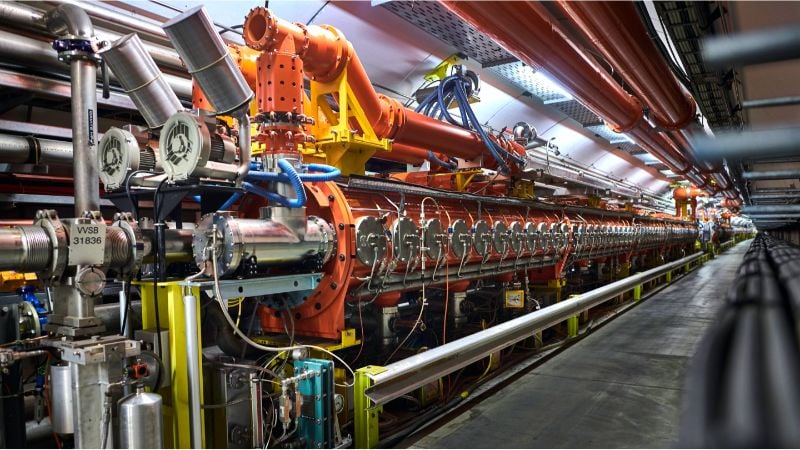
CERN’s Super Proton Synchrotron accelerator. Image used courtesy of CERN
Danisense DM1200: The Solution for POLARIS Power Converters
After rigorous evaluation, CERN selected Danisense’s DM1200 DCCT for its ability to meet these extreme demands. Using proprietary closed-loop fluxgate technology, the DM1200 offers unmatched accuracy and stability for high-current applications. This technology allows the DM1200 to deliver a signal proportional to the measured current with minimal error, even under challenging conditions.
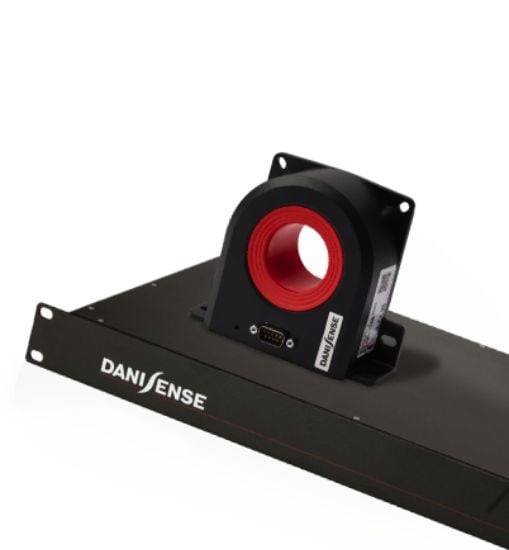
The DM1200. Image used courtesy of Danisense
Miguel Cerqueira Bastos, Section Leader in CERN’s Electrical Power Converter group, highlighted the importance of this innovation in a press release: “The DM1200 is a current signal proportional to the measured current, which in this case is the output current of the POLARIS power converter. We convert the output current from the DCCT into a voltage signal, then digitize it, and use it in a digital current loop to precisely control the current in the magnets of the NA experimental lines.”
During testing, the DM1200 demonstrated exceptional performance, achieving a linearity error of less than one ppm and shallow offset drift. These capabilities enable CERN to maintain precise control of the critical magnetic fields in its experiments.
Closed-Loop Flux Explained
Danisense’s proprietary closed-loop fluxgate technology is a highly advanced method for measuring electrical current with exceptional precision. This system relies on a fluxgate sensor to detect magnetic fields generated by the primary current. It uses a compensating secondary current to neutralize the magnetic flux within the toroid. Integrating fixed excitation frequencies and second harmonic zero flux detection ensures sub-ppm accuracy, ultra-low drift, and high stability over time. The technology naturally compensates for environmental factors like temperature fluctuations by employing dual magnetic cores in a balanced configuration. This approach allows Danisense’s products to achieve industry-leading linearity and flat bandwidth, making them ideal for demanding applications such as particle accelerators, renewable energy systems, and precision drives.
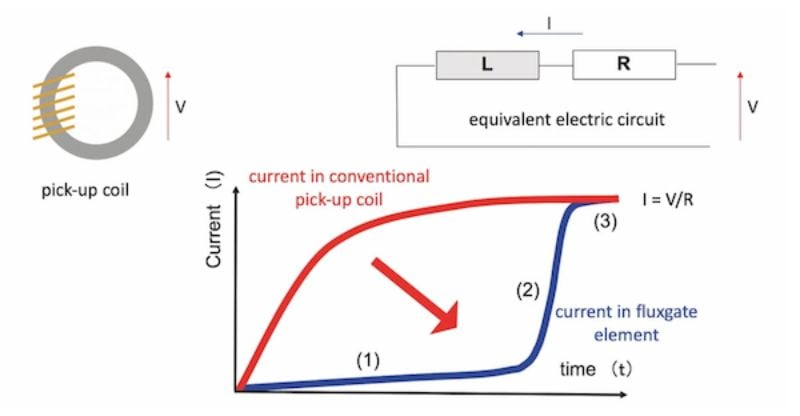
Differences in current vs. time between fluxgate elements and a conventional pick-up coil. Image used courtesy of Danisense
Enhancing Experimental Accuracy
The DM1200's high-resolution measurement capabilities allow CERN to detect and correct even minute variations in current, enabling tighter control of particle beams. This improvement enhances experimental accuracy and supports more complex experimental setups, broadening CERN’s research capabilities.
Since its founding in 2012, Danisense has established itself in high-accuracy current sensing technology, combining advanced magnetic performance with innovative electronics. Danisense’s collaboration with CERN addresses the needs of demanding applications like particle physics.