Facebook
 Google
 GitHub
 Linkedin
Advanced Fuel Storage and Decompression for Distributed and Resilient Microgrids
Learn how advanced microgrid technologies can allow you to bypass grid infrastructure delays using CNG today and be ready to transition to hydrogen tomorrow.
Grid instability is becoming more frequent and disruptive, driven by aging infrastructure and extreme weather events like wildfires, hurricanes, and heatwaves. At the same time, industrial growth and site expansions are outpacing the grid’s ability to keep up.
In many regions, delays in utility service upgrades are slowing down new builds, preventing facilities from going online or scaling operations when ready. Distributed energy systems—especially microgrids—are filling this gap, offering a faster, more resilient way to deliver power where and when it’s needed.
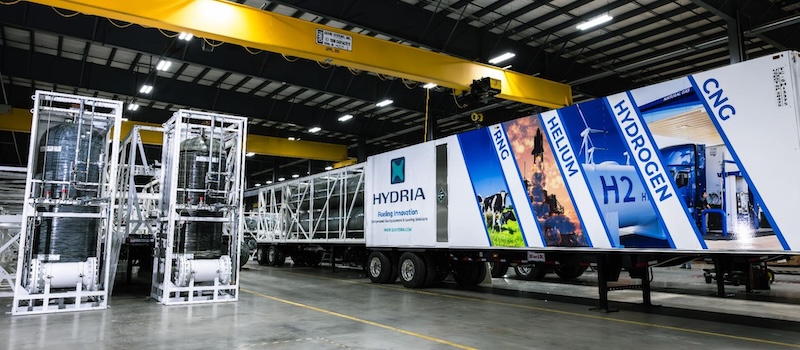
Long lead times for grid development are pushing industries to deploy microgrids that don’t wait for infrastructure.
Microgrids also offer a compelling economic case. By reducing dependency on central utilities and enabling the use of low-cost fuels like compressed natural gas (CNG), microgrids can significantly lower operational costs while improving reliability. As more facilities seek energy autonomy, cost-effective and scalable fuel infrastructure will play a critical role in supporting expansion.
The Infrastructure Gap and Why Microgrids Matter
Delays in utility interconnection are increasingly common. Lead times for transformer upgrades, service extensions, or substation improvements can stretch from months to years. For companies building new facilities or expanding existing ones, this creates a mismatch: the site is construction-ready, but grid power is not.
Microgrids solve this problem by enabling power independence. They allow facilities to proceed on their timeline, using distributed generation assets like solar, batteries, and gas generators. By integrating cost-effective gas fuel systems, microgrids deliver immediate ROI compared to waiting on expensive grid infrastructure. In many cases, they also qualify for tax credits or local incentives, further improving the value proposition.
Challenges with Legacy Fuel Systems
Conventional fuel storage and decompression technologies weren’t designed for flexible, modern microgrid deployments. Steel tanks are heavy, prone to corrosion, and cumbersome to scale. They require reinforced installation and take up valuable space—an issue for urban, mobile, or modular energy units.
Beyond space constraints, legacy systems increase the total cost of ownership. Maintenance-intensive steel tanks and manually operated decompression systems contribute to higher labor costs, increased downtime, and fuel loss. For energy systems that must operate at high availability and low marginal cost, these inefficiencies add up quickly.
Hydria’s Modern Approach to Fuel Storage and Regulation
Hydria’s technology is purpose-built to support microgrids in fast-paced, high-demand environments. The foundation is a high-performance fuel storage platform based on Type IV composite cylinders. These tanks are lightweight, corrosion-resistant, and can store gas at higher pressures than traditional steel. More importantly, they’re modular, allowing operators to scale capacity based on changing site demands.
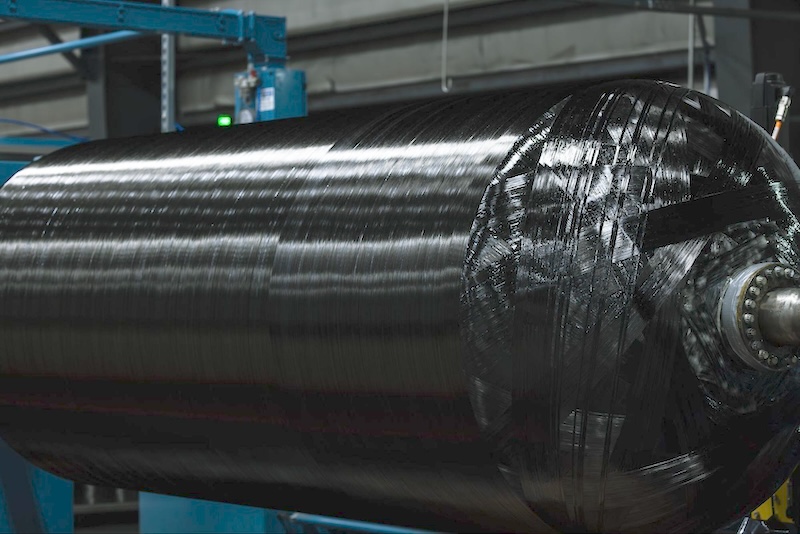
Lightweight composite cylinders provide many advantages over traditional steel tanks.
Compared to traditional steel, Type IV tanks significantly reduce installation costs by eliminating the need for special foundations or protective coatings. Their compact footprint enables deployment in tight locations, containerized microgrids, and mobile power units.
On the regulation side, Hydria has developed a smart decompression system that maintains consistent pressure even as loads fluctuate. Built-in telemetry enables real-time monitoring and automated diagnostics, while safety features like leak detection and emergency shutoff are standard. This integrated intelligence reduces the need for manual oversight and helps avoid costly fuel losses or emergency repairs.
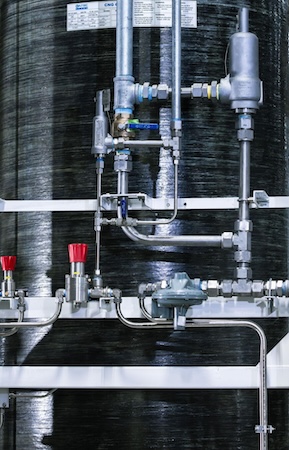
Smart regulation system ensures consistent fuel delivery, with telemetry for real-time insights.
Bridging Today’s CNG with Tomorrow’s Hydrogen
Compressed natural gas is not only widely available—it’s also highly economical. With lower volatility and fewer storage concerns than diesel, CNG offers substantial operational savings. Its price stability and cleaner burn also reduce wear on engines and emissions equipment.
Hydria’s systems enable immediate deployment of CNG solutions while supporting a seamless transition to hydrogen. This dual compatibility eliminates the need to retrofit or replace hardware as fuel markets evolve. By investing in future-ready infrastructure now, organizations avoid stranded assets and future capital expenditures.
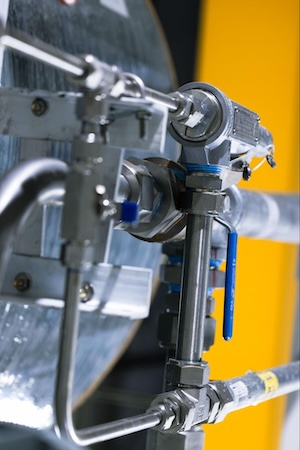
Hydria systems are compatible with CNG and hydrogen—no retrofits required.
Application Spotlight: BSD Builders and Hydria Partnership
One example of this technology in action is the partnership between Hydria and BSD Builders. Eliminating utility outages, BSD deployed a modular microgrid using CNG as the primary dispatchable fuel. Hydria’s Type IV tanks and smart decompression systems formed the backbone of that setup, allowing the site to operate independently from the grid.
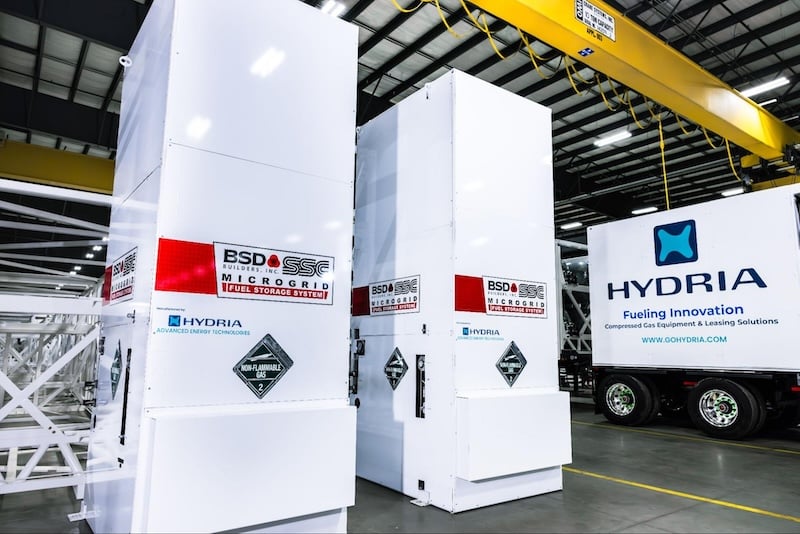
BSD Builders deployed Hydria’s modular microgrid to eliminate outages and cut costs.
Beyond meeting immediate power needs, BSD leveraged the microgrid to cut energy costs while ensuring long-term resilience. By transitioning from diesel-based generation, BSD helped the customer lower fuel expenses and extend maintenance intervals. The system also brought the facility up to regulatory standards, enabling full compliance with emissions thresholds, tax credits, and local energy incentives.
The improved fuel profile and real-time telemetry tools allowed BSD to actively track and reduce the facility’s carbon footprint. As demand increased, the modular tank system made it easy to expand capacity without reengineering, and predictive maintenance features kept downtime and service costs to a minimum. The project ultimately enhanced the customer’s energy security while ensuring compliance, sustainability, and operational flexibility.
Looking Forward
As industrial activity increases and grid upgrades lag, distributed energy systems will continue to grow in importance. Microgrids are already proving themselves as the solution of choice for facilities needing fast-track commissioning, backup during weather-driven outages, or long-term grid resilience.
What’s been missing is infrastructure that meets the same standards of speed, adaptability, and affordability. Hydria’s approach—combining modern materials, modular architecture, smart regulation, and fuel flexibility—fills that gap. It lowers the barrier to adoption and makes resilient power solutions financially viable for a wide range of projects, from commercial expansions to disaster response.
The future of power isn’t just distributed—it’s fast, flexible, and cost-efficient. Hydria’s next-generation fuel systems make it possible to bring clean, scalable energy to projects that can’t wait for the utility. By solving for fuel storage and regulation, Hydria helps make microgrids a complete, economical solution for today’s energy challenges—and tomorrow’s.
For organizations facing tight timelines, rising energy demands, or infrastructure bottlenecks, advanced fuel technologies offer a way forward—delivering reliable power, minimizing operational costs, and ensuring readiness for what comes next.
All images used courtesy of Hydria Gas Technologies.