Facebook
 Google
 GitHub
 Linkedin
Ideal Semiconductor Unleashes Its First 150 V Silicon MOSFETs
Announced today, Ideal Semiconductor is beginning full production of its proprietary silicon MOSFETs. EEPower met with the company's leaders, who explained the company’s innovative engineering.
Today, Ideal Semiconductor announced that it has begun full-volume production of its first 150 V MOSFETs. While the technology was released in 2023, entering full-volume production is a major milestone for the Pennsylvania-based startup, which is finally bringing its technology concept to a commercial product line aimed at high-efficiency applications in AI data centers, motor drives, power tools, and telecom systems.
EEPower had the chance to hear from Ideal Semiconductor’s CTO and Founder, David Jauregui, and Vice President of Systems, Applications and Marketing, Ryan Manack, to learn about the MOSFETs and the unique technology firsthand.
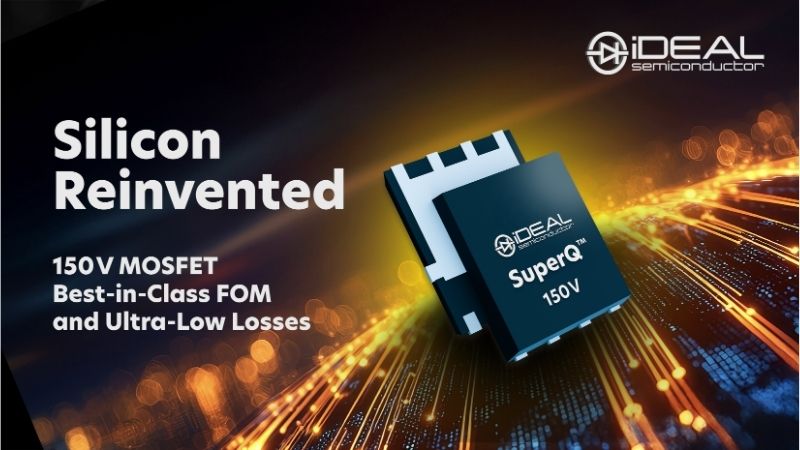
Ideal’s 150 V MOSFET. Image used courtesy of Ideal Semiconductor
SuperQ Structure
Ideal’s devices are built on the company’s proprietary SuperQ architecture, which offers a fundamentally different approach to silicon power device design. Developed using a high-throughput process compatible with conventional CMOS fabs, SuperQ leverages an asymmetrical vertical trench structure that maximizes conduction area while reducing switching losses. The company claims this enables up to 2.7x lower RDS(on) compared to incumbent technologies in the same voltage class, without sacrificing thermal performance or ruggedness.
Regarding the decision to stick with silicon, Jauregui explains, “Silicon has the infrastructure, the quality, the manufacturability. It’s so well balanced, so reliable ... It’s tough to bet against a platform that has all that history.”
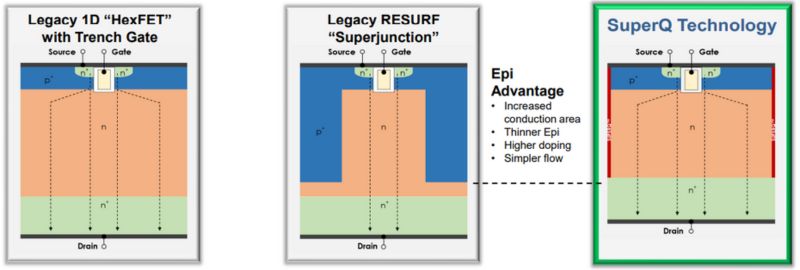
Device structure of HexFETs, Superjunction FETs, and SuperQ FETs. Image used courtesy of Ideal Semiconductor
According to Ideal, SuperQ represents the first significant structural innovation in silicon MOSFETs since the introduction of Superjunction devices in the late 1990s. Conventional Superjunction (RESURF) designs achieve high breakdown voltages by alternating p-type and n-type regions in the drift layer, but this symmetrical structure limits conduction area to roughly 50%. Instead, Ideal’s SuperQ uses an asymmetric structure that dedicates up to 95% of the silicon cross-section to n-type conduction to significantly reduce specific on-resistance. Voltage blocking is achieved using a high aspect ratio trench, allowing the device to withstand fields of up to 20 V/μm, compared to 13-15 V/μm in Superjunction designs.
The simplified vertical structure also enables a thinner epitaxial layer with higher doping to reduce drift resistance without requiring multiple complex mask layers.
Quantified Gains in RDS(on), Switching Losses, and Energy Storage
One product in the family, the 150 V iS15M7R1S1C, offers a maximum RDS(on) of 6.4 mΩ in PDFN form. According to Ideal’s internal testing, stepping up to 200 V, the company's TOLL-packaged part achieves an RDS(on) of 3.7 mΩ, outperforming the current leading silicon competitor by 45% and the next best by over 2.7x. At 400 V, Ideal’s forthcoming product is expected to outperform even SiC devices on resistance metrics, achieving 11.5 mΩ compared to 14.4 mΩ for the best available SiC alternative.
1.jpg)
Specific resistance for silicon, GaN, SiC, and SuperQ (SuperQ mid-voltage). Image used courtesy of Ideal Semiconductor
SuperQ also demonstrates competitive switching behavior. The measured switching charge (QSW), which directly impacts transition losses, is up to 2.1x lower than comparable devices. Lower QSW enables either reduced switching losses at the same frequency or operation at higher switching speeds without increased power dissipation.
“For a system engineer, this gives them the ability to switch two times faster or keep the same switching frequency and lower their switching losses by about 2x,” said Manack.
Meanwhile, stored output charge (EOSS), which contributes to turn-on losses in hard-switching topologies, is up to 4.4x lower than leading silicon competitors and notably lower than comparable GaN devices.
Applications in Datacenter, Motor Drive, and Telecom Systems
In high-current applications like BLDC motor drives for e-mobility, power tools, and industrial automation, Ideal believes that SuperQ offers the potential to reduce parallel MOSFET count. For example, devices traditionally requiring four or more parallel FETs can achieve equivalent or superior performance with fewer devices for lower system BOM costs, smaller PCB area, and simpler thermal design.
In data center power delivery, SuperQ targets the secondary side of resonant converters such as PSFB and LLC stages. These architectures are increasingly used to step down 400 V or ±400 V rails to a 54 V intermediate bus. Ideal claims that their devices have already been evaluated in AI server applications, where they replaced 24 discrete MOSFETs with 12 SuperQ parts. The change yielded lower thermal load and system cost while maintaining efficiency.
Telecom and networking equipment also benefit from improved thermal margins. In one real-world test, replacing incumbent devices with SuperQ parts yielded up to a 0.3% efficiency improvement and a 14°C reduction in peak device temperature. These results were achieved in standard AC-DC and DC-DC converter topologies.
Built on U.S. Infrastructure
Ideal also holds some geopolitical importance for the U.S., as the SuperQ MOSFETs are fabricated at Polar Semiconductor in Minnesota, a foundry funded under the CHIPS and Science Act. Ideal leverages Polar’s established 0.18 µm process tools and high-volume lines to enable a competitive cost structure while maintaining control over intellectual property and yield optimization.
With SuperQ now in production, Ideal Semiconductor claims it is the only U.S.-based company to bring a next-generation power semiconductor platform to market in recent years. Future product releases will expand the voltage range and introduce additional package options, including TO-220, D2PAK-7L, and TOLL, to support broader adoption across industrial, datacenter, and consumer applications.
Speaking to how far the company has come, Jaurgeui reflected, “We started in 2017... and since then, I’ve not seen anyone come out with some next-generation platform. For a while there, I thought, ‘Have we gone down the wrong path?’ But certainly, we got it done, which is great.”