Facebook
 Google
 GitHub
 Linkedin
Hyundai Tech Detects and Kills Battery Fires Quickly
Hyundai Mobis brings a new line of defense against thermal runaway in electric vehicle batteries.
Fire risk from EV battery failures ranks among the most urgent and costly engineering challenges facing the auto industry, with manufacturers spending billions of dollars on recalls in the last decade. All it takes is one overheating cell to trigger thermal runaway, a chain reaction across the entire battery pack.
Hyundai Mobis, the parts and technology division of Hyundai Motor Group, has unveiled a prototype system that could mitigate battery fires before they start. Rather than relying on conventional battery management systems to passively monitor conditions, Hyundai’s new approach actively intervenes when detecting early signs of failure.
The system uses sensors to track real-time voltage, pressure, and temperature at the cell level. If abnormal behavior is detected, it discharges a chemical fire suppressant targeted directly at the relevant cell. The agent quickly floods the source before the reaction spreads.
Hyundai Mobis reports that this agent is about five times more powerful than a standard residential fire extinguisher, and the substance is formulated to offer high insulation, excellent efficiency, and permeability properties.
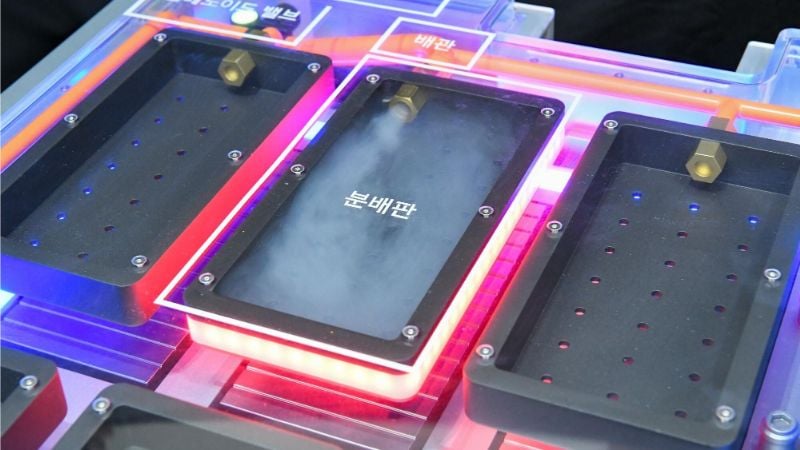
Hyundai Mobis’s cell-level thermal runaway prevention technology. Image used courtesy of Hyundai Mobis
Thermal Runaway Prevention
Most modern electric vehicles have battery management systems to oversee charge cycles, temperatures, and voltage consistency across cells. However, small electrochemical inconsistencies in lithium-ion cells, such as minuscule manufacturing defects or separator quality variations, can still cause voltage drift between cells.
Over time, these discrepancies can increase the internal resistance and trigger localized overheating. Other degradation factors, like lithium buildup during fast charging, breakdowns in the cell’s protective layers, or internal shorts, make thermal runaway more likely, especially under high loads or rapid charging.
If one cell overheats beyond a critical threshold, it can trigger chemical reactions that release gas, rupture the cell casing, and ignite. Heat then spreads to the adjacent cells, starting a chain reaction that’s difficult to control once underway.
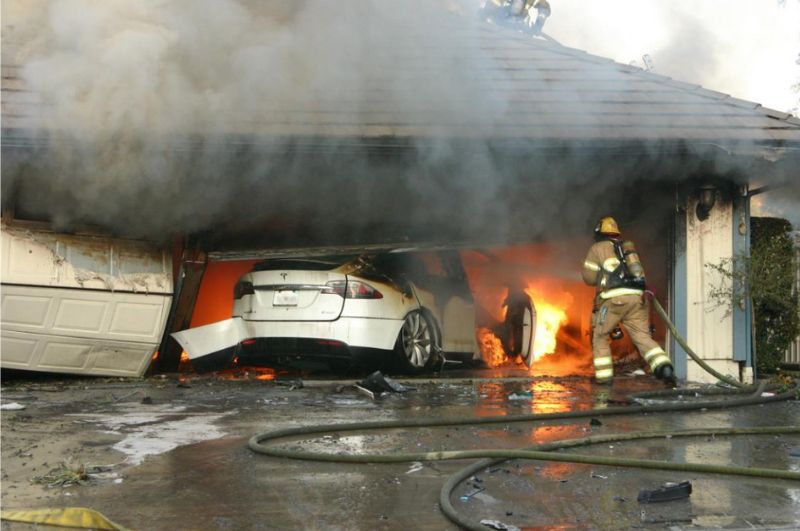
EV battery fires are harder to extinguish than conventional gas-powered cars, often requiring 3,000 to 8,000 gallons of water. Fires have even reignited hours after the initial flames were extinguished. In the last few years, automakers have recalled several EV models due to dangerous lithium-ion battery defects. In 2021, Hyundai and battery supplier LG Chem spent $900 million to replace 82,000 Kona EVs after several fires. GM faced a similar crisis, spending $2 billion to recall every Chevrolet Bolt EV produced since 2016.

California firefighters work to extinguish a burning electric vehicle. Image used courtesy of the Orange County Sheriff’s Department, via the National Transportation Safety Board
Regulators in Europe and China have set strict standards around limiting thermal runaway. For example, China’s laws require battery packs to delay the spread of thermal runaway for at least five minutes so occupants can escape safely. The United States is following suit, as the National Highway Traffic Safety Administration has investigated battery fire risks across multiple automakers. The agency also set new safety requirements for mitigating ignitions during normal operations, charging, and post-crash conditions.
Hyundai Mobis’s new thermal runaway mitigation system. Image used courtesy of Hyundai Mobis
Hyundai’s Battery Safety Tech and Recent Patent Filings
Hyundai Mobis’s complete system is integrated into the battery pack design. It includes a reinforced battery case, the fire suppression hardware, software controls, and a high-pressure piping mechanism designed to deliver targeted spray to the precise cell or module where failure is detected.
In addition to the fire extinguishing system, Hyundai Mobis has developed a pulsating heat pipe to reduce the battery system’s internal temperature and prevent overheating.
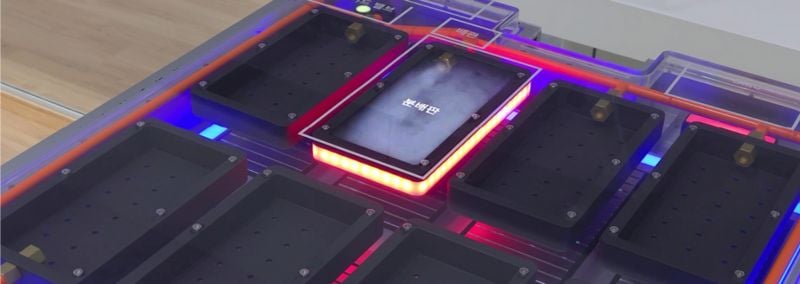
Hyundai’s new battery system. Image used courtesy of Hyundai Mobis
Hyundai Mobis has filed for three domestic and international patents covering its extinguishing system design, battery case architecture, and piping. Separate filings with the U.S. Patent and Trademark Office detail additional innovations, including an early diagnostics system that generates an incremental capacity analysis profile for each cell to identify weak points before they fail.
In Europe, the company filed a patent for a gas duct-based thermal runaway prevention system, incorporating parallel venting devices and porous materials to control the release of gas. The combination of these venting mechanisms is designed to maintain normal internal conditions during regular operation and respond to thermal runaway events quickly when needed.