Facebook
 Google
 GitHub
 Linkedin
Thermal Runaway Threat: Cracking the High-Temp Battery Code
Could a polymer electrolyte lead to safer and longer-lasting electric vehicle batteries?
Lithium-ion technology has been the dominant battery architecture in electric vehicles due to its commercial robustness. Unfortunately, these batteries don’t have high energy density. Scientists seek to develop more advanced EV batteries to achieve longer driving ranges.
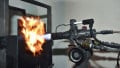
How does lithium-ion thermal runaway cause EV battery fires? This video demonstrates the process. Video used courtesy of Reactions/American Chemical Society
However, many higher energy density batteries are unsuitable from a safety perspective, so Li-ions have won the “EV battery race” so far. EV batteries can reach high temperatures that can potentially cause thermal runaway and fire.
In addition to EVs, batteries operating in extreme temperatures are also needed for subsurface exploration, thermal reactors, and medical devices requiring sterilization. Many batteries are optimal in and around room temperature conditions but unsuitable for high-temperature applications.
Lithium-metal batteries have the potential to meet many applications’ energy demands, but their thermal properties have let them down so far. Many Li-metal failures are attributed to the liquid electrolytes, which are unstable at elevated temperatures.
University of Hong Kong researchers have created a borate-enhanced polymer electrolyte that could support Li-metal battery use in a high-temperature setting.
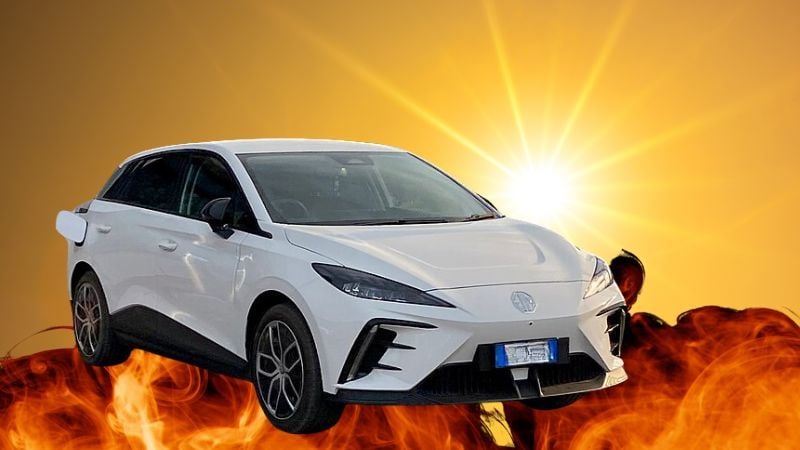
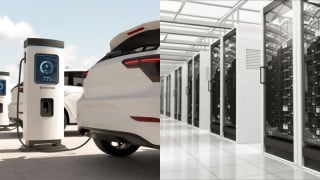
Can Li-metal EV batteries withstand high temperatures? Adapted from images used courtesy of Canva and Wikimedia Commons
Li-Metal Batteries and Thermal Challenges
Li-metal batteries could solve many energy challenges since they hold more energy than Li-ion batteries. However, many Li-metal batteries are fabricated with liquid electrolytes, which can cause numerous safety concerns and shortened battery life, especially at higher operating temperatures.
These concerns include:
- Large electrolyte volume changes
- Continuous side reactions with the liquid electrolyte
- Lithium dendrite formation
Studies show higher energy density batteries can cause more severe thermal runaway reactions. So, while the higher energy density of Li-metal batteries is a positive in higher temperature environments, they could become a liability and pose a higher safety risk. A non-liquid electrolyte could offer greater protection against parasitic reactions, which is why researchers from the University of Hong Kong experimented with polymer electrolytes.
Creating a High-Temperature Battery
Using a one-step click reaction, the researchers created a microcrack-free anionic borate network polymer membrane electrolyte. This approach enables large molecular networks to be easily built by “clicking" together molecular fragments.
The electrolyte possessed a cation conductivity of 3.1 × 10⁻⁵ S cm−1 at high temperatures, an electrochemical stability window up to 5 V, excellent non-flammability properties, and a large resistance to dendrite formation. These results were achieved in an 88°C/190°F operating environment.
The electrolyte was then used in high-heat-tolerating power packs in Hong Kong and retained 92.7% of their capacity and almost 100% of their Coulombic efficiency (99.867%) over 450 cycles at boiling temperatures (100°C/212°F). By comparison, standard lithium batteries with liquid electrolytes generally last less than 10 cycles under such high temperatures. The battery demonstrated stable discharging across a wide temperature range of 30-120°C/86-248°F and under negatively pressurized environments.
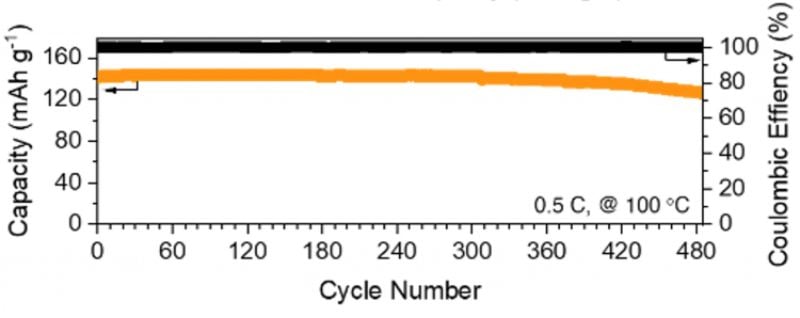
Nearly 93% of battery capacity was retained after 450 cycles. Image used courtesy of the University of Hong Kong
Many Li-ion battery packs can operate only up to 60°C/140 °F before undergoing degradation that prematurely ends the battery’s life. The researchers attribute their battery’s extended life span, high operating temperature, and safety to the presence of tethered/immobile borate anions in the polymer network. The borate anions have low flammability and high resistance to temperature, and tests showed that the borate-enhanced polymer network started to decompose between 300-400°C/572-752°F.
The borate anions also accelerated Li+ cation conduction transport and suppressed dendrite growth. The microcrack-free structure of the network was also said to play a part in cation conduction because the ions did not have to diffuse along long and tortuous pathways. It was shown that the membrane had a low ion pair energy due to the borate ions having a pairing preference with the Li+ ions. This delocalized the Li+ ions throughout the network, and the large amount of dissociated Li+ ions resulted in a higher freedom of motion for the ions and higher ionic transport, which led to fewer dendrites forming.
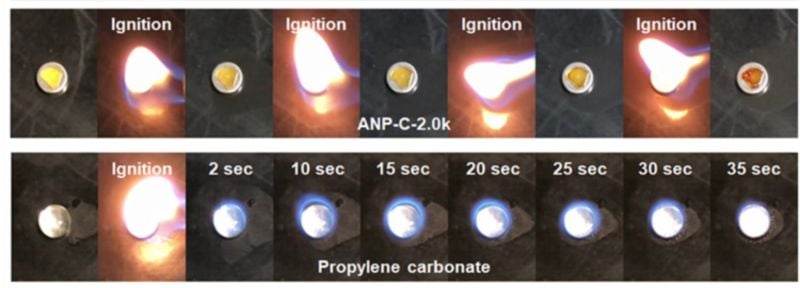
Combustion tests of ANP-C-2.0K and propylene carbonate. Image used courtesy of Hong Kong University
Applying the Approach to Other Batteries
Parasitic side reactions and dendrite formation are not challenges isolated to Li-metal batteries. Many battery architectures can suffer from these issues. The University of Hong Kong’s approach to enhancing the cyclability and stability of Li-metal batteries could apply to other high-energy-density batteries. It could pave the way for using polymer electrolytes across more battery technologies.