Facebook
 Google
 GitHub
 Linkedin
Simulations Find the Best Electrolytes for Sodium-Ion Batteries
Researchers used a simulation to map out the liquid electrolytes that could create safer, better-performing sodium-ion batteries.
A liquid electrolyte study could lead to safer, lower-cost sodium-ion batteries by providing battery designers with clearer guidance on improving conductivity without sacrificing safety.
Brazilian scientists studied sodium ion movement within several ionic-liquid electrolyte types to understand why some formulations allow ions to move more easily, while others slow them down. They mapped how ion-solvent structures change and how sodium ions cluster, providing insights that can help narrow down which electrolyte chemistries are worth pursuing in next-gen sodium-ion batteries.
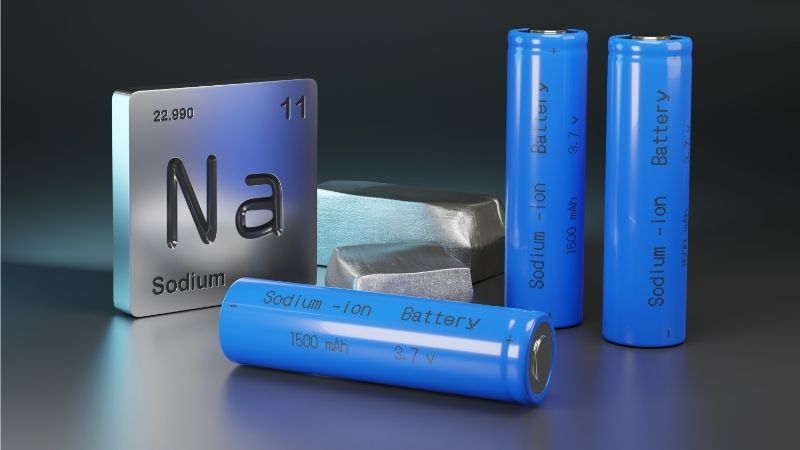
Sodium-ion batteries. Image used courtesy of Adobe Stock
Why Sodium
Sodium-ion batteries are strong candidates for grid-scale storage because sodium is cheap and abundant. It’s also easy to integrate into current lithium-ion manufacturing. But sodium ions are larger than lithium and form more complex structures in solution, which can make them harder to stabilize, especially at high concentrations.
This is where ionic liquids (ILs) come in. Their low volatility, thermal stability, and tunable chemistry make them ideal candidates for safer battery electrolytes. Protic ILs, which contain hydrogen bond donors, can offer improved ion mobility and lower viscosity compared to their aprotic counterparts. But tradeoffs remain, such as strong electrostatic interactions within the liquids, which can hinder conductivity. Scientists know little about how sodium behaves in these complex environments at the molecular level.
To close that gap, the researchers used advanced simulations that capture subtle polarization effects to examine how sodium ions behaved in both protic ionic liquids (which can donate protons) and aprotic ionic liquids (which cannot) at different salt concentrations.
Using CL&Pol polarizable force field, a computational framework capable of capturing subtle polarization effects in ion interactions, they simulated four IL systems—three protic, one aprotic—at varying concentrations of sodium trifluoromethanesulfonimide (NaNTf2), adjusting parameters for each cation species to ensure fidelity across all systems. The result is one of the most comprehensive molecular-level datasets yet produced on sodium-ion solvation in IL-based electrolytes.
Coordination Shells to Ionic Aggregates
The team’s simulations showed that as NaNTf2 concentration increases, sodium ions replace IL cations in the anion's solvation shell, favoring smaller, more compact coordination environments. Across all systems, sodium ions preferred to coordinate with the NTf2- anion in a monodentate mode, where it binds to just one oxygen atom, especially at higher salt concentrations. This shift away from bidentate binding allows more sodium ions to be packed into the same volume, which in turn promotes the formation of polymer-like ion chains.
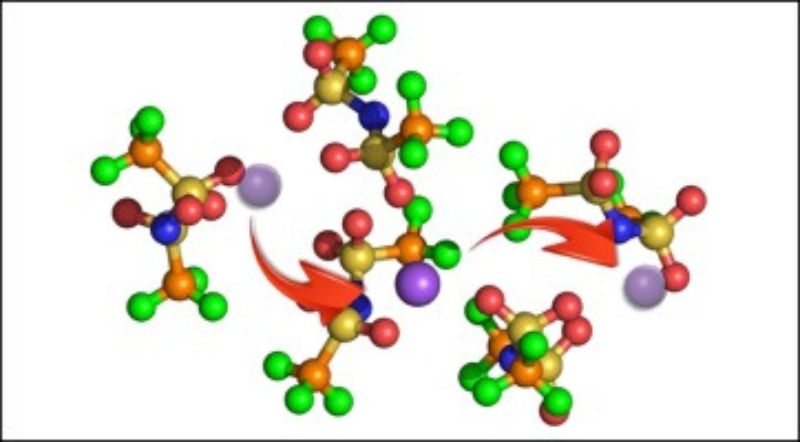
Concept of ionic activity. Image used courtesy of Lourenço et al.
These effects influence transport and performance. The potential of mean force calculations showed that energy barriers for ion movement decrease as concentration increases, especially in protic systems. That suggests higher conductivity could be achieved even in salt-rich environments, as long as the electrolyte structure promotes this kind of solvation behavior.
Protic ILs also led to larger sodium coordination numbers and more extensive sodium ion-sodium ion aggregation. In systems with smaller cations, nearly all sodium ions became part of a single, connected network at the highest salt concentration, demonstrating a percolating phase that could facilitate fast ion transport or, depending on context, increase viscosity and reduce mobility. Either way, the data can help clarify what happens as real battery systems push toward high-density, high-capacity regimes.
Implications for Electrolyte Design
The study highlights design strategies for building safer, higher-conductivity electrolytes. Protic ionic liquids, for example, may handle high salt loads better, while the size and hydrogen bonding ability of the cation can help control clustering. The researchers also validated their models against experimental density data, increasing confidence that these trends reflect real systems.
This modeling work doesn’t replace experimentation, but it does accelerate it. By identifying which solvation modes and aggregate formations are favorable, researchers can narrow down the search space for new electrolytes. That’s a powerful advantage in a field where development cycles are long and materials are expensive.
The study appeared in the Journal of Molecular Liquids.