Facebook
 Google
 GitHub
 Linkedin
Ford Shakes Up EV Assembly With Its Universal Platform
Ford claims its innovative electric vehicle assembly line will speed up production, lower costs, and increase worker safety.
Almost all major automobile manufacturers make electric vehicles. While the specifics vary from manufacturer to manufacturer, all EVs are manufactured similarly, using the same general steps. However, that could be about to change, and the result could be more affordable EVs, according to Ford Motor Company.
Learn why Ford claims its new Universal EV Platform is a “Model T moment.” Video used courtesy of Ford
Ford has developed an EV manufacturing method called the Universal EV Production System that saves time, improves personnel safety, and could lower EV costs dramatically. The company is investing $5 billion into the assembly line, including $2 billion to transform the existing Louisville Assembly Plant, with the first production set for 2027. Ford claims the method will produce an EV truck with a starting price as low as $30,000.
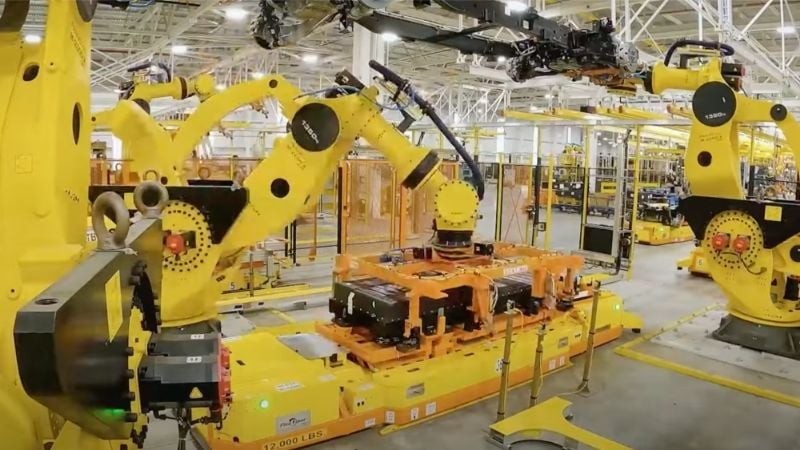
Ford Motor assembly line. Image used courtesy of Ford
Assembling EVs the Conventional Way
EVs are manufactured similarly to internal combustion engine (ICE) vehicles, but the process does vary because components differ between EVs and ICE vehicles, particularly the engine and powertrain. EVs have a battery-powered motor instead of a gasoline- or diesel-powered engine.
When manufacturing an EV, all the internal components are assembled first. This starts with the gearbox (assembled in two parts), followed by assembling the electromagnetic system—the rotor and the stator. The electromagnetic system is then attached to the gearbox to create the drivetrain, which is fitted with cables that will eventually attach to the battery.
The chassis is preassembled, and the drivetrain is lowered into the vehicle’s rear and attached to a drive axle and suspension. The assembled parts are lowered onto the powertrain and battery pack. This process differs from ICE vehicle manufacturing, where the engine is loaded into the vehicle. The wirings are then attached. Once the car's inner parts are assembled, the body panels, seats, and other key parts—charging port, lights, aesthetic features, etc.—are assembled on a production line to produce the finished car.
The Ford Universal EV Assembly Line
Ford’s Universal EV Production System presents a new way to assemble EVs. Unlike the conventional approach, which uses one long conveyor system, this method uses three sub-assembly lines called branches. These mini-assembly lines combine at the end to put the total vehicle together. This manufacturing approach has been called an “assembly tree.”
_vs._Ford’s_“assembly_tree”_(bottom)_.jpg)
Conventional assembly line (top) vs. Ford’s “assembly tree” (bottom). Image used courtesy of Ford
The vehicle’s front and rear are assembled using separate assembly lines in this approach. The assembly tree’s third branch comprises the battery, which is preassembled with the seats, console, and carpeting. The three assembly branches converge at the end of the assembly line. Throughout the process, large single-piece aluminum unicastings replace dozens of smaller parts, enabling separate assembly of the vehicle’s front and rear.
The sub-assembly lines allow operators to work with all the correct equipment, scanners, and fasteners for specific operations, saving time and improving personnel safety. Ford stated that the platform reduces the number of required parts by 20% compared to conventional EV manufacturing and uses 25% fewer fasteners. This platform also requires 40% fewer workstations due to the optimized lines, resulting in a 15% faster assembly time.
A new midsize EV truck will be the first to be produced on this platform. It will have 1.3 km less wiring and be 10 kg lighter than Ford’s first-generation EV.
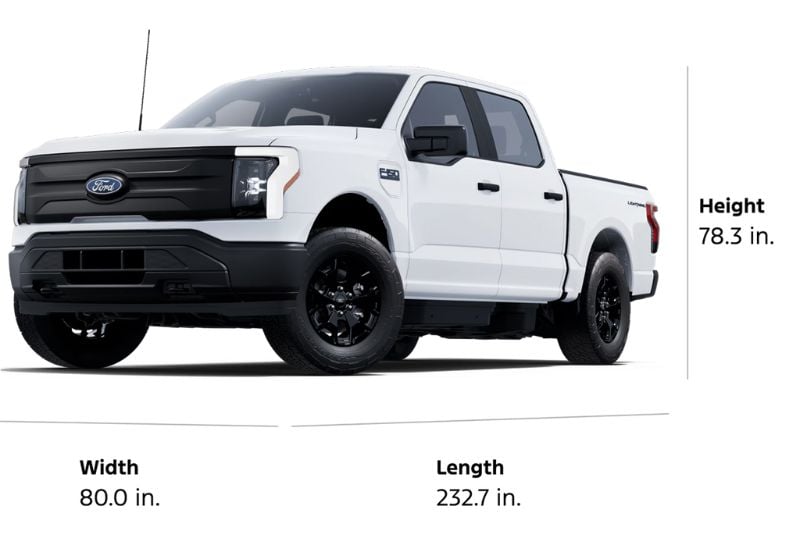
The midsize EV truck using Ford’s Universal Platform will be smaller and lighter than the 2025 EV Lightning. Image used courtesy of Ford
First EV Debuts in 2027
Ford will assemble its midsize electric truck on the new Universal EV Platform in 2027. According to Ford, it will be as quick as a Mustang EcoBoost but with more passenger carrying capacity than a 2025 Toyota RAV4, plus a truck bed. The truck is set to have a starting MRSP of around $30,000.