Facebook
 Google
 GitHub
 Linkedin
Potassium-Ion Batteries May Top Sodium-Ion in Energy Density
Researchers at Dongguk University reviewed potassium-ion batteries’ potential as high-energy-density, cost-effective alternatives to lithium- and sodium-ion systems.
In the shift toward electrification and renewable energy, the limitations of lithium-ion batteries are becoming increasingly apparent. While lithium-ion technology has enabled widespread adoption of electric vehicles and portable electronics, concerns about cost, resource availability, and geopolitical supply constraints have driven interest in alternative battery chemistries.
Sodium-ion batteries are among the most commercially mature of these alternatives, but research increasingly suggests that potassium-ion batteries (KIB) may offer even greater performance potential.
Researchers at Korea’s Dongguk University reviewed progress in KIBs, focusing on anode material development. The team found that KIB batteries have electrochemical advantages that could lead to higher-density energy storage for renewable energy and other applications.
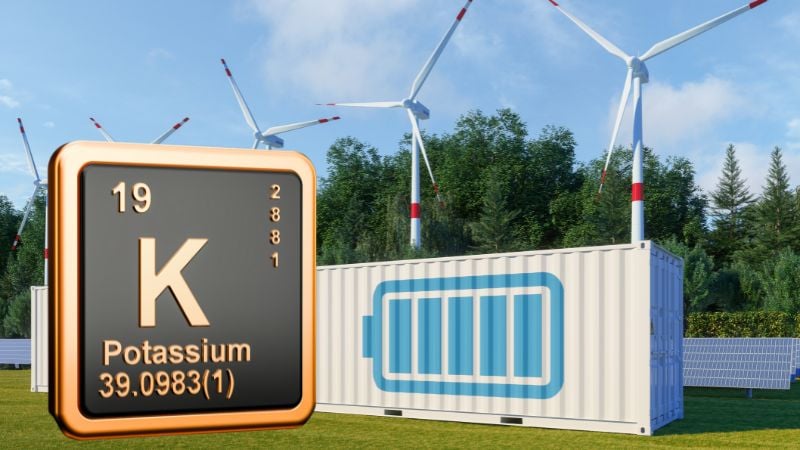
Potassium-ion batteries could offer better energy storage performance. Adapted from images used courtesy of Canva
Why Potassium?
Potassium (K) is significantly more abundant than lithium and comparably as accessible as sodium. However, what gives KIBs an edge over sodium-ion systems is the lower redox potential of potassium, which allows for higher cell voltages and greater energy density.
Additionally, while potassium ions are larger than lithium ions, their solvated (Stokes) radius in common electrolytes is smaller, resulting in lower desolvation energy and superior ionic conductivity. These properties translate to potentially faster charge and discharge cycles, provided the electrode and electrolyte systems are properly engineered.
The researchers pointed out a key design advantage. Unlike lithium, potassium does not react with aluminum current collectors within the typical anode voltage range. This allows both the anode and cathode to use lightweight, cost-effective aluminum instead of heavier copper, further reducing material costs for large-scale applications.
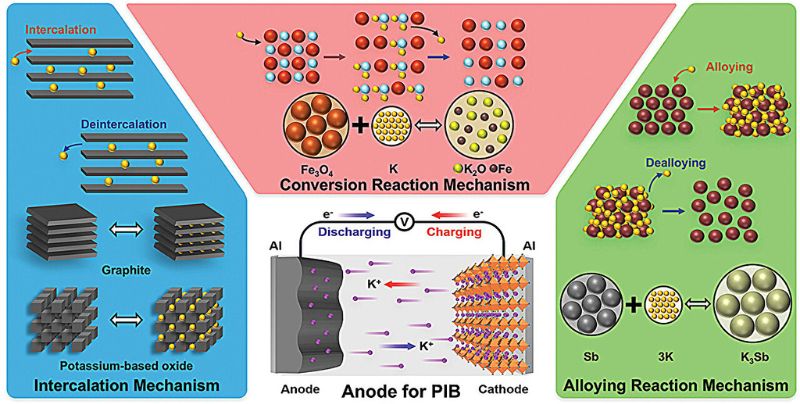
Dongguk University’s review lays a solid foundation for future work in potassium-ion batteries. Image used courtesy of Lee, Lee, & Lim
The Role of Anode Materials
High-performance anode materials are essential for capitalizing on potassium’s electrochemical properties. The researchers categorized KIB anodes into three primary reaction mechanisms: intercalation, alloying, and conversion. Each mechanism offers different trade-offs in terms of capacity, structural stability, and long-term performance.
Intercalation involves the reversible insertion of K⁺ ions between the layers of a host material. Graphite can theoretically intercalate potassium to form KC₈, offering a capacity of ~279 mAh/g. However, the larger size of K⁺ ions leads to significant volume expansion, structural strain, and sluggish kinetics.
To address this, previous researchers have explored expanded graphite, porous carbon, and nitrogen-doped carbon nanofibers. One standout example is mesoporous carbon spheres with open-ended channels, which reduce ion diffusion lengths and improve rate capability. These materials have shown enhanced electrochemical performance by promoting surface-controlled reactions and accommodating volume changes during cycling.
_and_discharging_(b)_process_in_a_KIB.jpg)
The charging (a) and discharging (b) process in a KIB. Image used courtesy of Lee, Lee, & Lim
Alloying anodes can store multiple potassium ions per metal atom, offering much higher theoretical capacities than intercalation materials. Tin (Sn), antimony (Sb), silicon (Si), and phosphorus (P) are commonly studied for this purpose. However, the alloying process introduces massive volume changes, leading to mechanical degradation.
Conversion anodes offer the highest theoretical capacities by transforming metal compounds into metallic nanoparticles and potassium compounds during cycling. Materials like Fe₃O₄, MoS₂, and Sb₂S₃ fall into this category. However, conversion reactions suffer from high reaction overpotentials, irreversible capacity loss, and severe structural changes.
To mitigate these issues, researchers are experimenting with amorphous phases, core-shell structures, and hybrid composites. One promising development involves amorphous FeVO₄/carbon composites, which deliver over 350 mAh/g and maintain near 100% Coulombic efficiency over thousands of cycles. Similarly, MoS₂/graphene hydrogels leverage a dual intercalation–conversion mechanism to improve both rate performance and volumetric capacity.
Engineering Toward Commercialization
While the foundational chemistry of KIBs is promising, commercialization depends on the ability to engineer stable, scalable, and cost-effective systems. Dongguk University’s review emphasizes several critical paths forward:
- Electrolyte formulation: Optimizing solvents and potassium salts to stabilize the SEI and reduce side reactions.
- Interface engineering: Designing robust electrode-electrolyte interfaces to support high-rate performance.
- Material scaling: Developing synthesis routes that are compatible with industrial-scale manufacturing.
The team plans to build on this groundwork by using in-situ analytical tools to better understand the structural and chemical changes occurring during battery operation. With lithium prices soaring and global supply chains under pressure, potassium-ion batteries represent a timely and technically viable alternative. Although sodium-ion batteries are closer to market, KIBs may eventually surpass them in performance, particularly for grid-scale storage and applications requiring high energy density.
Dongguk University’s review lays a solid foundation for future work and identifies the critical research areas needed to bring potassium-ion batteries from lab to market.