Facebook
 Google
 GitHub
 Linkedin
Sunny-Side Up: The Truth About End-of-Life Solar Panels
Can solar panels last longer than the manufacturer’s “use by” date? A Texas recycling company has a plan.
Many solar enthusiasts know how long their panels may last based on the manufacturer’s warranty. However, this is not the actual end of their life cycle. Worldwide, innovators are revising expectations about solar panel life spans to extend the materials’ usefulness for at least another decade.
How can recycling solar panels create a circular economy? Video used courtesy of SolarCycle
New initiatives to extend the usefulness of solar panels will have a global impact on the circularity of solar generation technologies, changing the priorities of electrical engineers and recycling facilities.

Solar panels. Image used courtesy of Unsplash
Solar Panels: Reusing and Recycling Again
A solar system in Odessa, Texas, will use solar panels made entirely from recycled materials recovered from used panels. The 500 kW array is the first solar facility to “close the loop” in the recycling process.
SolarCycle built the system using solar panels from households and businesses like Sunrun and Ørsted. When the array reaches its true end-of-life in another five to 10 years, the panels will head to recyclers for repurposing.
The effort shows how engineers can scrape more utility from electronics destined for landfills. When their capacities are truly sapped, professionals are ready to send the panels on a circular path.
Failure to reclaim and recycle metals and other materials is a significant stain on solar’s reputation, harming its public buy-in. Stakeholders and panel designers desiring to be a part of the solution will engage in these necessary strategies:
- Make electronics more straightforward to take apart
- Remove costly and toxic materials
- Lengthen life spans
- Enhance recycling techniques, accessibility, and processes
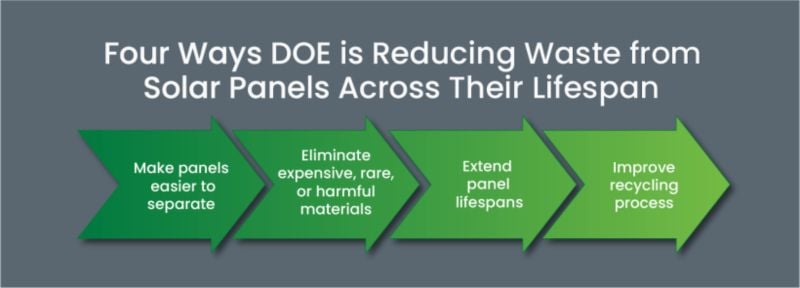
Recommendations to reduce solar panel waste. Image used courtesy of the Department of Energy
SolarCycle’s Odessa array exemplifies how the industry can reframe its definition of “end of life.” While a panel may have lived through its warranty and lost some of its production capacity, it still has value. Solar still produces around 80% of its starting output after an estimated 25 years of operation.
Engineering Challenges in Solar Decommissioning
Solar engineers have leaned into building-integrated photovoltaics (BIPV). Seamlessly integrating solar early in construction designs is promoted as a critical facet of advancing decarbonization. However, BIPV could cause stopgaps if decommissioning becomes a routine aspect of renewable operations.
Buildings will require unprecedented constructional malleability to remove and accept new panels. In the coming decades, design advancements could shift everything from panel shapes to weight. Electrical workers must collaborate closely with architects to anticipate these shifts so BIPV can be decommissioned as simply as other arrays.
Additionally, solar panel makers and designers will encounter numerous conventional difficulties solar faces when finding homes for decommissioned panels. Land use debates will still cause project delays and legal challenges alongside non-comprehensive policies, which could confuse which aspects of the decommissioning process are the party’s responsibility. This includes rehoming, installation, transportation, and materials handling.
The Industry-Wide Changes Decommissioning Will Create
Installations with high upfront costs or regions with minimal solar access are ideal locations for setting up decommissioning projects. Engineers will see an influx of floating solar panels installed on bodies of water to provide renewable energy to densely populated areas. Placing panels in unintuitive areas will bridge retrofitting activities with decommissioning ideals.
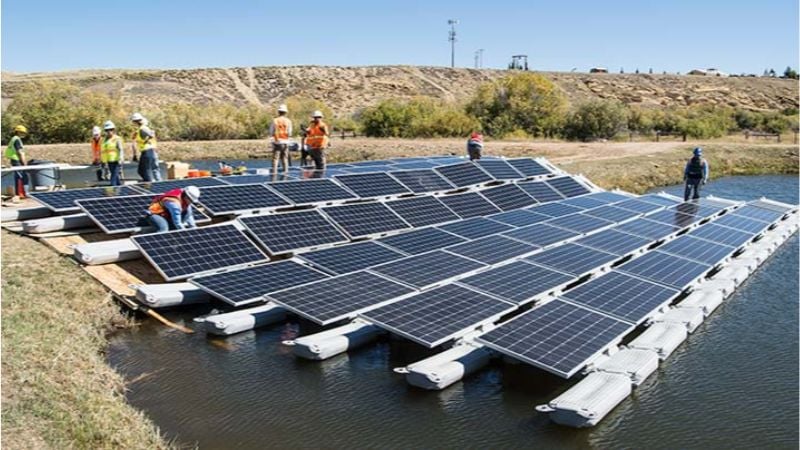
Floating solar panels. Image used courtesy of National Renewable Energy Laboratory/Dennis Schroeder
Designers must rework racking systems or curate what panels go into these arrays. For example, the bifacial gain for floating panels is 4.57%, compared to 2.51% on land. These factors will influence where specific panel types go after customers decommission them. Experts will be responsible for allocating the panels to applications where they can obtain the most significant returns.
Many engineers suggest retrofitting panels with new technologies, like transformers and inverters, to upgrade them past their perceived shelf life. However, there is more value in returning land to its original state before solar installations, incorporating new equipment, and rehoming the aged panels for other applications. Industry experts see this as more lucrative, so much so some states have begun requiring decommissioning plans from solar projects.
The priority shift will change the workflow for solar designers and engineers by focusing on deconstruction and crafting advanced panels from scratch instead of compatibility and retrofits. It will still be essential to a circular economy's clean energy transition equation, primarily as material incorporations change to more accessible, sustainable alternatives. Retrofits prevent supply chain disruptions and ease pressures on natural resource extraction.
Decommissioning’s Future
The solar workforce will take SolarCycle’s revolutionary project and recreate a world where panels live and operate for over half a century before being taken apart. Sector experts could anticipate future panels with advanced technologies and durability to decommission and continue generating energy for nearly a century, depending on how fast researchers forge the perfect panel. Secondhand panels will become the new norm for facilities, especially to help alleviate burdens on the demand for budding recycling infrastructure.