Facebook
 Google
 GitHub
 Linkedin
Emerson, UT Partner To Advance Semiconductor and AI Research
The collaboration will upgrade University of Texas lab facilities and accelerate research and training in energy, semiconductors, and AI automation research.
The collaboration will upgrade University of Texas lab facilities and accelerate research and training in energy, semiconductors, and AI automation research.
As global demand for advanced technologies grows, the need for cutting-edge semiconductor research, development, and manufacturing capabilities has intensified. At the same time, the industry's workforce requires an ever-increasing level of expertise to harness the benefits of traditional and emerging domains like artificial intelligence and automation. These factors, combined with aging infrastructure and rising operational complexity, leave much room for improvement in meeting modern technology demands.
An initiative between Emerson and The University of Texas at Austin seeks to address these concerns through semiconductor research and training. This academia-industry partnership could prove fruitful in AI-based automation.
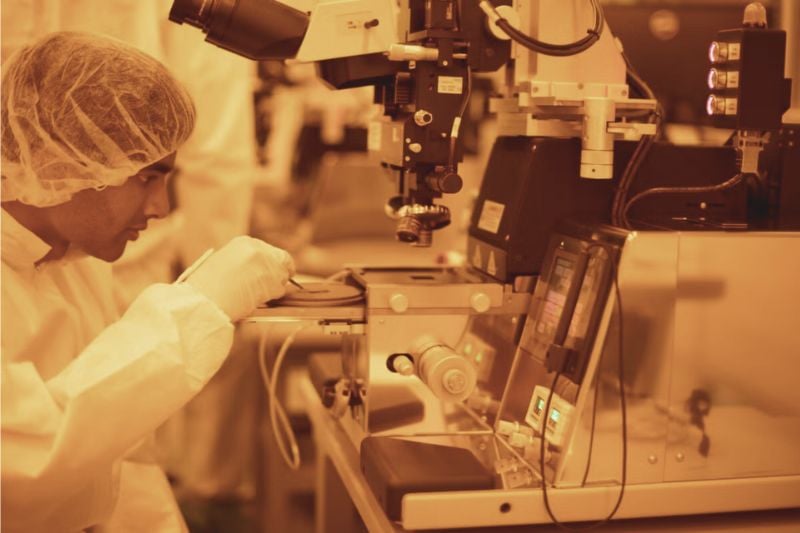
Semiconductor research. Image used courtesy of University of Texas
AI Automation in Semiconductor Industry
AI and automation have become hot-button topics in nearly every industry worldwide in the last few years. In fact, about 44% of companies today are pursuing significant AI investments, with projections suggesting that leveraging AI could add up to $15.7 trillion to the global economy by 2030.
AI generally falls into two categories: automation, which reduces human labor, and augmentation, which boosts human intelligence and performance.
In the semiconductor industry, manufacturing faces challenges from high-mix, low-volume production, which shortens cycles and increases product variation while intensifying cost and quality pressures. Every phase of semiconductor processing, from lithographic design rule specifications to yield analysis, relies on precise, dependable data for critical dimension patterning and material composition.
In lithography, geometric patterns are transferred from a mask to a thin resist layer on a wafer, enabling the continual reduction of device dimensions driving nanotechnology. Registration accuracy, which measures the precise alignment of successive masks with established wafer patterns, is essential for exposure performance.
Generally speaking, manually adjusting registration accuracy is slow and could lead to misalignments, ultimately causing defects, low yield, and reduced device performance. Therefore, an intelligent automated process could have major implications on the overall workflow productivity.
The UT-Emerson Partnership
The Emerson and UT Austin partnership is an exciting step forward for semiconductor and AI research. Specifically, it focuses on introducing modern upgrades to UT Austin facilities, including state-of-the-art data acquisition and process control systems. The collaboration will modernize UT Austin’s Montopolis Research Center, replacing decades-old supervisory control and data acquisition systems with high-performance digital instrumentation. This upgrade will introduce real-time monitoring capabilities for semiconductor processing parameters, such as temperature, pressure, and chemical compositions during material deposition and etching cycles.

Rendering of state-of-the-art lab facility at UT. Image courtesy of UT News
Enhancements to the Process Science and Technology Center at the J.J. Pickle Research Campus will also support research in AI-enabled automation.
Additionally, a new Engineering Discovery Building, slated for completion in 2026, will incorporate a signature Emerson Lab outfitted with modular test and measurement setups capable of processing gigahertz frequency signals and conducting detailed system diagnostics.
This series of developments, valued at $8.5 million for the current agreement and with overall contributions exceeding $20 million, hopes to deliver the infrastructure necessary for a nation-leading automation research program.
Future Outlook
Emerson and UT Austin hope that their joint initiative will open avenues for synergy between academia and industry, refine manufacturing practices, and develop more skilled professionals to meet the growing demands facing the semiconductor industry and workforce.