Facebook
 Google
 GitHub
 Linkedin
ChargePoint’s Level 2 AC EV Charger Offers Bidirectional Use
The charging technology delivers 80 amps at 19.2 kW for electric vehicle charging in as little as four hours.
As electric vehicle adoption accelerates, charging infrastructure must evolve to meet rising expectations around speed, flexibility, and grid integration. Most Level 2 AC chargers in operation today deliver between 30 and 40 amps, which is sufficient for overnight home charging but inadequate for faster turnaround in fleet or multifamily environments.
To address this shortcoming and boost AC charging performance, ChargePoint has recently launched an architecture that doubles traditional output and integrates full bidirectional capability into a software-defined platform.
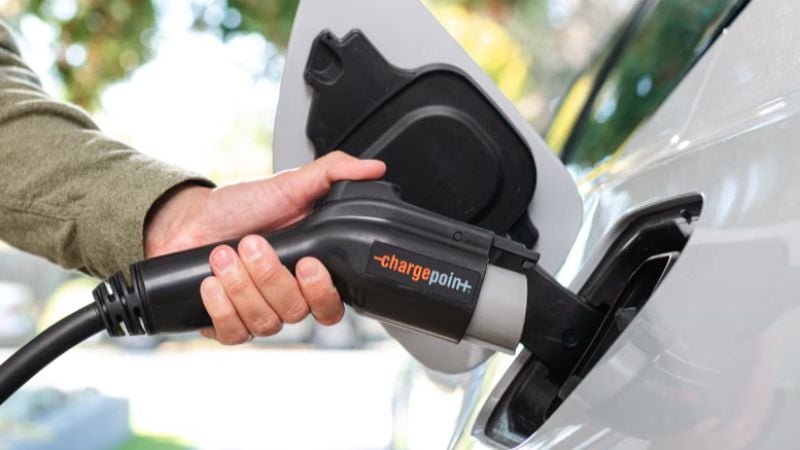
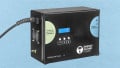
ChargePoint has integrated bidirectional charging into Level 2 chargers. Image used courtesy of ChargePoint
Why Bidirectional AC Charging Has Lagged Behind DC V2X
Bidirectional AC charging has historically lagged behind DC-based vehicle-to-everything (V2X) solutions due to both hardware and protocol constraints. While AC charging infrastructure is more widespread and cost-effective, the requirement to invert power within the vehicle has limited bidirectional abilities. In AC V2X systems, the onboard charger must include a bidirectional inverter that can rectify grid power to charge the battery and invert DC battery power to export it as AC. This places thermal, cost, and complexity burdens on the vehicle, which most OEMs have avoided in favor of offboard DC solutions.
In contrast, DC V2X systems shift the complexity to the charger, which houses the bidirectional inverter and handles all AC-DC conversion. This allows tighter control over power quality and protocol handling. However, DC systems’ high cost, bulk, and permitting complexity limit their deployment to fleet depots and high-end residential applications. As a result, DC V2X remains niche.
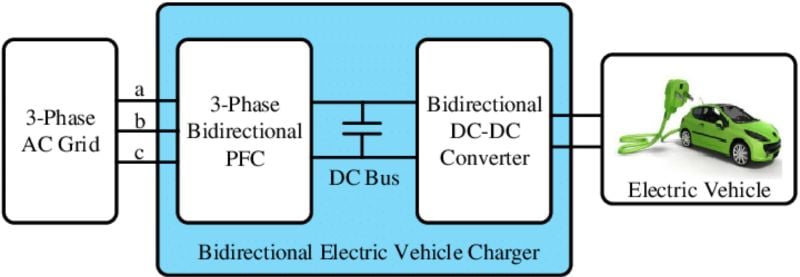
Bidirectional EV charger. Image used courtesy of Xuan et al.
The absence of standardized communication protocols for AC V2X has also hindered progress. While ISO 15118 provides a framework for bidirectional communication, widespread adoption remains inconsistent, and integration with grid management systems varies by region. In the U.S., for example, utility programs for AC-based energy feedback are still emerging and lack uniform technical guidelines or economic incentives. Safety certification has posed another barrier, as standards bodies have been slow to approve vehicle-side inverters for grid export.
ChargePoint’s New Charging Tech
ChargePoint’s new AC Level 2 charging architecture consolidates bidirectional functionality, high-power throughput, and intelligent load management into a unified platform. Notably, the system delivers 80 amps at 19.2 kW, which doubles the output of many existing AC chargers and reduces typical EV charge times to around four hours. Designed to operate across residential, commercial, and fleet environments, this platform also introduces full V2X capability. Drivers can discharge energy from their EVs back into homes, buildings, or the grid.
To address infrastructure constraints, the architecture supports dynamic load balancing so that electrical power can be reallocated within a facility to maximize charging speed without overloading circuits. It also supports series wiring to allow multiple chargers to operate on a shared connection. With such a feature, users can choose to upgrade their solutions in the future without completely overhauling the existing installation.
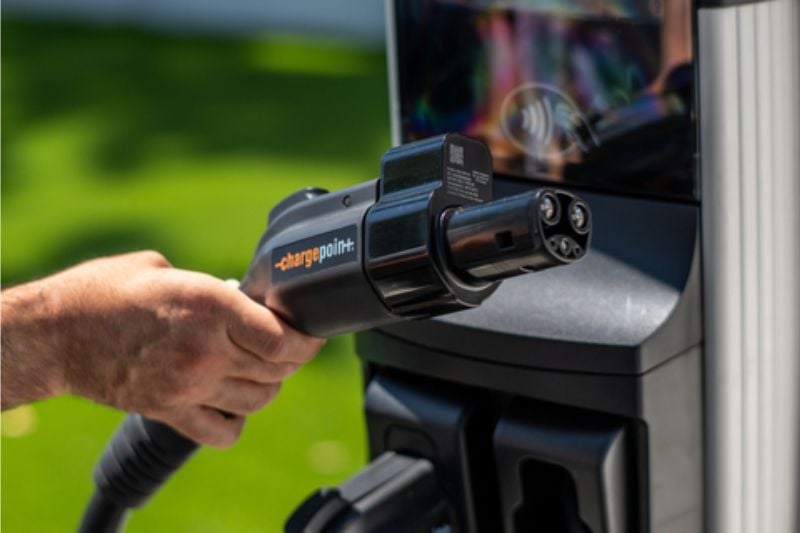
ChargePoint’s Omni Port. Image used courtesy of ChargePoint
From a compliance perspective, ChargePoint designed this architecture to meet both U.S. and European regulatory requirements, including Energy Star, MID, and Eichrecht. Other features include interoperability with smart energy ecosystems and the inclusion of ChargePoint’s Omni Port to support all major North American connector types through a single port.
Moving Forward
By integrating power electronics, communications, and software controls into a single platform, ChargePoint’s solution could improve the widespread adoption of AC charging solutions. Production will begin in Europe in mid-2025, with North American models expected later in the year.