Facebook
 Google
 GitHub
 Linkedin
Business Shorts: Helion, Tesla/Lucid and Stargate Make Moves
Energy and electric vehicle companies are pushing ahead with fusion, data center AI, and charging capabilities.
Big players in energy and electric vehicles are making significant strides in 2025, expanding fusion power development, data center infrastructure, and next-generation EV charging.
Assembling a nuclear fusion system. Video used courtesy of Helion Energy
Recent developments include a $425 million funding round for fusion startup Helion, a solar and battery project for OpenAI’s Stargate initiative, and advancements in Lucid Motors’ EV charging capabilities.
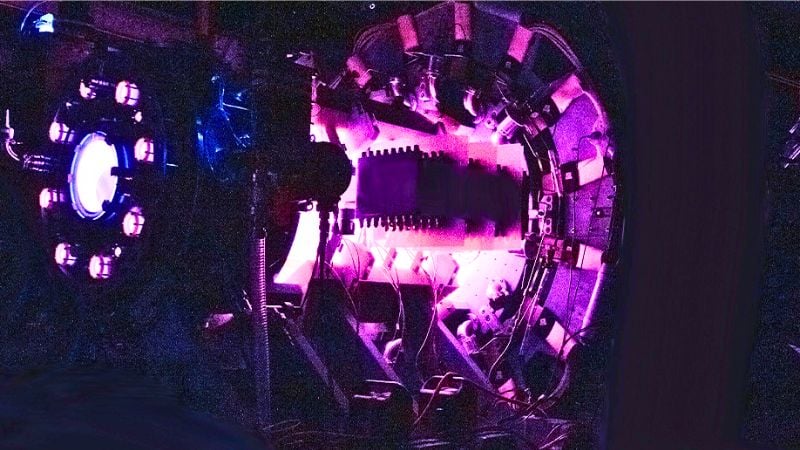
Helion Energy’s Polaris fusion prototype. Image used courtesy of Helion Energy
Helion Raises $425M for Fusion System to Serve Microsoft
Washington-based fusion startup Helion Energy secured a $425 million funding round to scale up its U.S. manufacturing capacity for magnets, semiconductors, and capacitors—all essential components in its first 50 MW fusion power plant. The facility, expected to come online by 2028, will supply power to Microsoft data centers as the tech giant continues expanding its AI services.
Besides Microsoft, Helion has another major customer lined up: Steel producer Nucor plans to source power from a 500 MW fusion plant in the 2030s.
Helion’s magneto-inertial fusion system uses a field-reversed configuration. This method generates electricity directly from a pulsed fusion reaction by harnessing magnetic fields to induce a current. The company is currently developing its seventh prototype, Polaris, with a higher magnetic field strength and pulse rate. The last iteration, Trenta, successfully reached a 100 million °C fuel temperature. Although this milestone meets the temperatures necessary for a commercial plant, Helion has not yet achieved a sustained net energy gain.
Expecting high demand for its product, the company has steadily built up its in-house manufacturing capabilities to output over 40 high-voltage pulsed capacitors per week as of 2024. Helion is currently looking to fill several technical job openings, including for electrical and mechanical engineers.
The latest investment round brings Helion’s total funding to more than $1 billion, raising its valuation to $5.4 billion. The company attracted new names like SoftBank Vision Fund 2 and Lightspeed, alongside existing investors such as OpenAI CEO Sam Altman and Facebook co-founder Dustin Moskovitz, who were both early backers of the 12-year-old startup.
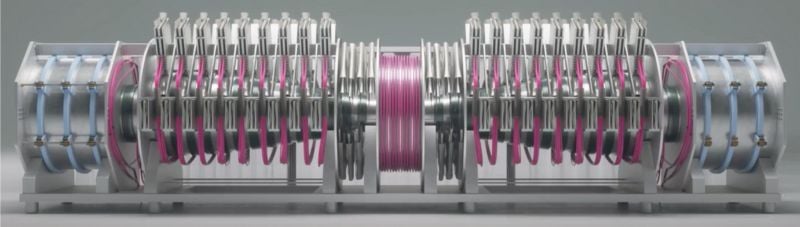
A rendering of Helion’s fusion generator. Image used courtesy of Helion Energy
Private investments in fusion technology have accelerated over the last few years. According to the Fusion Industry Association, the market has attracted over $7 billion in investments (as of 2024). Nearly 90% of fusion companies expect to have grid-connected power plants by 2035.
Stargate Eyes Solar Power and Battery Storage
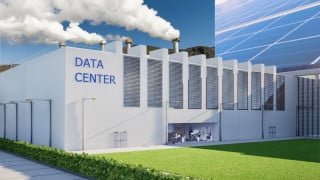
The rapid expansion of artificial intelligence is causing a sharp rise in electricity consumption at data centers across the U.S. According to a recent GridStrategies report, industry analysts estimate that data center demand will grow by 10-65 GW from 2024 to 2029. However, utilities’ five-year aggregate load forecasts place that number even higher at 90 GW, accounting for about 10% of the projected load.
This expansion will require significant investments in energy infrastructure, a critical focus of the new Stargate Project led by OpenAI and SoftBank. The initiative will infuse $500 billion into AI development over the next four years, including $100 billion for supporting infrastructure and data centers.
SB Energy, a SoftBank-backed company already supplying power to Google data centers, has reportedly been tapped to contribute solar and battery systems to the Stargate Project. According to Bloomberg, SB Energy will provide digital infrastructure and power generation. However, details on specific projects and plans remain limited.
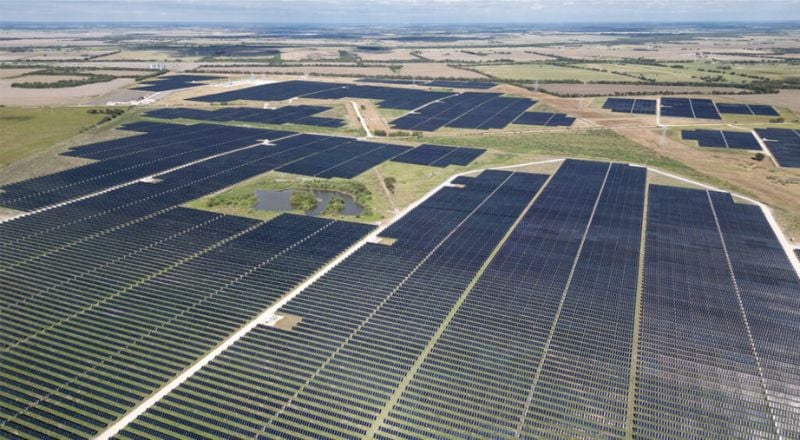
SB Energy’s Orion Solar Belt project in Texas came online last year. Image used courtesy of SB Energy
SB Energy has completed its 900 MW Orion Solar Belt project, which uses 1.3 million solar modules to power Google’s data center facilities in Texas. The company is developing other sites across the U.S. today, with a project pipeline exceeding 15 GW of solar and 12 GWh of storage capacity.
SB Energy sources its modules from Waaree Energies, an India-headquartered solar manufacturer with a growing U.S. presence. The two companies signed a long-term supply deal in 2023, covering multiple gigawatts of solar modules for five years.
Lucid Enables Tesla Supercharger Access for Gravity SUV
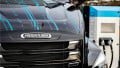
In late January, Lucid Motors announced that Gravity drivers could start fast-charging their electric SUVs through Tesla’s Supercharger network, opening access to more than 20,000 chargers. The move makes Gravity, Lucid’s second model, the first non-Tesla vehicle sold with ports supporting Tesla’s North American Charging Standard (NACS). Lucid joins a growing list of automakers, including Ford and General Motors, planning to adopt NACS charge ports in new models.
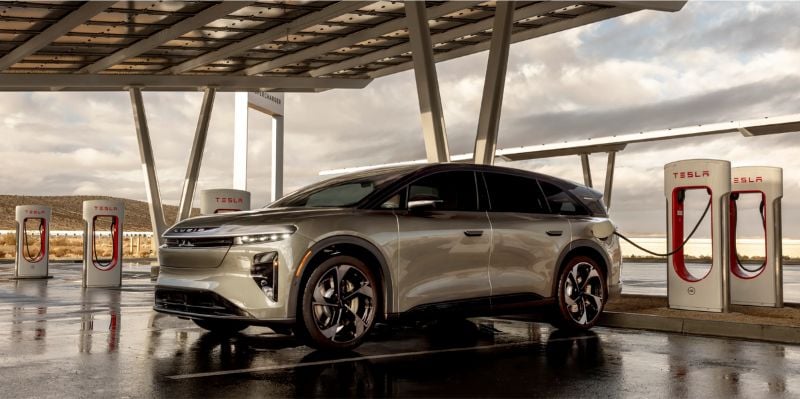
A Lucid Gravity SUV juices up at a Tesla Supercharger station. Image used courtesy of Lucid Motors
To make Gravity compatible with 500 V and 100 V charging networks, Lucid boosted the 500 V charging voltage in the rear motor drive to serve the 926 V battery pack. This feature allows the SUV to use the highest voltage available at charging stations, including up to 400 kW on 1000 V equipment and 225 kW on 500 V fast chargers like Tesla’s V3 Supercharger.
Gravity’s 926 V powertrain uses a compact 123 kWh battery paired with an advanced cooling system for high-performance charging. The vehicle also features a new Panasonic battery cell, enabling an estimated range of up to 450 miles and faster charging times.
Gravity also includes CCS1- and SAE J1772-to-NACS adapters. Lucid will also roll out Supercharger access for its Air sedan in the second quarter of 2025.