Facebook
 Google
 GitHub
 Linkedin
Microsoft Bets on Fusion for AI Energy Solution
Could harnessing the sun’s power source unlock limitless emissions-free electricity to counter AI computing demand?
Microsoft aims to be carbon-negative by 2030, but progress remains stalled by its energy-intensive artificial intelligence software. The tech giant’s energy consumption rose nearly 30% last year to 24 TWh, while its emissions grew 29% from a 2020 baseline.
How Helion creates energy from fusion. Video used courtesy of Helion
Microsoft is increasingly procuring solar power and investing in renewable projects to offset its carbon footprint. However, its long-game solution targets a far more advanced form of clean energy that has yet to hit the market. By the decade’s end, the company could be among the first customers receiving fusion power from Washington-based startup Helion Energy, which has spent 11 years developing a magneto-inertial process to generate electricity from super-hot plasma. Last year, Microsoft agreed to purchase power from Helion’s first fusion plant, slated to come online in 2028 with an initial 50 MW.
Helion is developing its seventh prototype, targeting net electricity generation from pulsed fusion reactions. The last iteration ran over 10,000 pulses to reach 9 keV with 104 million°C plasma temperatures—nearly seven times hotter than the sun’s 15 million°C core. The company is now finalizing its next-generation device, Polaris, with a stronger magnetic field and 100x faster pulse rate.
Specific terms of the Microsoft deal are undisclosed. However, The Washington Post reported that the contract is binding and Helion could face financial penalties for delays. Brad Smith, Microsoft’s vice chair and president, recently visited Helion’s facility earlier this year to get a firsthand look at its progress.
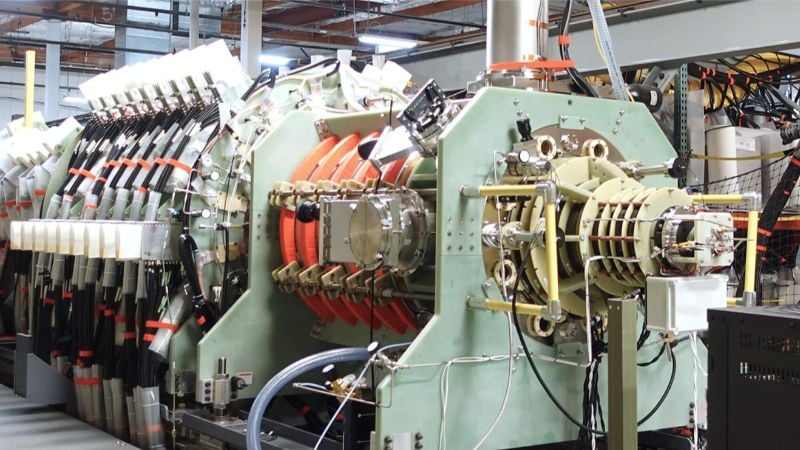
Helion’s fusion energy prototype. Image used courtesy of Helion Energy
A Theoretically Limitless Energy Source
Fusion technology is gaining traction for its theoretical promise of a limitless energy supply. According to the International Energy Forum, fusion provides nearly four million times more energy than fossil fuels like coal and gas. It also quadruples that of conventional nuclear fission.
Fusion offers many advantages over fission, the process behind nuclear power plants. It uses abundant hydrogen isotopes like tritium and deuterium and produces little radioactive waste with no meltdown risk from overheating.
Helion Energy is one of many companies harnessing fusion for electricity. Competitors are at various stages of development. In a recent Fusion Industry Association survey, nearly 90% of fusion companies expected the resource would serve the power grid by the late 2030s. In the meantime, two-thirds of respondents cited power efficiency as a significant technical challenge between today and 2030.
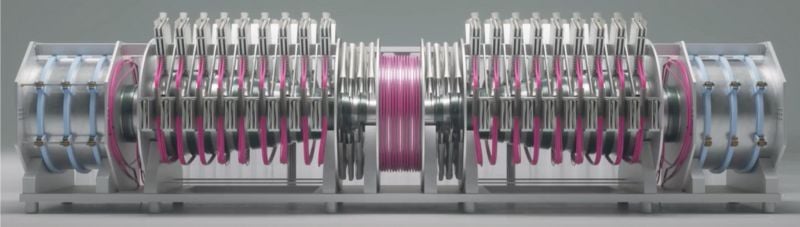
Rendering of Helion’s magnetized vacuum chamber. Image used courtesy of Helion Energy
Helion achieves efficiency by recovering unused electricity. Early testing without plasma demonstrated that electricity stored in capacitors could be converted to magnetic fields and then retrieved with 95% efficiency. Its non-ignition approach can directly recover unused and new electromagnetic energy, similar to regenerative braking in a car. In contrast, other fusion methods lose energy when heating water into steam for turbines.
How Does It Work?
Helion Energy’s early development work considered tritium, deuterium, and helium-3 as potential fuel sources—all of which can be heated to plasma conditions in gaseous forms to create practical reactions. However, a combination of deuterium and helium-3 (D-He-3) presented the best benefits. Although it requires 200 million°C temperatures and a stronger magnetic pull to maximize electricity capture, magnets can always be strengthened, and circuits can be improved for efficiency.
Ultimately, the company favored D-He-3’s 18.3 MeV energy yield, higher than tritium. Electricity can also be recovered from the fusion process without thermal conversion, thus avoiding expensive steam turbines or cooling equipment.
Helion’s fusion energy process injects deuterium and helium-3 gasses into a magnetized vacuum chamber, where the input is superheated into ionized gas at plasma temperatures. Magnets invert the plasma’s magnetic field into a donut-shaped field reversed configuration (FRC), where the particles are confined.
Two FRCs form on both ends of the generator, and then magnets accelerate them to a velocity exceeding 1 million miles per hour. Once they collide, the magnetic field compresses the plasma at a force of more than 10 tesla, reducing its size while increasing the density and pressure under 100 million°C conditions. The close-range atoms fuse to create energy, similar to the sun’s naturally occurring fusion reaction. Helion can control the output by adjusting the pulse rate.
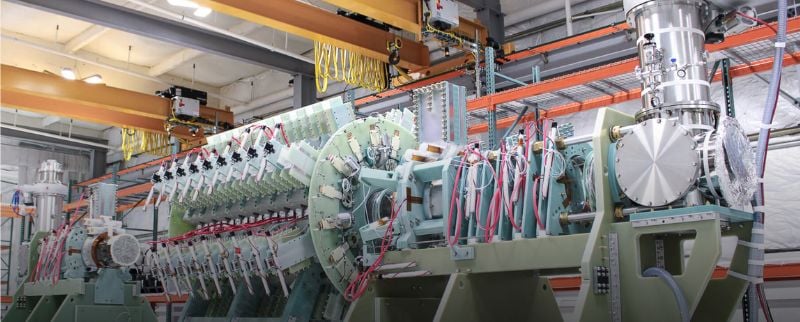
Polaris test assembly. Image used courtesy of Helion Energy
Electricity production happens as the plasma’s field picks up strength. The magnetic flux creates current in the coils, which returns to the capacitors that previously charged the magnets. This step requires shielding walls equipped with thousands of high-voltage capacitors. Helion manufactures 12µF capacitors in-house for its Polaris prototype, which needs thousands of cables to transport electricity to and from the machine. Millions of amps are discharged to the system’s electromagnetic coils.
Seventh Prototype Inches Closer to Commercialization
Helion Energy’s Polaris prototype will demonstrate electricity production later this year. The company has upgraded the power bank for its formation section testbed, where its engineers can optimize the FRCs. Polaris will have stronger magnets and a faster pulse than the sixth prototype.
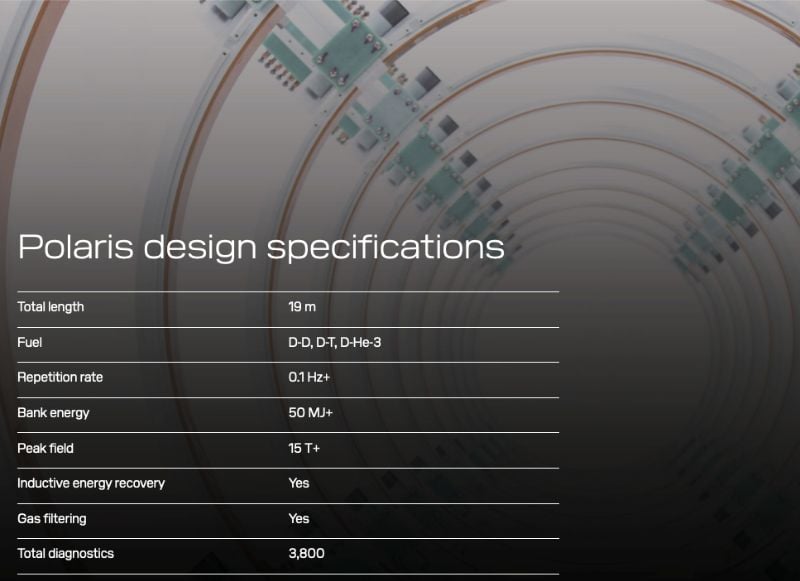
Polaris’s design specifications. Image used courtesy of Helion Energy
Helion has attracted high-profile investors like OpenAI CEO Sam Altman, Facebook co-founder Dustin Moskovitz, and LinkedIn co-founder Reid Hoffman.
Once commercialized and connected to the grid, Helion’s fusion power plant would be a lifesaver for countering the tech industry’s growing energy footprint. Goldman Sachs estimates global data center energy demand could more than double by 2030 due to AI and decelerated efficiency gains.
That’s part of the draw for Microsoft, which is on track to be Helion’s first customer. Steelmaking giant Nucor also partnered with the company to support a future 500 MW fusion power plant.