Facebook
 Google
 GitHub
 Linkedin
Is Tesla’s Supercharger Still Super?
Tesla’s Supercharger network was a strategic move, but is it spreading or stalling?
Tesla launched its Supercharger network in September 2012, initially unveiling six stations in California, with plans to expand across the United States and internationally. The Supercharger network was designed to enable long-distance travel for Tesla vehicles, offering fast-charging capabilities to replenish significant range in a short time. This network was a strategic move to address electric vehicle owners’ range anxiety and to make electric travel as convenient as gasoline-powered travel.
How was Elon Musk’s Tesla supercharger network developed? Video used courtesy of the Tesla Space
The Supercharger network has been a significant part of Tesla's strategy, providing a competitive advantage over other electric vehicle manufacturers by ensuring that Tesla owners can access fast and reliable charging infrastructure. Over the years, Tesla has expanded its network significantly, and by 2024, there were over 50,000 Superchargers globally.
As technology improves and the network grows, several problems remain, particularly with charging compatibility for non-Tesla vehicles. Moreover, Tesla faces competition from competitors who are developing EV fast chargers and networks. How is Tesla’s Supercharger performing in this quickly changing market?

A Tesla Cybertrick charges at a Supercharger. Image used courtesy of Tesla
Charging Compatibility: Tesla vs. Non-Tesla EVs
Tesla has been gradually opening its Supercharger network to non-Tesla electric vehicles to encourage EV adoption and to qualify for federal funding. However, not all Supercharger stations are available to non-Tesla vehicles, and compatibility depends on the connector type and availability of specific adapters.
Tesla introduced the Magic Dock adapter at some Supercharger stations, which allows non-Tesla EVs with a Combined Charging System (CCS) connector to use the chargers. Most modern non-Tesla EVs have CCS connectors, making them compatible with these adapted Superchargers.
Several automakers, including Ford, Rivian, General Motors, Volvo, and Polestar, have partnerships with Tesla to allow their vehicles to access Superchargers. Vehicles from these brands either come with or can use adapters to connect to Tesla's North American Charging Standard (NACS) ports. Non-Tesla EV owners need a Tesla account on the app to use the Superchargers. The app helps locate available Superchargers equipped with the necessary adapters.
Charging a non-Tesla vehicle at a Supercharger can be more expensive than other fast-charging options, with prices ranging from $0.48 to $0.55 per kWh. Charging speeds may also be slower than advertised for non-Tesla vehicles due to compatibility and technical constraints.
Supercharger Network Success
Tesla's Supercharger network has been largely successful, becoming one of the world’s largest and most reliable EV charging networks. The network's reliability is a standout feature, with only a small percentage of Tesla owners reporting charging failures compared to other public charging stations. This reliability and extensive coverage have made the Supercharger network a key asset for Tesla, contributing to the company's ability to sell electric vehicles by alleviating concerns about charging availability.
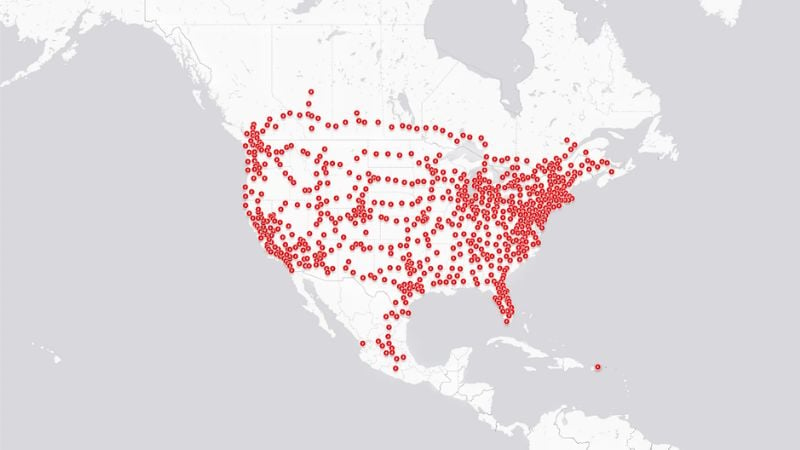
Supercharger locations in North America. Image used courtesy of Tesla
How Does Tesla's Supercharger System Compare to Other EV Charging Networks?
Tesla's Supercharger system stands out in the EV charging landscape due to several key features and advantages compared to other EV charging networks.
| Feature/Aspect | Tesla Supercharger | Other EV Charging Networks |
| Charging Speed | Up to 250 kW (V3 and V4 Superchargers) | Electrify America offers up to 350 kW; others like ChargePoint and EVgo range from 50 kW to 350 kW. |
| Network Coverage | Over 2,200 stations in the U.S. with more than 25,000 ports globally. | ChargePoint is the largest, with over 15,000 locations, but most are Level 2 chargers. Electrify America and EVgo have fewer locations but focus on fast charging. |
| Ease of Use | Integrated with Tesla's navigation system; no need for additional apps or accounts for Tesla owners. | Often requires different apps and accounts for each network, which can complicate the user experience. |
| Compatibility | Primarily for Tesla vehicles, but some stations are being opened to non-Tesla EVs with CCS connectors. | Generally compatible with a wider range of EVs, but compatibility varies by network and location. |
| Pricing Structure | Charges per kWh or per minute, with tiered pricing based on charging speed. | Varies widely; some networks charge per kWh, others per minute, and pricing can depend on membership status. |
| Sustainability | Often powered by solar energy, aiming for a net positive energy impact. | Varies by provider; not all networks have a focus on renewable energy sources. |
Tesla’s Supercharger Struggles
In 2024, Elon Musk fired nearly all Tesla's Supercharger division employees, including its head, Rebecca Tinucci. The controversial move was reportedly not driven by strategic considerations but rather by personal conflicts, resulting in significant disruption to the Supercharger expansion plans.
The layoffs have raised concerns about the future growth of the Supercharger network. Although Musk announced plans to invest $500 million in expanding the network, this budget is significantly lower than initially planned, potentially leading to a 77% reduction in the number of new charging ports being built. The responsibility for the Supercharger network has been shifted to Tesla's energy team, which was already struggling with its workload, further complicating the expansion efforts.
Firing the Supercharger team also strained relationships with contractors and suppliers, who were left with unfinished projects and uncertainty about future collaborations with Tesla. This disruption cast doubt on Tesla's ability to maintain its rapid pace of network expansion, which is crucial to support the increasing number of EVs on the road, including those from other manufacturers that have recently gained access to the Supercharger network.
Tesla rehired some employees from its Supercharger team after initially laying off nearly the entire division. This rehiring effort came after widespread criticism and logistical challenges following the mass layoffs. Among those rehired is Max de Zegher, the director of charging for North America, who was part of the original team. It remains unclear how many laid-off employees have been brought back, as reports indicate that not all employees have been rehired.
The rehiring move appears to be an attempt to stabilize the Supercharger network's operations and expansion plans, which were disrupted by the layoffs. Despite the initial decision to cut the team, Tesla aims to continue growing the network, albeit slower, focusing on maintaining uptime and expanding existing locations.
Tesla’s Supercharger Future
While Tesla's Supercharger network has been a critical success factor, the recent uncertainties pose significant challenges to its future growth and reliability. The long-term impact of Tesla’s changes remains unknown, but they have introduced a level of doubt about Tesla's future charging infrastructure strategy.