Facebook
 Google
 GitHub
 Linkedin
Electrifying Flight: Electric Aircraft Technology Takes Off—And Lands
An electric airplane landing at a New York airport represents the rapid progress in electrifying aircraft and decarbonization through sustainable fuels.
An all-electric aircraft has landed at John F. Kennedy International Airport in New York. Beta Technologies’ ALIA CX300, carrying the pilot and four passengers, became the first electric-powered aircraft to touch down at JFK Airport on June 3 after a 45-minute flight from Suffolk County in Long Island.
Watch the electric airplane land at JFK. Video used courtesy of CBS News New York
The ALIA aircraft has already completed tens of thousands of test miles in preparation for FAA certification. Earlier this year, Beta flew its ALIA model on a coast-to-coast journey across the United States, traveling more than 8,000 nautical miles from Plattsburgh, New York, to Los Angeles and back, and stopping at numerous airports along the way.
The most recent Beta Technologies achievement marks a series of recent advancements in electric airplane technologies and alternative aircraft fuels, paving the way for cheaper and lower-emission passenger flights.
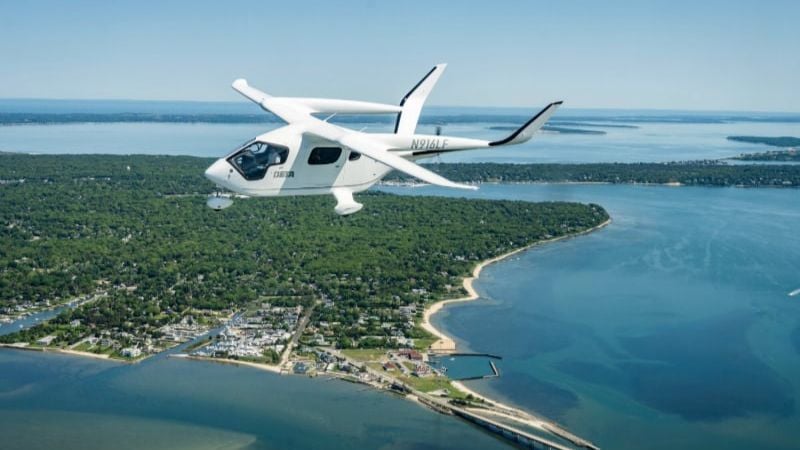
The Alia CX300. Image used courtesy of Beta Technologies
Sustainable Aviation Fuel
Commercial aviation is responsible for approximately 2.5% of global carbon dioxide emissions, and electric aircraft and sustainable aviation fuel (SAF) are two of the critical technologies for reducing aviation’s greenhouse gas emissions. The technologies differ, but both are necessary to reduce aviation emissions.
Sustainable aviation fuel is the aviation industry's main term for non-fossil-derived jet fuel produced from sustainable feedstocks, such as used cooking oil, agricultural residues, waste fat, and, in the future, non-biological sources like green hydrogen and captured CO₂. SAF is chemically and physically similar to conventional jet fuel, allowing safe blending with traditional jet fuel in existing aircraft and infrastructure without modification. SAF can reduce lifecycle carbon emissions by up to 80% compared to conventional jet fuel, depending on the feedstock and production pathway.
By 2024, SAF represented only about 0.3 percent of global jet fuel consumption, but production is expected to double to 0.7 percent in 2025. The European Union has mandated SAF use, with flights departing from Europe required to include an average of 2% SAF as of 2025.
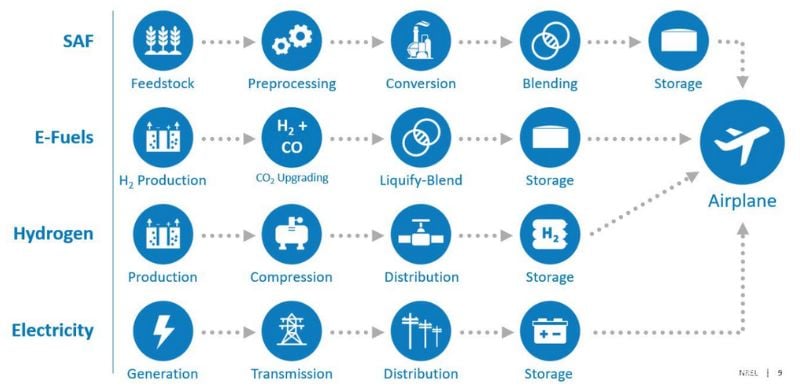
Supply chains for alternative aircraft fuels. Image used courtesy of National Renewable Energy Laboratory
SAF is technically ready for use now—over 450,000 commercial flights have already used SAF blends. Airlines and engine manufacturers have rigorously tested SAF. However, SAF is between two and 10 times more expensive than conventional fuel due to feedstock scarcity and a complex production process. Boeing and Airbus aim for 100% SAF-compatible fleets by 2030, and the U.S. is targeting 3 billion gallons of SAF production by 2030, while the EU has mandated synthetic fuel adoption starting in 2030.
Powering Electric Aircraft
Battery-electric planes eliminate direct combustion emissions, but lifecycle emissions depend on grid decarbonization. Reductions can be as high as 90% when renewable energy is used to charge the battery pack. Electric aviation is considered Ideal for short-haul flights (<500 km) with small aircraft (2–19 seats). Hybrid models that combine jet turbine power with electrification could extend range for regional routes (1,000+ km). Current batteries provide an energy density of ~0.3 kWh/kg versus jet fuel’s 12 kWh/kg, limiting the range and payload of electrically-powered aircraft.
Leading Electric Aircraft Companies and Production Timelines
A rapidly growing number of companies are developing electric and hybrid-electric aircraft, targeting both regional passenger and cargo markets as well as urban air mobility.
Heart Aerospace (Sweden/U.S.)
- Product: ES-30 (30-seat hybrid-electric regional aircraft)
- Status: The first full-scale demonstrator (Heart X1) will fly in 2025. A more production-representative prototype will fly in 2026, with certification and service entry targeted for 2028.
- Orders: Over 250 firm orders, including from United Airlines and Air Canada.
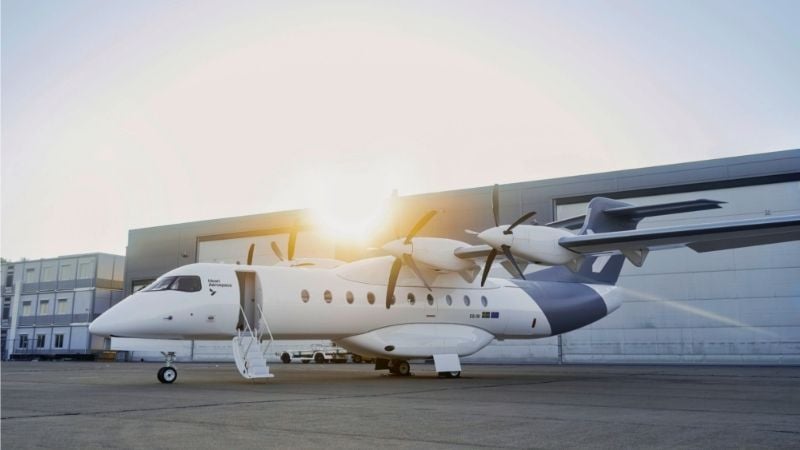
Heart X1, a 30-passenger regional electric plane. Image used courtesy of Heart Aerospace/Patrik Olsson
Beta Technologies (U.S.)
- Product: ALIA CX300 (conventional take-off and landing electric aircraft)
- Status: Manufacturing began in 2023, with serial production and commercial service targeted for 2025.
- Deployment: Air New Zealand will begin testing in 2025 and plans to introduce the aircraft for regional freight in 2026.
VoltAero (France)
- Product: Cassio 330 (hybrid-electric, 5-seat)
- Status: Maiden flight planned for late 2025, with certification and first deliveries expected in 2026.
- Production Capacity: Facility capable of producing 150 aircraft per year.
Joby Aviation (U.S.)
- Product: eVTOL air taxi (electric vertical take-off and landing)
- Status: Progressing through FAA certification; commercial passenger operations are anticipated before 2030.
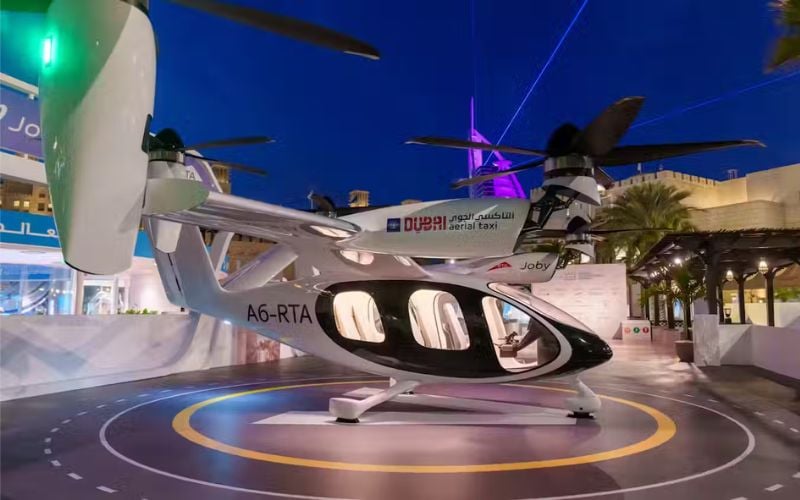
Electric air taxi. Image used courtesy of Joby Aviation
Bye Aerospace (U.S.)
- Products: eFlyer 2 (2-seat), eFlyer 4 (4-seat), eFlyer 800 (7–8 seat)
- Status: eFlyer 2 and 4 are in advanced testing, with certification and production expected within the next few years.
Development Timeline
The electric aircraft sector is moving from prototype to production, with the first commercial operations of small regional and cargo aircraft expected between 2025 and 2028. Larger hybrid-electric models and eVTOL air taxis will follow later in the decade. Most companies are targeting regional and short-haul markets, with hybrid systems bridging the gap until battery technology matures further.
- Short-term (2025–2030): Small electric planes for regional routes (e.g., air taxis)
- Medium-term (2030–2040): Hybrid-electric regional aircraft (50–100 passengers) enter service
- Long-term (post-2040): Breakthroughs in solid-state batteries or hydrogen fuel cells enable larger, long-haul electric planes
Long-Term Outlook for Air Travel
SAF and electric aviation are not mutually exclusive but part of a multi-pronged strategy to decarbonize air travel. While SAF adoption is already underway and will continue to address long-haul routes, electric aircraft will likely remain niche until battery technology matures. The aviation industry’s net-zero goals hinge on accelerating both pathways in parallel.