Facebook
 Google
 GitHub
 Linkedin
Power Outage? No Problem at Airports With Microgrids
Many airports are protecting against power outages by adding microgrids using solar and other energy sources.
A power outage at an airport disrupts essential services that jeopardize passenger and worker safety. Case in point: in March, a substation fire cut the power to London’s Heathrow Airport for over 18 hours, causing 1,300 flight cancellations and stranding 200,000 passengers. Terminals and runways went dark, and all operations stopped. Heathrow had diesel generators and a biomass generation system as power backups, but they were not enough to power the entire airport campus.
Airports are required to install generators, which can keep electricity flowing for hours, but they are usually designed for emergency services only. They also require refueling, which can be difficult during storms or natural disasters. Instead, many airports are supplementing their backup power with microgrids powered by renewable energy or natural gas. These can provide energy independence during an emergency and reduce reliance on grid power all year long. They also help decrease the airport’s carbon footprint.

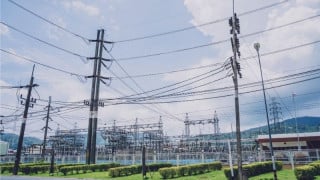
What keeps the power on at airports during an outage? Image used courtesy of Adobe Stock
Why Airports Need Microgrids
Major international airports rely on electricity 24/7 for essential assets like air traffic control, transportation, communication systems, conveyors, escalators, flight information systems, and much more. A sudden outage can leave departing and arriving airplanes without full guidance and cause work stoppages throughout the airport. It could be several minutes before generators fire up, and no one knows how long the outage will last. The financial consequences can be enormous. In 2017, an 11-hour outage at Atlanta’s Hartsfield-Jackson airport cost airlines $50 million.
Airport terminals are also energy hogs. A major airport uses significantly more power than the average public building. Sprawling terminal buildings consume power for air conditioning and heating, luggage conveyors, lighting, and other electrical equipment.
At the same time, airports are concerned about carbon emissions, and not only during outages. Worldwide, airplane exhaust contributes 2-3% of carbon dioxide emissions. In the U.S. alone, airplane emissions are about 10%, according to the Environmental Protection Agency. In 2022, the Federal Aviation Administration began an Airport Climate Challenge to meet net-zero emissions by 2050, providing funding for switching to electric vehicles, developing renewable energy, and making other carbon reductions.
Airport Microgrids
Microgrids allow airports to lessen grid dependence and provide protection during outages. Those using solar or wind generation can also decrease the facility’s carbon footprint. Grid-connection microgrids can strengthen grid reliability, as grids can draw energy from the airport during peak demand periods.
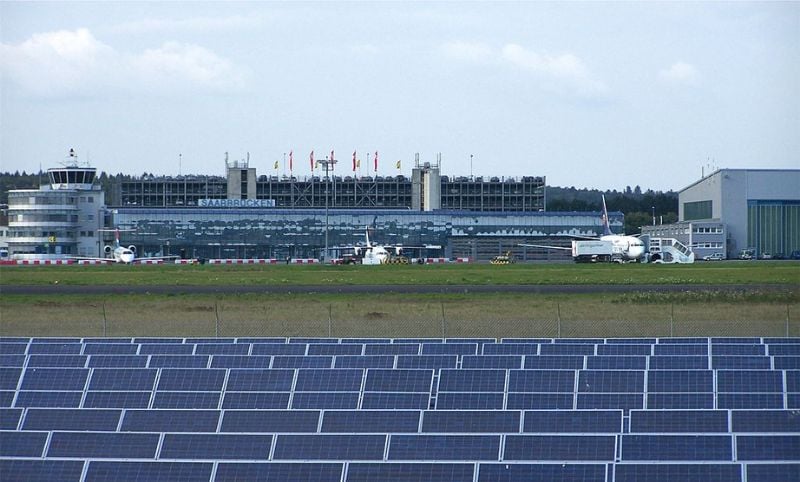
Solar panels at a German airport. Image used courtesy of Wikimedia Commons
Microgrids take various forms, depending on the airports’ geographies and available resources.
Pittsburgh International Airport
The Pittsburgh International Airport provides 100% of its needs with a combination of natural gas-powered generators and solar energy. This stand-alone microgrid produces 20 MW of power.
The 8,800-acre airport campus uses five natural gas generators and 10,000 solar panels. The airport claims it saves about $1 million a year in electricity costs. The facility is grid-connected as a backup.
Denver International Airport
Denver’s airport has been developing solar energy since 2008. Its 50 MW solar array spans 200 acres. It also installed a solar-powered battery storage system to provide power to its underground trains during outages.
Redwood Coast Airport
Redwood Coast, a regional airport on Northern California’s coast, is 100% microgrid-powered. The system includes a 2.2 MW solar array and a 2.3 MW, 8.9 MWh battery storage system. In 2022, a 6.4 magnitude earthquake caused power outages for the entire area, but the airport remained operational, thanks to its microgrid. It also provided 15 hours of backup power to others, including a nearby U.S. Coast Guard Air Station.
Daniel K. Inouye International Airport
In sunny Hawaii, the Daniel K. Inouye Airport in Honolulu has installed 24,000 solar panels on parking garages and terminal buildings that can generate 8 MW of energy. It also has a 1 MWh energy storage system. The airport claims it saves 7 MWh of electricity annually and about $25 million in costs.
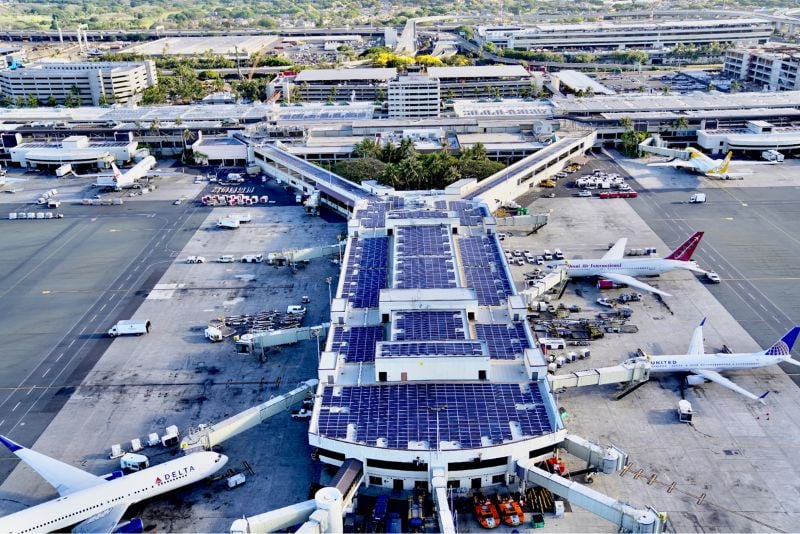
Rooftop solar at Inouye Airport. Image used courtesy of Hawaii Department of Transportation
Airport Microgrid Surge
More airports are turning to microgrids to achieve energy security and net-zero goals. New York’s John F. Kennedy International plans to install a 12 MW microgrid using 13,000 rooftop solar panels, a battery energy storage unit, and fuel cells. The fuel cells will use natural gas, but they are compatible with hydrogen use in the future. The microgrid, scheduled to open in 2026, will reduce greenhouse gas emissions by 38%.
As microgrid development continues, government grants and public-private partnerships are crucial. Airports are energy-intensive and require around-the-clock, uninterrupted power. Microgrids could be the solution they need.