 Facebook
 Google
 GitHub
 Linkedin
Briefs: Planning for EV Chargers, BESS, and Grid Infrastructure
Companies working on electric vehicles, BESS, and grid infrastructure tech include Visteon, Shinry, Infineon, BW ESS, Wattmen, WeaveGrid, Hyundai, Kia, GE Vernova, and PG&E.
Partnerships and investments are advancing electric vehicle charging technology, battery energy storage systems, and grid infrastructure. Visteon, Shinry, and Infineon are collaborating on a single-stage OBC with GaN bidirectional switches. WeaveGrid is partnering with two major EV makers, Hyundai and Kia, to develop smart charging and vehicle-to-grid platforms.
In France, BW ESS and Wattmen are developing battery energy storage systems totaling 500 MW. In Louisiana, GE Vernova is spending $34.5 million to expand its renewable energy transformer manufacturing facility.
Finally, PG&E has reached its goal of placing 1,500 miles of transmission lines underground to reduce wildfire risk.
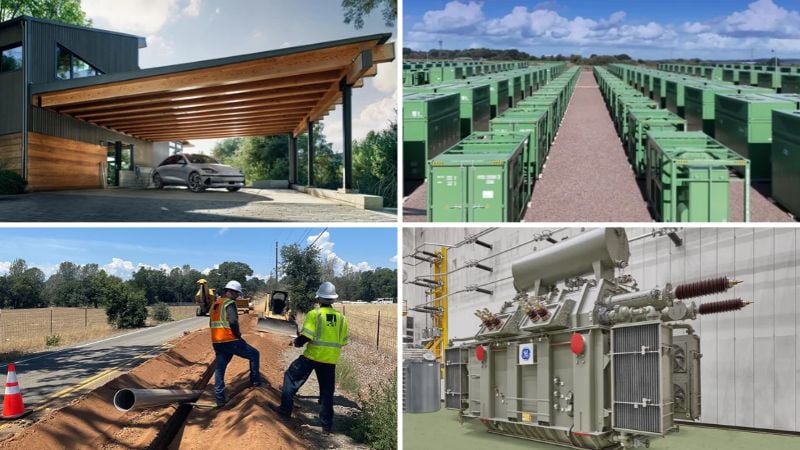
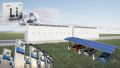
![]() EV charging, grid infrastructure, and energy storage.
Visteon, Shinry, and Infineon Partner on Single-Stage OBC with GaN BDS
Visteon Corporation and Shinry Technologies, through their joint venture Visteon-Shinry Power Electronics LLC (VSPE), are working with Infineon Technologies to build a single-stage electric vehicle onboard charger (OBC). The system pairs VSPE's converter hardware topology and control software with Infineon's monolithic gallium nitride (GaN) bidirectional switches (BDS) to shrink charger size, lower costs, and boost power density.
The OBC delivers 22 kW three-phase and 19.2 kW single-phase AC charging. It also supports full vehicle-to-everything (V2X) bidirectional power flow for grid interaction.
Unlike standard two-stage OBCs, VSPE's single-stage design combines separate power-conversion steps and removes large bulk capacitors. Infineon's monolithic GaN BDS chips handle bidirectional voltage blocking and current conduction in one component, which cuts the total semiconductor count.
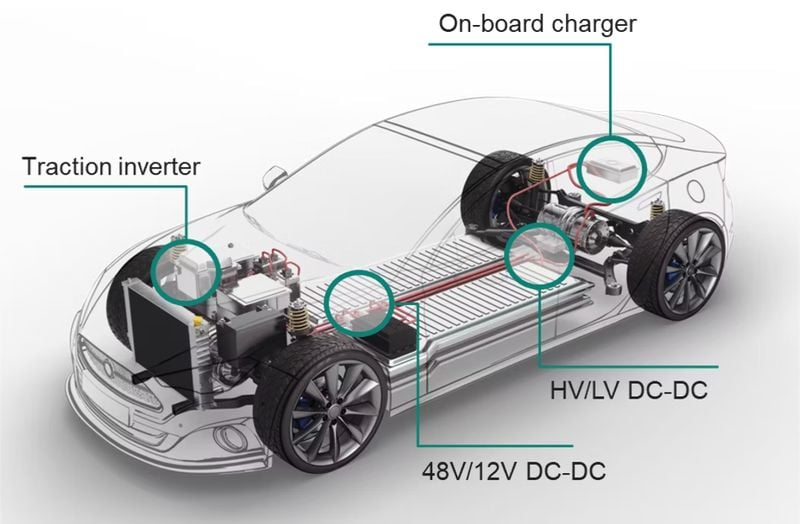
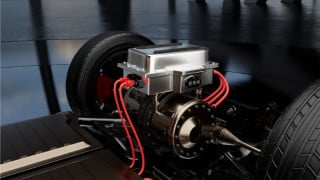
Concept of EV with onboard charger. Image used courtesy of Infineon
High-frequency GaN switching also allows engineers to use smaller inductors and transformers. VSPE's research and development team is now validating the architecture to meet global automotive reliability standards.
WeaveGrid Partners With Hyundai, Kia To Power V1G, V2X Tech
WeaveGrid and Hyundai Motor Group have partnered to build an EV smart charging (V1G) and vehicle-to-grid (V2G) platform for Hyundai and Kia drivers in North America. The system lowers charging costs for drivers and gives electric utilities dispatchable energy storage to stabilize local grids.
WeaveGrid will power the software connecting Hyundai and Kia EVs to U.S. utility energy services. Drivers will control V1G smart charging inside the myHyundai App and Kia Access App by setting a target battery level and departure time. The software automatically shifts power draw to off-peak hours while sending battery data to grid operators.

The platform will begin with smart charging and build toward bidirectional capabilities. Image used courtesy of WeaveGrid
Most U.S. Hyundai and Kia EVs use the Electric-Global Modular Platform, which already supports bidirectional hardware functions like vehicle-to-load on the Ioniq 5 and EV6 and home backup on the Kia EV9. Both companies will expand the software to support full V2G power export at local transformers and feeders as utility interconnection rules mature.
BW ESS and Wattmen Develop 500 MW BESS Portfolio in France
BW ESS and French developer Wattmen will build 500 MW of battery energy storage system (BESS) projects in France over the next three years. The standalone, transmission-connected installations will increase grid flexibility across the French power network.
The joint project seeks sites with a minimum grid connection capacity of 100 MW. Each facility will require enough space to house batteries with at least four hours of storage near existing grid connection points.
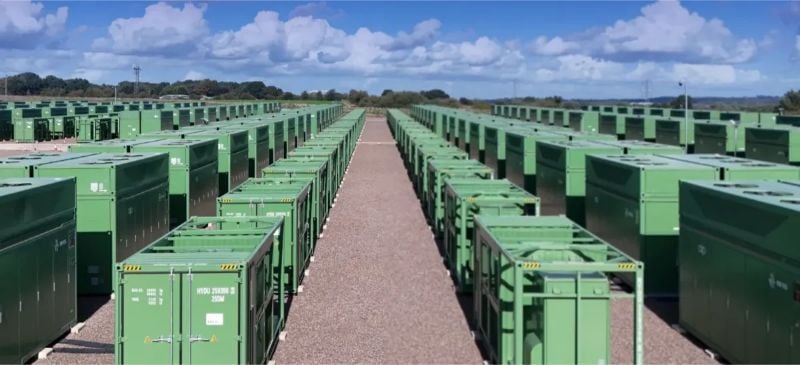
BESS facility. Image used courtesy of BW ESS
Wattmen will handle local site identification, land agreements, permitting, and grid connection coordination with authorities and landowners. BW ESS will apply its storage investment, design, and procurement experience from seven international markets to advance projects from greenfield to ready-to-build status.
The alliance expands BW ESS's French footprint following its recent purchase of two 100 MW/400 MWh BESS projects.
GE Vernova Commits $34.5M To Expand Transformer Manufacturing
GE Vernova will invest $34.5 million to expand its transformer manufacturing plant in Shreveport, Louisiana. The upgrade increases output of industrial and renewable energy transformers to meet rising electrical grid demand from industrial, energy, and digital sectors.
The 500,000-square-foot facility began making transformers in 1970. Planned upgrades cover new production equipment, process improvements, and supporting site infrastructure, with full output capacity scheduled for 2028.
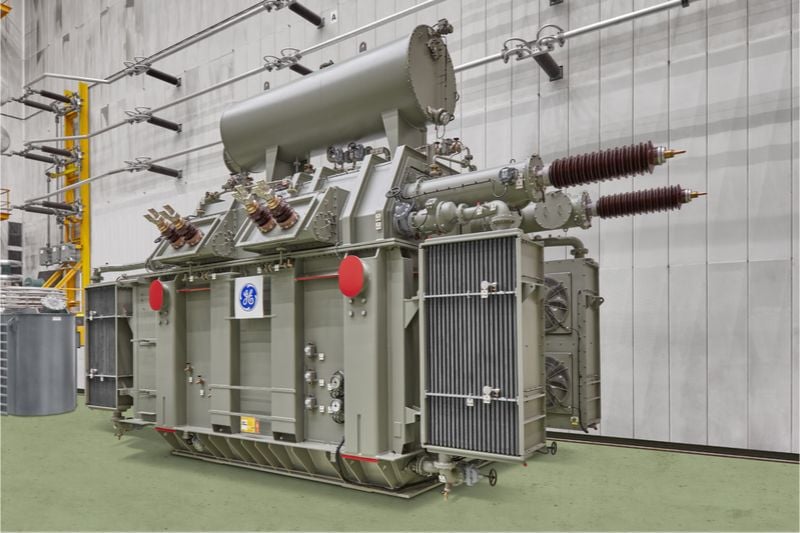
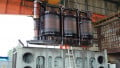
GE Vernova 100 MVA transformer. Image used courtesy of GE Vernova
Louisiana backed the project with an incentives package that includes a $300,000 performance-based grant for site and infrastructure work. GE Vernova also plans to join the state's Quality Jobs and Industrial Tax Exemption programs.
PG&E Undergrounds 1,500 Miles in Wildfire Safety Program
Pacific Gas and Electric Company (PG&E) has achieved 1,500 miles of installed underground power lines in high fire-risk districts. Launched in 2021, the program permanently reduces wildfire ignition risk by about 98% and power outages by about 90%.
Crews completed 325 miles of buried distribution lines in 2026 alone. Recent projects brought underground service to Foresthill, Middletown, Apple Hill, Arnold, and Angwin.
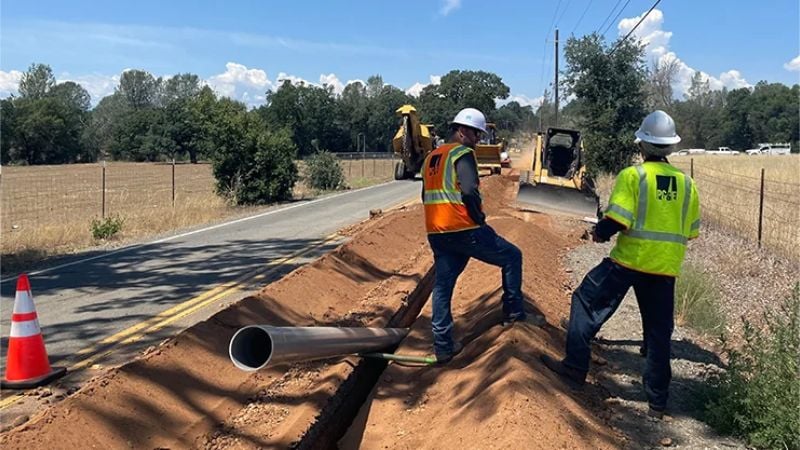
Undergrounding power lines. Image used courtesy of PG&E
PG&E also submitted a 10-year Electrical Undergrounding Plan to bury an additional 5,000 miles of lines across over 30 Northern and Central California counties. The proposal aims to deliver reliable power to hospitals, fire stations, and police departments while reducing reliance on Public Safety Power Shutoffs and Enhanced Powerline Safety Settings.
However, regulatory hurdles threaten the broader expansion. A California Public Utilities Commission Proposed Decision under proceeding SPD-37 could cut eligible mileage in PG&E's 10-year plan from 5,000 miles down to roughly 1,100 miles.