Facebook
 Google
 GitHub
 Linkedin
Eyes Underground: AI Sensors Assist in Power Line Installations
A subsurface sensing system allows faster and safer undergrounding of power lines.
The University of Houston and Hawaii-based Oceanit are developing artificial intelligence-enabled subsurface sensing technology to support underground power line installations. The system will combine high-resolution electromagnetic resistivity sensors and uncrewed aerial vehicles to identify underground obstacles like existing power lines and cables.
How can undergrounding prevent fires and other safety issues? Video used courtesy of Oceanit
Using antenna-equipped drones and sensor-mounted drill bits, the AI and Unmanned Aerial Vehicle Real-Time Advanced Look-Ahead Subsurface Sensor (AURALSS) project will deliver precise subsurface images of hidden objects that could damage infrastructure and pose safety risks to utility workers.
The project secured $3.27 million in federal funding through GOPHURRS, a Department of Energy ARPA-E program. It was one of 12 projects in 11 states to receive $34 million last year for undergrounding technologies.
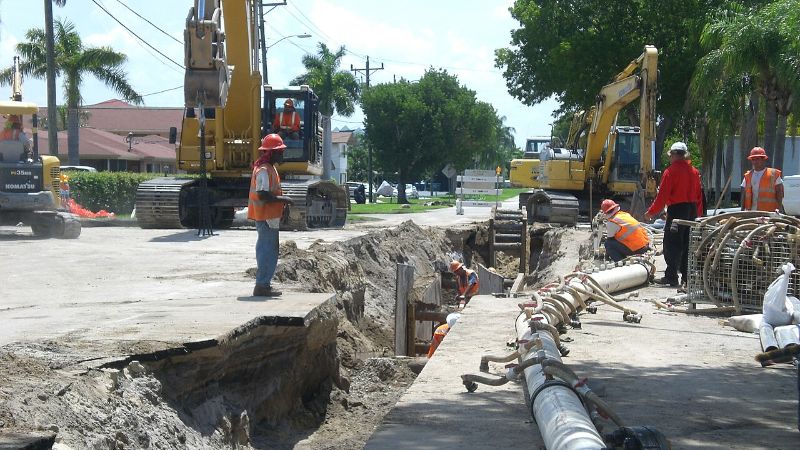
Undergrounding transmission lines. Image used courtesy of Wikimedia Commons
A Horizontal Directional Drilling Support Tool
The AURALSS project will develop a prototype to generate near-real-time, high-resolution images during horizontal directional drilling (HDD), a common alternative to traditional trenching methods. Utilities often employ HDD to avoid damaging existing infrastructure, like telecommunication cables or water pipes, in the drill path.
The system will incorporate electromagnetic resistivity well logging technology, emitting electromagnetic waves to identify content in underground formations. Antennas will be mounted onto an uncrewed aerial vehicle to enhance the detection distance and sensitivity, while an electromagnetic sensor will be attached to the HDD string.
The University of Houston is also exploring geophysical signal processing techniques to detect the precise location impeding the drill bit. The project will integrate machine learning to guide the drill path, speed up the modeling process, and generate real-time images.
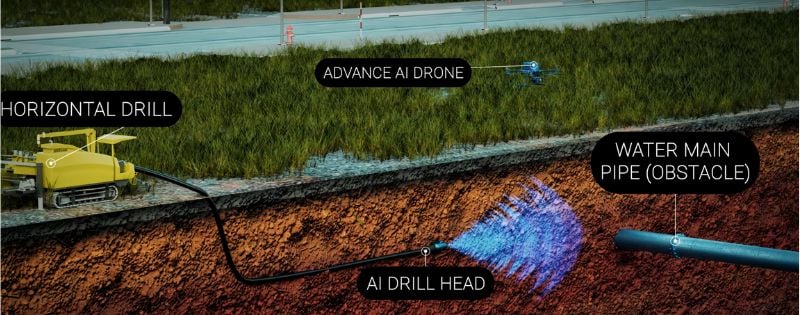
BURROW detects underground infrastructure using AI-enabled drones and sensors. Image used courtesy of Oceanit
Hawaii-based Oceanit will lend technical expertise from its work developing the Borehole Underground Reconnaissance and Real-time Obstacle Wayfinder (BURROW), an advanced sensor system for underground utility installations. The company claims BURROW can lower undergrounding costs to the level of cheaper overhead power lines, thanks to faster installation and AI-supported mapping.
According to Oceanit, BURROW reduces undergrounding expenses by 50% compared to conventional methods—making the costs comparable to installing and maintaining overhead lines.
Why Is Undergrounding Important?
The U.S. power distribution system comprises more than 5 million line miles of 180 million poles, much of which is susceptible to weather-related damage. Fallen trees, vegetation overgrowth, storms, heavy rain, and lightning strikes are among the leading causes of power outages in overhead systems, which fail 78% more often than underground lines, according to a recent report from Scenic America. However, underground wires reduce downtime by about 69% and are 97% less prone to failure in hurricanes because they’re shielded from most environmental disruptions.
As extreme weather increases the frequency of power outages, utilities nationwide want to reduce their reliance on above-ground infrastructure. Downed overhead lines can ignite or worsen wildfires amid dry conditions and high winds. In August 2023, hurricane-force winds struck a Hawaiian Electric power line in Maui, sparking the deadliest natural disaster in the state’s history.
The utility is investing in undergrounding, among other system-hardening measures, to protect its 9,800-plus miles of transmission and distribution infrastructure across five islands. About 43% of Hawaiian Electric’s lines are already underground today, and it plans to deploy more in targeted areas like evacuation routes. In a recent modeling assessment, the company found that undergrounding is 95% effective, with a 55-year asset life. However, the cost is a steep $11 million per mile.
New subsurface sensing technologies—like the one envisioned in the AURALSS project—would significantly reduce HDD costs, allowing utilities to unlock the full benefits of horizontal drilling techniques.