Facebook
 Google
 GitHub
 Linkedin
Toshiba Offers 2-Channel Digital Isolators for EV Design
The SOIC8-N packaged devices feature 3 kV isolation, 100 kV/µs CMTI, and 50 Mbps data rates, suitable for onboard chargers and battery management systems.
Toshiba has launched its DCM32xx00 Series, a line of two-channel digital isolators designed for automotive systems. The four models, DCM321C00, DCM321D00, DCM320C00, and DCM320D00, are compliant with AEC-Q100 standards and specifically target applications such as battery management systems and onboard chargers in hybrid and electric vehicles.
The digital isolators could provide a solution for the automotive industry's increasing demand for high-speed, noise-immune signal isolation.
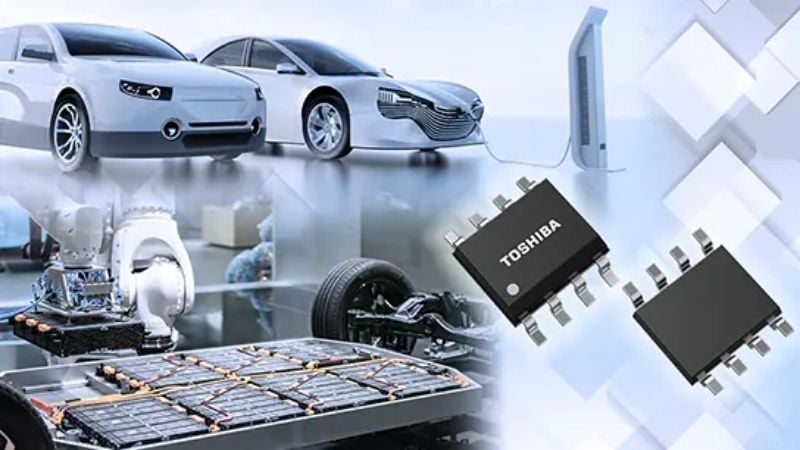
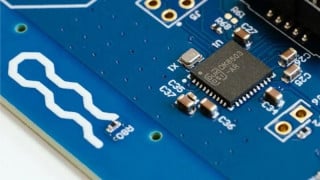
Toshiba’s two-channel high-speed standard digital isolators. Image used courtesy of Toshiba
The DCM32xx00 Series
The DCM32xx00 Series features two-channel digital isolators with differing signal direction configurations. The DCM321 variants provide one forward and one reverse channel (1:1), while the DCM320 variants offer two forward-only channels (2:0). According to Toshiba, these configurations allow for flexible design in full-duplex and simplex communication setups.
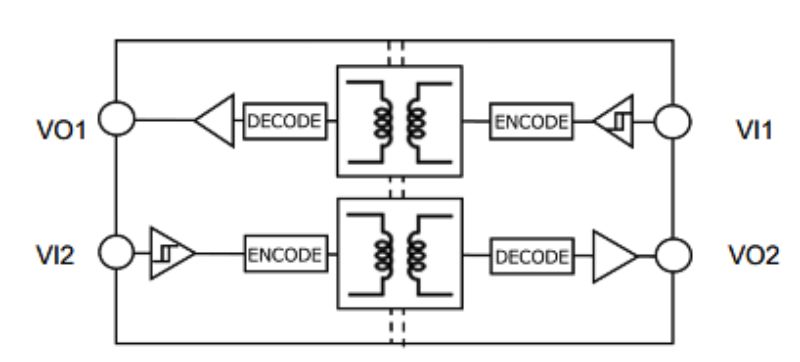
Block diagram of the DCM321C00. Image used courtesy of Toshiba
All devices operate across a temperature range of -40°C to 125°C and support a storage range of -65°C to 150°C. Isolation is achieved with a withstand voltage of 3000 Vrms for one minute, tested at 25°C. Meanwhile, a major highlight of the series is its high common-mode transient immunity, rated at 100kV/μs (typical) under a test condition of VDD1 = VDD2 = 4.5 V to 5.5 V and VCM = 1500 V. With these specs, Toshiba has designed the devices to operate reliably in environments with fast transient voltages, such as high-power inverters or switching power supplies.
The maximum data rate is specified at 50 Mbps, with a typical pulse width distortion of only 0.8 ns. Furthermore, the devices exhibit a typical propagation delay of 10.9ns. None of the four devices requires external control for input/output operation and are housed in standard SOIC8-N packages.
CMTI in Automotive Isolation
Common-mode transient immunity (CMTI) is a fundamental parameter in isolator selection for automotive electronics, especially in systems operating with high switching speeds or under rapidly changing voltages. On a high level, CMTI quantifies an isolator’s ability to reject noise or voltage changes that occur simultaneously on both input and output grounds.
High CMTI is necessary for data integrity when interfacing low-voltage microcontrollers with high-voltage subsystems. For instance, when gate drivers or inverters switch at high frequency, they induce transient voltages that can couple through parasitic paths. A low-CMTI isolator might falsely toggle or corrupt signal transmission in such cases.
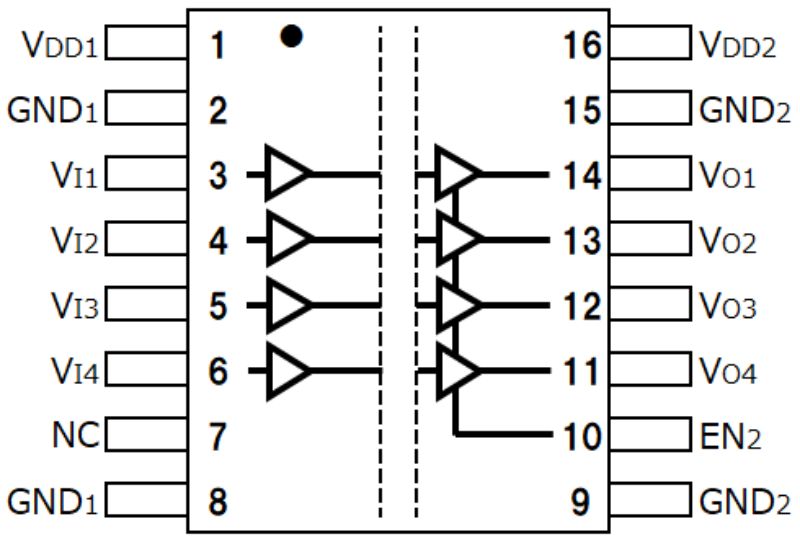
Toshiba’s four-channel digital isolator is already in production. Image used courtesy of Toshiba
Toshiba claims that their magnetic coupling method improves CMTI performance by eliminating optical signal paths, which are more susceptible to capacitive coupling. The result is a more robust design that maintains signal fidelity in the face of common-mode noise. The company claims that automotive BMS and OBCs benefit from this capability since they often operate in electrically noisy environments with demanding safety requirements.
In addition to robustness, a high CMTI allows engineers to place isolators closer to high-voltage domains without compromising functionality. The result is reduced layout constraints and minimized signal degradation.
High-Speed Communication in Automotive Platforms
As automotive designs continue to converge toward higher integration and faster switching power electronics, robust isolation becomes more important. To keep up, Toshiba plans to expand the product family with additional channel counts and package options. All four existing models are available through Toshiba's authorized distributors.