
 Facebook
 Google
 GitHub
 Linkedin
Toshiba Intros Dual-Channel Standard Digital Isolators for Industrial Gear
The four-device DCL32xx00 series draws just 0.2 mA per channel and supports data rates up to 25 Mbps and 3,000 Vrms isolation in an SOIC8-N package.
Toshiba Electronic Devices & Storage Corporation has launched four dual-channel standard digital isolators for industrial equipment. The DCL32xx00 series draws a typical operating current of just 0.2 mA per channel, supports mid-speed communications up to 25 Mbps, and ships in an industry-standard SOIC8-N package.
The devices use Toshiba's proprietary magnetic coupling isolation technology with an optimized signal-transmission circuit designed to minimize power consumption while maintaining stable digital communication. Magnetic coupling transmits data across the isolation barrier using coreless transformers, avoiding the optical degradation issues that can affect optocouplers over time.
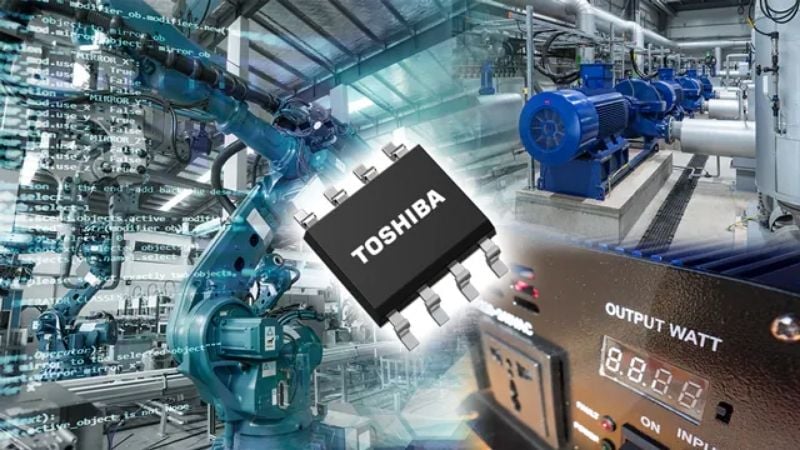
The dual-channel digital isolators for industrial applications. Image used courtesy of Toshiba
Four Models Across Two Channel Configurations
The lineup splits into two channel arrangements. The DCL320C00 and DCL320D00 provide two forward (unidirectional) channels suited to I2C-style communications, where data flows in one direction across each isolation channel. The DCL321C00 and DCL321D00 provide one forward and one reverse channel, supporting UART-style bidirectional data transfer across the isolation barrier.
Within each pair, the C variant defaults to a low output logic level, and the D variant defaults to high, giving designers control over the output state during power-up or when the input signal is absent. This is particularly important in safety-critical industrial systems where an isolated output's default state can determine whether a motor controller or actuator remains in a known-safe condition during power transitions.
All four models share the same electrical foundation.v A supply voltage range of 2.25 V to 5.5 V, an operating temperature range of -40°C to 125°C, and the SOIC8-N package measuring 4.9mm x 6.0mm x 1.75mm.
The wide supply voltage range allows the devices to bridge 3.3 V and 5 V logic domains on either side of the isolation barrier without external level-shifting circuitry. Engineers working with mixed-voltage industrial bus architectures can use a single isolator family across both voltage rails, reducing the number of unique components in a bill of materials.
Low Power at Speed
The 0.2 mA per channel specification applies under standardized conditions: VDD1 and VDD2 at 3.3 V, a data rate of 1 Mbps, a load capacitance of 15 pF, and an ambient temperature of 25°C. At the maximum supported data rate of 25 Mbps, current consumption rises to approximately 3.2-3.4 mA on the primary side and 2.8-3.2 mA on the secondary side, depending on the model.
The 3,000 Vrms isolation rating satisfies reinforced insulation requirements common in industrial control systems, where galvanic isolation protects low-voltage logic from high-voltage power stages. The 30 kV/μs CMTI specification preserves signal integrity during rapid voltage transitions typical of motor drives and power conversion circuits.
Target applications include programmable logic controllers, I/O interfaces, field sensors, actuators, motor controllers, inverters, and switching power supplies.
Building Out the Low-Power Isolation Portfolio
The DCL32xx00 series expands Toshiba's low-power-consumption standard digital isolator portfolio to 10 products. The company released the DCL34xx0B series of quad-channel isolators in mid-2026, housed in larger SSOP16 packages. Those four-channel devices share the same 0.2 mA per channel current draw, 25 Mbps maximum data rate, 3,000 Vrms isolation voltage, and -40°C to 125°C operating range as the new dual-channel parts.
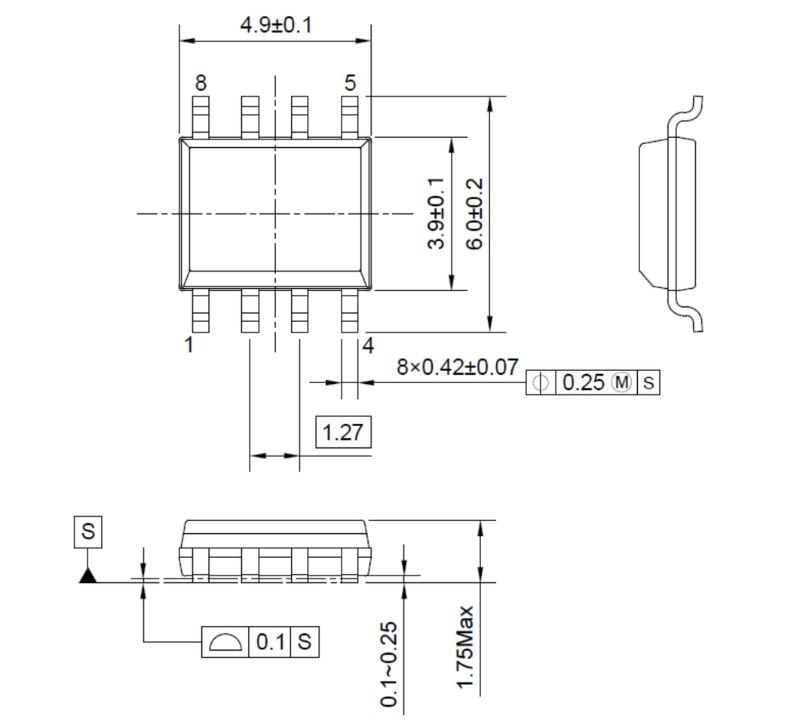
Package dimensions for the DCL32xx00. Image used courtesy of Toshiba
By offering dual-channel and quad-channel devices with matched electrical characteristics, Toshiba provides consistent isolation building blocks that scale across board layouts and channel-count requirements without forcing engineers to revalidate core isolation performance. The dual-channel series' SOIC8-N footprint is particularly relevant for space-constrained designs in distributed I/O modules and compact sensor interfaces, where a quad-channel SSOP16 package would consume too much board area.
Adding dual-channel devices also helps close a gap. Many industrial sensor interfaces and distributed I/O modules require only one or two isolated channels per node, and using a quad-channel device in those cases wastes silicon, board space, and standby power. The dual-channel SOIC8-N parts let engineers match the isolator channel count to the application without over-provisioning.
Toshiba also maintains complementary product families for applications outside the standard industrial mid-speed range. The DCL54xx01A and DCL52xx00 high-speed isolator series serve designs requiring faster data throughput, while the DCM34xx01 and DCM32xx00 families provide automotive-grade variants for in-vehicle and automotive-adjacent industrial applications.