Facebook
 Google
 GitHub
 Linkedin
Tektronix Unveils Regenerative Dynamic Test System for 800 V Power
The EA-ELR 21000 regenerative dynamic test system recreates load transitions at up to 12 A/µs per 240 kW rack for validating 800 V power shelves and racks in AI data centers.
As AI data centers move from 54 V in-rack distribution to 800 V DC, power shelves and racks must be validated at full voltage against load steps that can swing hundreds of amps in microseconds. Tektronix is addressing that with the EA-ELR 21000, an auto-ranging, high-dynamic electronic load test system built on a fully regenerative architecture for ±400 V and 800 V DC power.
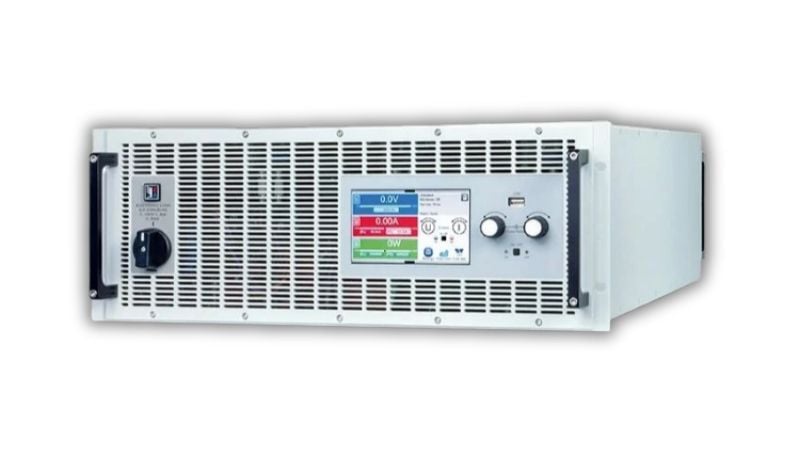
The EA-ELR 21000-80 4U HS is a 30 kW regenerative load module rated for up to 1,000 V and 80 A. Image used courtesy of Tektronix
Why AI Power Needs a New Load Test
Higher rack power means higher current, and current costs I²R losses in the busbars, copper mass, and extra conversion stages. Moving distribution to 800 V DC, as a single rail or ±400 V split rails in a sidecar, cuts current for the same delivered power.
That pushes two problems onto the test bench. First, AI workloads swing power demand rapidly, so a shelf must hold regulation through large di/dt at its output. Second, efficiency mapping, burn-in, and lifetime testing hold hardware at high power for long stretches, and dissipative load turns every watt the lab supplies into heat it must then remove. The EA-ELR 21000 targets both.
Dynamic Load Emulation at 800 V
The system's building block is the EA-ELR 21000-80 4U HS, a 30 kW regenerative electronic load rated for up to 1,000 V and 80 A. Because the module is auto-ranging, those limits don't apply at the same time. At 800 V, the 30 kW rating allows about 37.5 A per module.
A full rack of eight modules reaches a current slew rate of 12 A/µs at 240 kW. That speed lets the load mimic GPU clusters ramping up and down, so engineers can see voltage droop, recovery time, and control-loop stability on the bench rather than in a deployed data center.
Paralleling more modules raises the slew rate further. Beyond one rack, however, Tektronix's figures are calculated rather than measured.
A built-in arbitrary function generator applies programmable profiles to the load current or voltage and saves sequences for reuse, making design revisions easy to compare under identical conditions. The system can also briefly absorb 125% of its rated power, letting engineers validate a shelf's short-term peak output without a larger load.
Regenerative, Modular, Built to Scale
Rather than converting absorbed energy into heat, the system feeds it back to the facility grid at up to 95% efficiency, so only about 5% of test power becomes heat, sharply reducing cooling demand. Because the AC input mainly covers these losses, long endurance runs don't need a proportionally larger utility feed.
The system scales in 30 kW steps. Up to eight modules fit in one 42U rack, giving 240 kW in a 0.6 m² footprint, and up to eight racks combine for 64 modules and 1.92 MW. That lets teams start small and grow as rack power targets climb. Built-in master-auxiliary and share buses let all modules operate as one synchronized load, and any single module can be serviced without taking down the entire system.
Each rack has a two-channel emergency stop system, with the stop button on the front door and contact switches on the rear door. Opening the rear door during operation automatically triggers the emergency stop, protecting anyone who reaches into the cabinet while it's live. Optional network-and-supply (NS) protection prevents islanding, where the system keeps feeding energy into a dead grid line.
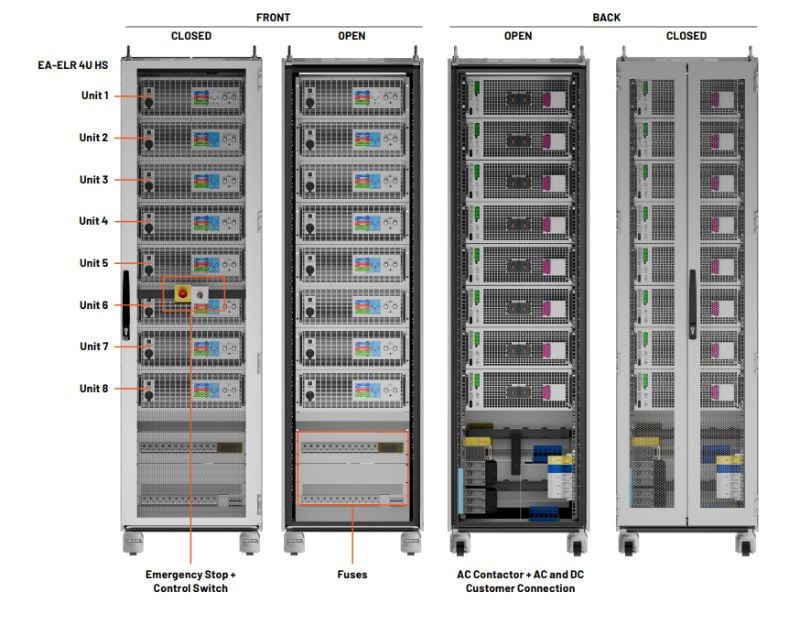
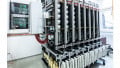
A fully populated 42U rack holds eight 30 kW modules, fuses, an emergency stop, and the AC and DC customer connections. Image used courtesy of Tektronix
Control, Protection, and Availability
The load regulates in constant-current, constant-voltage, or constant-power mode with fast crossover between them, keeping regulation smooth when a test pushes the shelf to a limit such as current limit. Adjustable overvoltage, overcurrent, and overpower protection, plus overtemperature shutdown, protect both the device under test and the system.
Each rack runs from a three-phase 380-480 V, 50-60 Hz supply at a 0.99 power factor, and operates at ambient temperatures of 0-35 °C. The EA-ELR 21000 system and EA-ELR 21000-80 4U HS module are available now.
Testing Ahead of the 800 V Rollout
Nvidia expects 800 VDC infrastructure for 1 MW racks starting in 2027, with its MGX-compatible 800 VDC power rack slated for the second half of 2026. That leaves shelf and solid-state transformer vendors a narrow validation window.
Later this fall, Tektronix plans to introduce the EA-ELR 20080-1000 4U HS, an 80 V, 1,000 A regenerative module for the 48-54 V rail closer to compute. The two platforms would cover both major conversion stages of the AI power path.