Facebook
 Google
 GitHub
 Linkedin
TDK Squeezes 3 A in 2.5 mm Package for Optical Transceivers
The FS3303 is the first in an expanded lineup spanning 3 A to 80 A, aimed at powering the DSPs and photonic ICs in next-generation optical modules
TDK has launched the FS3303, the first member of a broader expansion of its micro POL family of non-isolated DC-DC power modules.
The module delivers 3 A from a 2.5 mm x 2.5 mm footprint at just 1.2mm tall, targets optical transceivers and AI edge systems, and achieves peak efficiency of approximately 95%, all while supporting output voltages from 0.4 V to 3.3 V on an input range of 2.7 V to 6 V. TDK states the upcoming lineup will span 3 A to 80 A across 0.3 V to 3.3 V rails, with height profiles between 1.2 mm and 1.7 mm.
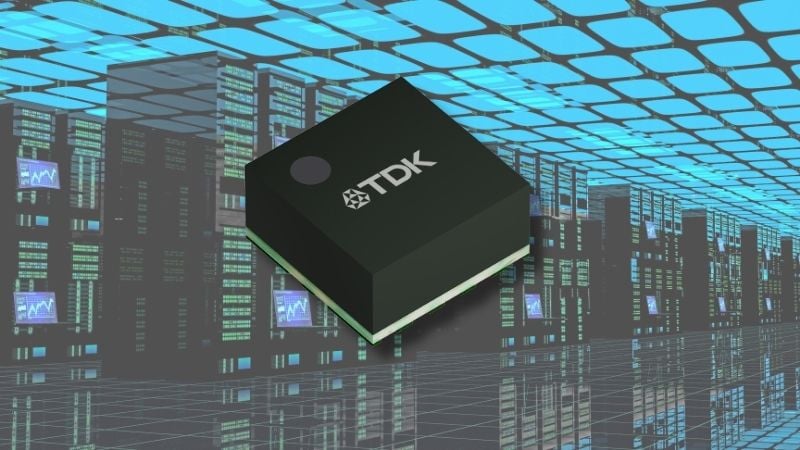
The FS3303 POL module. Image used courtesy of TDK
Why Optical Modules Need Better POL Converters
Optical transceivers are scaling rapidly, with modules rated at 800 Gbit/s as the mainstream choice for AI data center buildouts. The 1.6 Tbit/s modules are entering early production for hyperscale and AI cluster deployments.
Inside each of these modules sits a DSP handling signal equalization and error correction, alongside laser drivers, transimpedance amplifiers, and increasingly complex photonic ICs. Each of these components requires its own tightly regulated, low-voltage power rail.
The problem is space. OSFP and OSFP-XD form factors define strict mechanical envelopes, and the internal real estate available for power conversion is shrinking as the optical and electrical complexity grows larger.
Conventional discrete POL designs, with separate controllers, FETs, and inductors, consume board area and vertical clearance that designers cannot spare, and, at the same time, DSP power consumption is climbing with each generation. Modules running at 1.6 Tbit/s with 200G-per-lane PAM4 signaling place substantially higher demands on internal power delivery than their 400G or 800G predecessors.
TDK's FS3303 is designed specifically for this. At 2.5 mm x 2.5 mm and 1.2 mm tall, it fits within the height and area constraints of compact optical module designs while still delivering enough current to supply a low-voltage ASIC or DSP rail.
3D Chip-Embedded Packaging
The FS3303 uses TDK's proprietary 3D chip-embedded packaging technology. Rather than mounting discrete components on a substrate, TDK embeds the controller, gate driver, MOSFETs, and power inductor into a single integrated structure. This eliminates external compensation components and minimizes parasitic inductance in the power path, which improves transient response at the fast load steps typical of digital processors.
Optical module cages in networking switches run hot, particularly in dense faceplate configurations where airflow is limited. TDK rates the FS3303 for continuous operation at ambient temperatures up to 90°C, with derating extending that to 125°C. The 0.4 V to 3.3 V output range covers the typical supply rails for ASICs, SoCs, DSPs, and the emerging class of AI inference chipsets used in edge computing platforms.
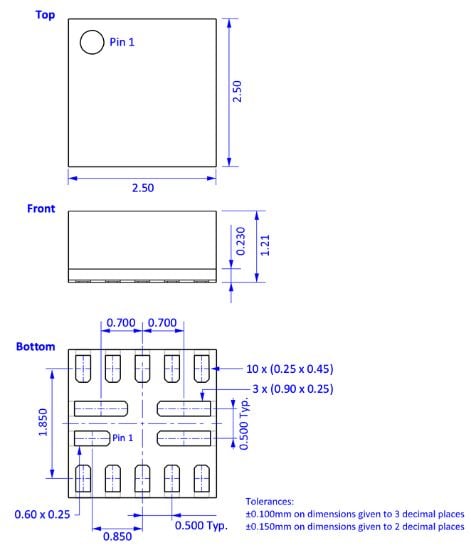
Package diagram. Image used courtesy of TDK
With the full DC-DC converter contained in one component, designers avoid the routing complexity and board area overhead of a multi-component discrete solution.
From Edge to Server
The FS3303 sits at the low-current end of TDK’s major expansion of its micro POL lineup. The full portfolio will reach 80 A, covering applications well beyond compact optical modules and into higher-power embedded computing and networking hardware. All modules in the expanded family will use height profiles between 1.2 mm and 1.7 mm.
This follows TDK's launch of the FS1525 in February, a 25 A point-of-load module designed for vertical power delivery architectures. The FS1525 can be stacked or paralleled to deliver up to 200 A combined, with the converters mounted directly beneath an FPGA or SoC on the backside of the PCB. That module targets AI servers, data center systems, and edge computing platforms where high-current, low-voltage delivery is needed close to the processor die.
The two product lines give TDK's µPOL family coverage from 1 A to 200 A. The FS3303 addresses the constrained, thermally challenging interior of optical transceivers, while the FS1525 handles high-current vertical delivery for processors. The upcoming 80 A modules in the expanded micro POL lineup will fill the middle ground, covering the range of edge AI accelerators, networking ASICs, and embedded SoCs that sit between those two extremes.