Facebook
 Google
 GitHub
 Linkedin
NREL Lab Reaches for ‘APEX’ in Electronics Materials
A new research facility eyes scalable materials and manufacturing techniques for power electronics.
The Department of Energy (DOE) has tapped the National Renewable Energy Laboratory (NREL) to oversee a new research lab exploring new materials and manufacturing processes for power electronics devices.
A Center for Power Electronics Materials and Manufacturing Exploration (APEX), hosted at NREL’s campus in Colorado, will centralize research to improve the efficiency and scalability of core components in the power grid, electric vehicles, and industrial production.
NREL stated the facility would enable significant thermal and power loads to meet the increased power demands of grid infrastructure and other equipment utilizing next-gen power electronics.

NREL’s campus in Golden, Colorado. Image used courtesy of NREL/by Josh Bauer (#59215)
Material Selection for Power Electronics
The rise of artificial intelligence, autonomous electric vehicles, quantum computing, and IoT devices is escalating. End-use demand in the automotive sector alone rose by 15% last year, according to the Semiconductor Industry Association. Nearly 1 trillion semiconductors were sold worldwide in 2023, and analysts anticipate growth will continue.
Meeting this demand requires scalability in production lines and material properties for next-gen devices.
APEX will increase the range of material choices for substrates, ultrawide bandgap semiconductors, thermal sinks, and contacts. NREL cited examples like borides, nitrides, carbides, or oxides—materials enabling smaller, more powerful devices. It will also discover techniques to optimize the interfaces between materials.
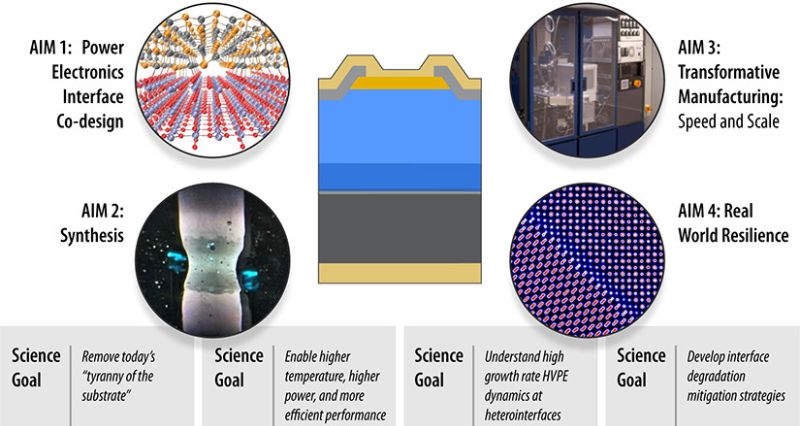
Focus areas of NREL’s APEX research center. Image used courtesy of NREL
Although NREL didn’t disclose specific research projects, the DOE referred to a technical report listing the fundamental research gaps in advanced manufacturing. Technical improvements often start with interface properties, the key ingredients of electronic devices. Interfaces are relevant in directing synthesis operations or assembling and integrating materials as building blocks in a system.
Surface chemistry plays a critical role in scaling component production. For example, selective material growth and the atomic-level ability to modulate surface phase and composition can support synthesizing novel catalysts and materials for energy storage and conversion. Surface design is also key to manufacturing energy systems like catalysts, membranes, and quantum devices, allowing functional particle arrangement with nanoscale control.
Researchers are devising new ways to control surface chemistry, such as laser patterning techniques. An NREL team recently introduced a novel laser process to alter electrode microstructures for better EV charging performance.
NREL’s APEX facility will also explore hydride vapor phase epitaxy (HVPE) with high growth rates, a method to deposit chemical vapors onto substrates. HVPE is a cheaper alternative to conventional metal-organic VPE, which uses expensive precursors and generally has a limited growth rate and throughput. HVPE enables the growth of high-efficiency solar cells using cheaper group III precursors with superior growth rates.
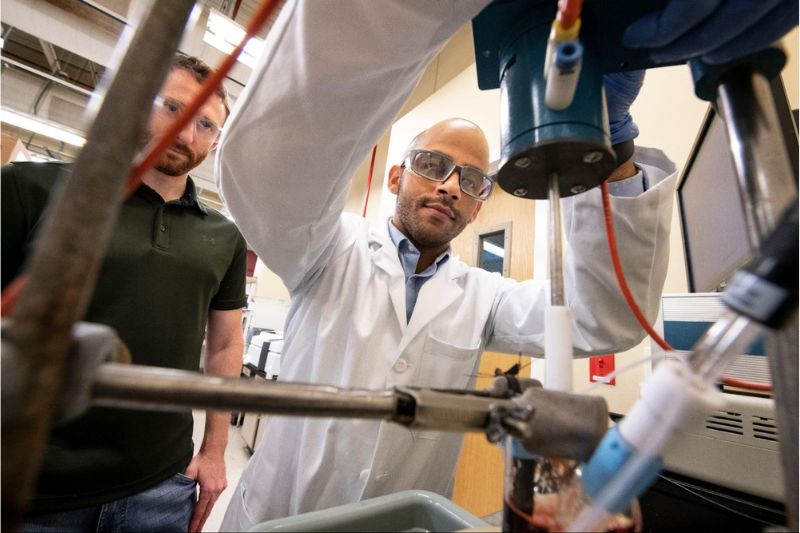
NREL researchers develop a three-electrode cell in a solar laboratory. Image used courtesy of NREL/by Dennis Schroeder (#65073)
Scalable Manufacturing
APEX will tackle four objectives:
- Simplifying substrates for power electronics interface designs
- Developing high-temperature, high-power synthesis processes with improved efficiency
- Enabling scalable and faster manufacturing through HVPE with high growth rates
- Mitigating interface degradation
NREL received a $13.9 million DOE grant to support the four-year project. The organization was one of several national laboratories and universities awarded $118 million for energy research programs.
NREL will collaborate with several partners on the project, including Illinois-based Argonne National Laboratory, Maryland’s Morgan State University and Johns Hopkins University, the University of Virginia, and the Colorado School of Mines. It will also work with a private company, North Carolina-based Kyma Technologies, which has previously partnered with NREL to design a reactor for a dynamic HVPE system.