Facebook
 Google
 GitHub
 Linkedin
ST Launches Automotive Gate Driver for EV Powertrains
The gate driver features advanced safety compliance and performance.
As electric vehicle adoption accelerates, designers are pushing switching speeds higher to reduce passive component size and improve power conversion efficiency. At the same time, the shift to wide-bandgap materials like silicon carbide (SiC) introduces new demands on gate control, isolation, and system robustness. ST’s STGAP4S could help these converging challenges in electric vehicle powertrains and automotive uses.
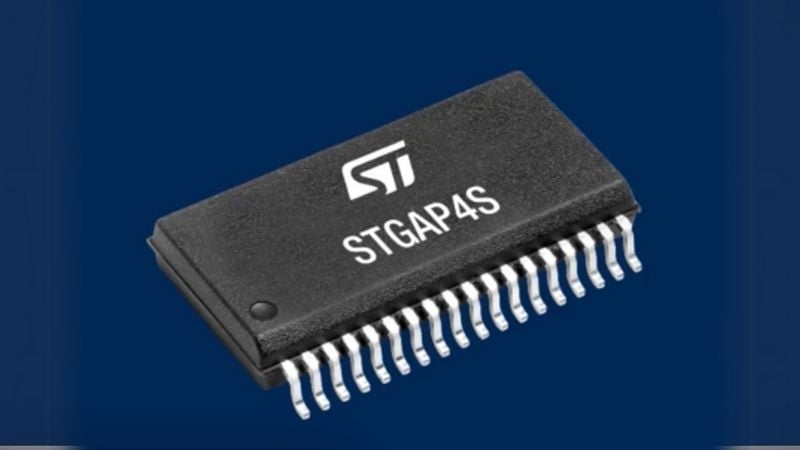
The STGAP4S. Image used courtesy of STMicroelectronics
STGAP4S Tech Details
With specific emphasis on high-voltage performance and safety compliance, ST’s STGAP4S supports a high-side supply voltage up to 1200 V and features both low-voltage and high-voltage domains. Its unique dual-output architecture (OUT1 and OUT2) permits direct interfacing with external push-pull stages to allow for adjustable sink/source current profiles (up to 2.5 A source and 2.4 A sink), which are optimized for parallel power switch control and high-speed switching.
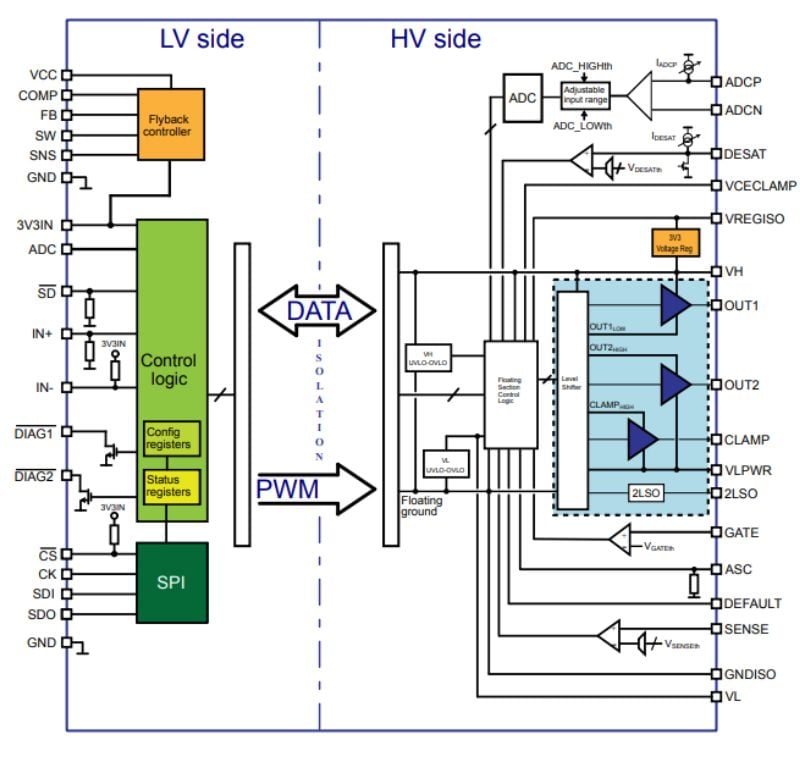
Block diagram of the STGAP4S. Image used courtesy of STMicroelectronics
Architecturally, the device integrates a flyback controller to generate isolated gate voltages from a single low-side supply, using voltage-mode control with input feedforward to maintain stable operation under variable conditions. It supports a maximum switching frequency of 80 kHz and incorporates burst-mode for light-load efficiency, internal soft-start, and protection mechanisms including cycle-by-cycle and latched overcurrent protection. The STGAP4S also implements desaturation detection with programmable thresholds and blanking currents, soft turn-off through a controlled discharge path, and a VCE active clamping circuit with nanosecond-scale response times to suppress voltage overshoot.
An SPI interface allows full programmability of control and protection features and access to diagnostics and the integrated 8-bit ADC. The driver also includes an embedded temperature sensor and two open-drain diagnostic outputs to support functional safety monitoring up to ASIL D. It features a high dV/dt immunity of up to ±1. It satisfies isolation standards such as VDE 0884-17 and UL1577.
High-Speed Switching SiC and IGBT
High-speed switching in SiC and IGBT systems presents challenges directly impacting system efficiency and reliability.
As switching frequencies increase to reduce passive component size and improve dynamic response, parasitic effects grow more pronounced. Parasitic inductance in the gate loop can lead to voltage overshoot, gate ringing, and unintended turn-on events due to Miller capacitance coupling. To maintain precise control over turn-on and turn-off behavior, gate drivers have to deliver sharp transitions with high peak current while also managing negative gate voltages to avoid shoot-through.
Desaturation events are another major risk during high-speed operation. Fast fault detection and soft turn-off are necessary to limit energy dissipation in the switch during a short-circuit. Traditional gate drivers may lack the resolution or reaction time required to protect devices switching at high dv/dt levels. Furthermore, high-frequency operation exacerbates common-mode transient immunity concerns. Without sufficient isolation robustness, noise coupling across control and power domains can lead to false triggering or latch-up conditions.
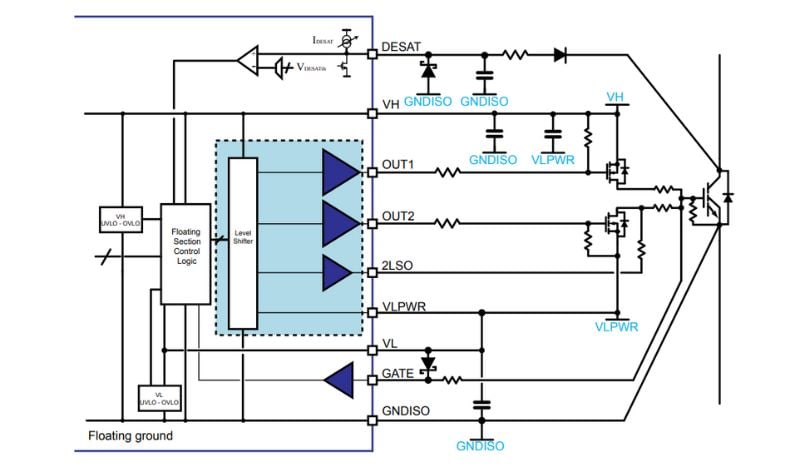
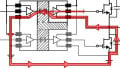
Desaturation protection. Image used courtesy of STMicroelectronics
Finally, thermal stress is also intensified during high-speed operation. Repetitive switching cycles generate localized heating at the gate and drain terminals, which can accelerate degradation without proper thermal management. The use of paralleled switches to share current introduces further complexity, as gate drive asymmetries can result in current imbalance or oscillation between devices. High-speed gate drivers are expected to mitigate these risks by offering features like programmable dead time and matched output drive strength.
Moving Forward
As EV powertrains mature, gate drivers are taking on more responsibility and importance. The STGAP4S could answer some outstanding challenges facing driving SiC and IGBT solutions in automotive. The device is now in production at scale.