Facebook
 Google
 GitHub
 Linkedin
Recom Launches 4 kW DC-DC Converter With 180-950 VDC Input
The series delivers up to 4.2 kW from traction batteries with reinforced isolation, liquid cooling, and CAN J1939 control.
As traction voltages rise to reduce current and copper losses, DC-DC converters must cover wider input ranges while maintaining isolation, EMC compliance, and thermal robustness. To that end, Recom has released the RMOD4000-EW series of high-voltage DC-DC converters for e-mobility platforms.
Designed to generate regulated 14 or 28 V low-voltage rails from traction battery inputs spanning 180 to 950 VDC, the units provide up to 4 kW class output power and a sealed, IP67 aluminum enclosure for harsh vehicle and marine environments.
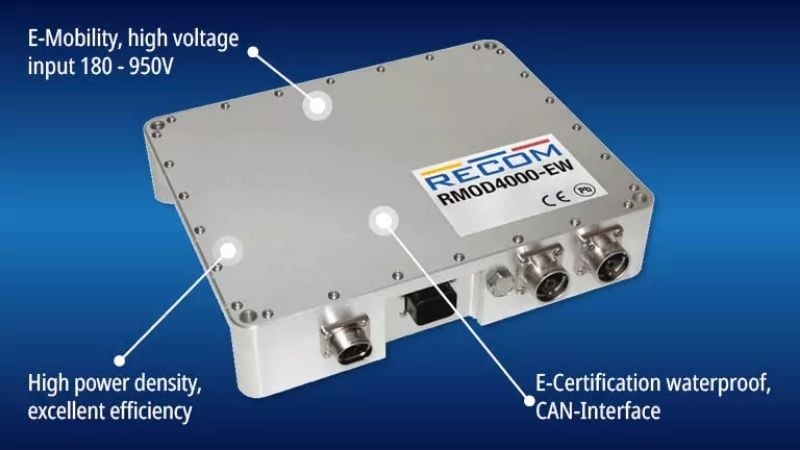
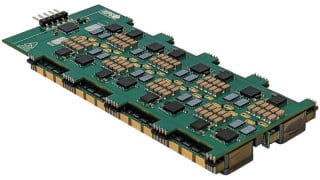
The RMOD4000 series. Image used courtesy of Recom
The RMOD4000-EW Series
Within the RMOD4000-EW series, the only variant currently available is the RMOD4000-650-28SEW. This model offers a nominal 28 V output, adjustable between 24 and 28 V.
When operated from an input range of 301 to 850 VDC, it delivers up to 150 A, corresponding to a maximum output power of 4,200 W under specified conditions. As the input voltage decreases, the converter applies active current limitation to manage component stress and maintain safe operation. Output current is reduced to 110 A for inputs between 251 and 300 VDC, and further limited to 75 A from 180 to 250 VDC.
Efficiency performance shows a design emphasis on high power density throughout the entire input span. Recom specifies a typical efficiency of up to 94% for the 28 V model under nominal conditions, with efficiency curves indicating peak performance in the mid-to-high load region. It features a two-stage conversion architecture to support the wide operating range, with the first stage switching at 65 kHz and the second at 75 kHz to balance conversion ratio, switching losses, and magnetic design constraints.
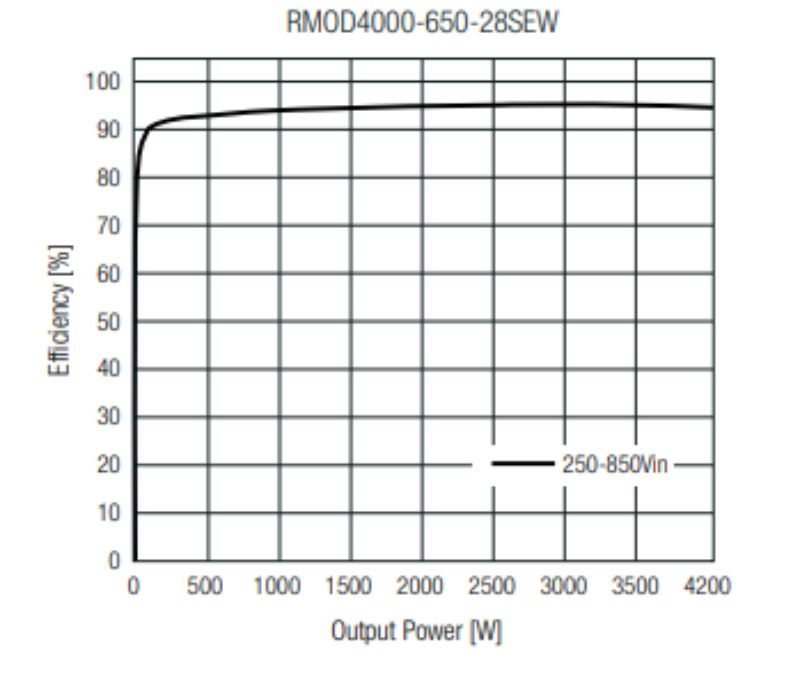
Efficiency versus load for the RMOD4000-650-28SEW. Image used courtesy of Recom
Beyond steady-state performance, the converter incorporates several measures to control startup and dynamic behavior. Active inrush current limitation restricts inrush to a maximum of 26.5 A, while under-voltage lockout prevents operation below 180 VDC input. Output voltage accuracy is specified at ±2.0% typical, with ±3.0% maximum line and load regulation. During a 10-90% load step, the 28 V version exhibits a transient deviation of 840 mV, with a typical recovery time of 50 ms.
The system also includes protection mechanisms, such as overvoltage protection that triggers latch-off between 29.4 VDC and 32.2 VDC for the 28 V model. The converter employs overcurrent and short-circuit protection using constant-current and hiccup modes, and integrates overtemperature shutdown with automatic restart once the junction temperature falls below the internal threshold above 80°C.
Managing a 5:1 Input Voltage Span
Designing a DC-DC converter to operate from 180 to 950 VDC imposes a conversion ratio exceeding 5:1 on the input stage. This span typically requires a multi-stage topology to sustain efficiency, device stress margins, and control stability. A front-end stage must accommodate wide duty-cycle variation while limiting peak currents at low input voltages and constraining switching losses at high input voltages.
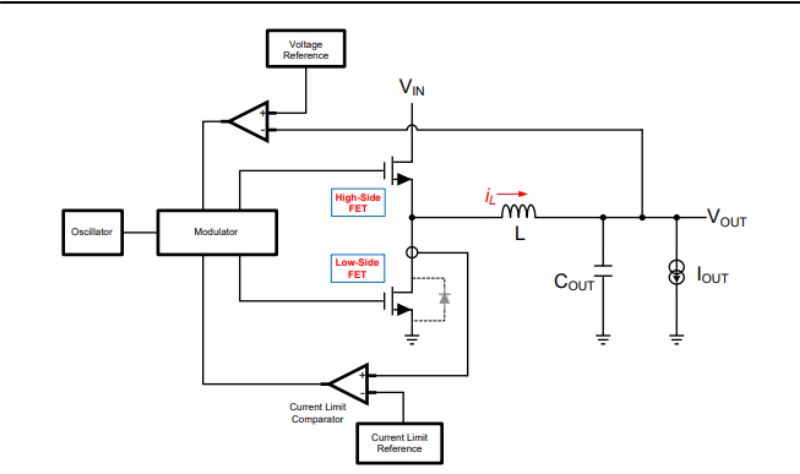
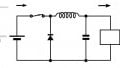
A synchronous buck converter with valley current limit. Image used courtesy of Texas Instruments
In these cases, active current limiting tied to input voltage prevents excessive semiconductor stress when the input approaches the lower bound of the operating range. As the input voltage decreases, the converter must draw higher current to sustain output power. Without dynamic limitation, magnetics and switching devices would face elevated RMS and peak currents.
Conversely, at high input voltages, insulation coordination and creepage distances become critical. Reinforced isolation, clearance distances of several millimeters, and controlled isolation capacitance help satisfy standards such as IEC 62477-1 and automotive safety requirements.
Wide-range designs also rely on carefully selected switching frequencies and magnetic materials to balance core losses and copper losses at different operating points. Control loops must remain stable despite large variations in input-to-output transfer characteristics.
A Platform for High-Voltage Vehicles
According to Recom, the RMOD4000-EW series is currently available in its 28 V version, with a 14 V variant coming soon. Both feature packaging dimensions of 316 x 254 x 83 mm and liquid-cooled construction.