Facebook
 Google
 GitHub
 Linkedin
Patented Tech Lets GaN Circuits Operate at Radio Frequencies With Greater Efficiency
Patented technologies from new market entrant QPT enable GaN circuits to operate at frequencies as high as 20 MHz, unleashing new performance capabilities for the wide bandgap technology.
QPT Limited, a recently formed Cambridge, UK-based company, has announced the development of a set of technologies that will allow gallium nitride (GaN) circuits to operate well past their conventional limitation of 100 kHz to frequencies as high as 20 MHz.
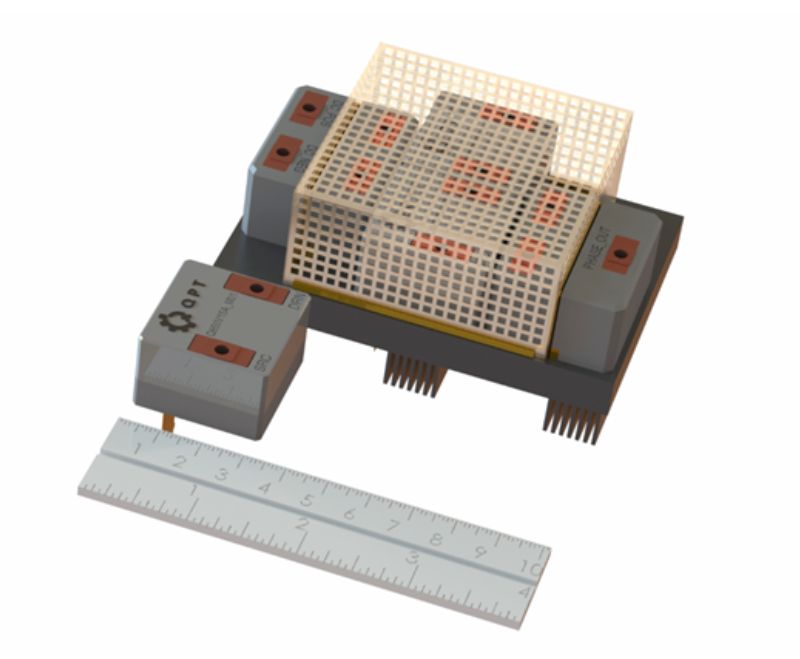
WisperGaN reference platform for VFD applications. Image used courtesy of QPT
The approach will allow faster switching in high-voltage applications like HVAC variable frequency motor drive circuits, reducing switching losses and improving motor efficiency.
GaN Performance Limited by Speed
Gallium Nitride is a wide bandgap compound semiconductor material offering much greater withstand voltages and can operate at higher temperatures and frequencies than traditional power devices built on silicon substrates.
According to QPT, one unique attribute of GaN switches is the ability to operate at very high frequencies, up to 20 MHz. This high-frequency capability translates to a switch on/off transition time of 1-2 ns, much faster than the 20-50 ns of conventional solutions. Switching time is critical in high-power applications since most power loss occurs when switching between the full-on and full-off state.
Despite the ability to operate at very high switching speeds, GaN circuits have generally been limited to 100 kHz or less due to thermal and EMI concerns that emerge at higher frequencies. These limitations have prevented GaN circuits from reaching their full potential.
QPT Controlled GaN
QPT says it has developed a solution addressing the limitations of operating GaN circuits at higher frequencies by applying the principles of high-frequency RADAR, RF, and microwave engineering to power conversion circuit design.
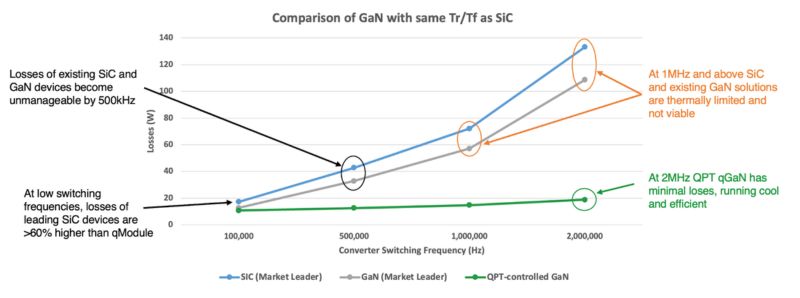
Comparing QPT high-speed GaN to other solutions. Image used courtesy of QPT
There are two main components of the QPT solution. The qGaN module integrates a 650 V GaN MOSFET with the company’s proprietary qDrive gate drive circuit. The qSensor integrates QPT’s ZEST and qSense technologies to provide the sensing and control capabilities that allow the GaN switch to be driven at very high frequency.
The qSensor is essential to the high-speed operation of the GaN switch by offering the capability to monitor the voltages and currents of the circuit at high frequencies.
Combined with the ZEST transformer technology, the qSensor employs proprietary modulation techniques for high performance, isolated control loop operations up to 20 MHz. ZEST provides high-frequency isolation for the qDrive gate drive circuit as well.
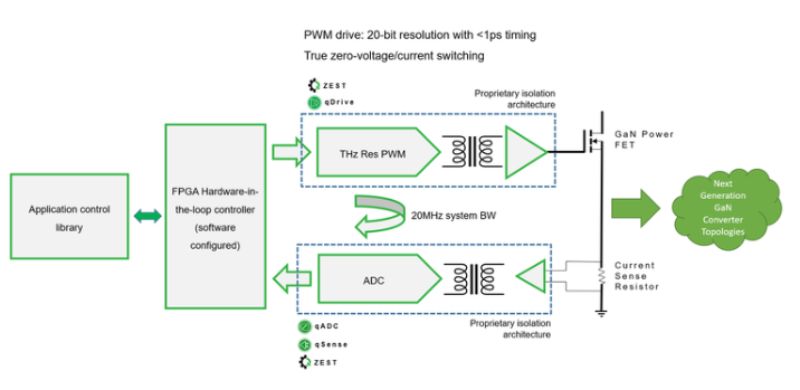
High-frequency control loop with ZEST transformer IP. Image used courtesy of QPT
The patented ZEST transformer technology can pass signals up to 100 MHz without compromising the fidelity of the transistor drive or sense circuitry.
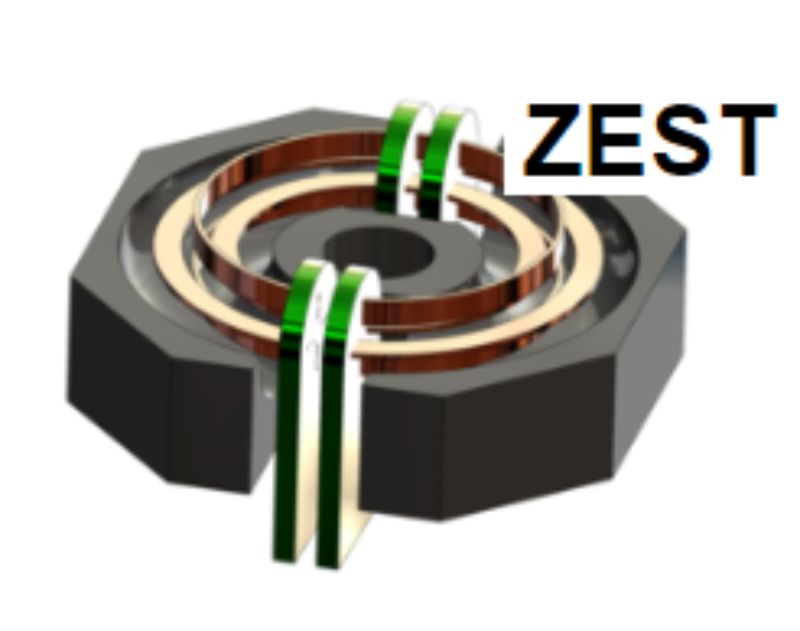
ZEST transformer. Image used courtesy of QPT
The first of the series of qGaN modules will be designed to accommodate 15A RMS of load current to power 380 V three-phase motors, with subsequent models released to accommodate varying power loads.
Variable Frequency Drives
QPT’s ultra-high speed control loop technology is all integrated into the WisperGaN platform that serves as a reference platform to integrate the QPT sub-modules, and associated circuitry, into a fully functioning power conversion block (gate drive, GaN FETs, loop sensing, isolation, EMI, etc.). The reference platform includes a Faraday cage to suppress radiated EMI from the hard switching circuits. According to QPT, power conversion losses for circuits using their high-frequency platform can be reduced by up to 80%.

Variable frequency drive electric motors. Image used courtesy of QPT
One key application for the new QPT technology is variable frequency drives (VFDs). VFDs convert DC input power to variable frequency AC to drive electric motors. The power conversion process in VFDs is inherently lossy, however, efficiency drops off significantly at lower motor speeds.
It is at the lower motor speeds where QPTs technology has the potential to make a difference. By rapidly transitioning through the full On and Off states of the MOSFET (1-2 ns compared with 10-20 ns for conventional solutions), switching losses can be significantly reduced, improving the overall efficiency of the motor by up to 10%.
Making an Impact
According to QPT, electric motors account for 45% of total energy usage, with 11 billion new motors shipped yearly. The company estimates the TAM (Total Addressable Market) for their high-speed GaN solution to be $365 billion annually.