Facebook
 Google
 GitHub
 Linkedin
Microsoft, Vishay Engineer Space-Resilient Power Converters
Space-grade certified DC-DC converters and planar transformers mark a significant advancement in the electronics industry.
Space exploration drives technological advancement and opens up frontiers. Due to the extreme conditions of space, space-grade electronics components are essential for space missions. These components must withstand high radiation levels, wide temperature variations, and vacuum environments without failure.
Microsoft and Vishay have developed products with advanced technology to deliver reliable power while enduring harsh conditions in space.
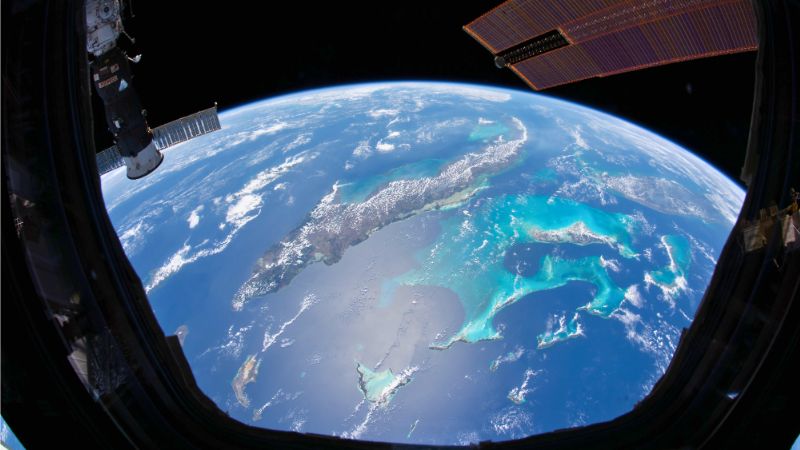
Earth from space orbit. Image used courtesy of NASA
Radiation Tolerant DC-DC Converters
The low-Earth orbit market is rapidly growing as private and public entities explore space regions for various applications. Demand for reliable, cost-effective, and configurable standard space-grade electronics solutions is increasing. Microchip Technology released a new family of radiation-tolerant LE50-28 isolated DC-DC 50 W power converters. The multi-output converter with nine variants offers single- and triple-outputs ranging from 3.3 V to 28 V with <1% output ripple.
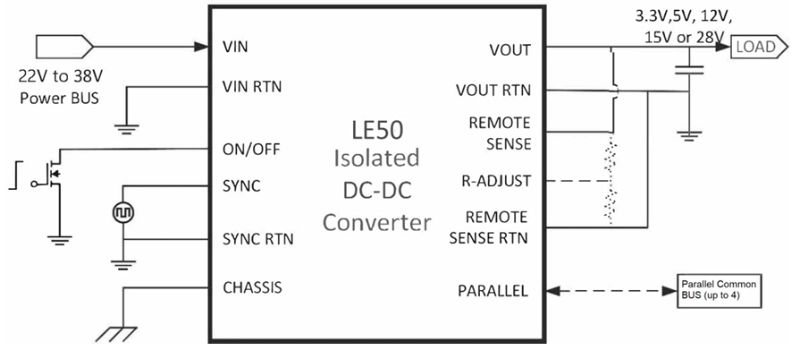
Typical application circuit of LE50-28. Image courtesy of Microchip
According to Microchip, the LE50-28 is the industry’s only standard non-hybrid space-grade radiation-tolerant DC-DC power converter utilizing surface-mount components. These power converters offer 80% efficiency and meet the MIL-STD-461 standards. With a companion EMI filter, the converters provide design flexibility, enabling customers to choose single- or triple-outputs based on voltage requirements. These converters can be paralleled up to four units for 200 W, catering to 28 V bus systems.
The LE50-28 series ensures space-grade radiation tolerance, with 50 Krad total ionizing dose and single event effects latch-up immunity of 37 MeV·cm2/mg linear energy transfer. The isolated DC-DC converter operates with a temperature range of -55°C to 100°C, allowing for a rugged solution to space-grade power electronics.
Featuring Space-Grade Planar Transformers
In a planar transformer, the windings and core are arranged in a flat, planar structure rather than the traditional cylindrical or toroidal shape. This design allows for compactness, improved thermal performance, and reduced leakage inductance.
Vishay Intertechnology has addressed the power conversion challenges in space-grade applications with its SGTPL-2516 series of low-profile, space-grade planar transformers. These transformers offer lower cost, smaller size, and higher density compared to traditional planar transformers, meeting the requirements of MIL-STD-981 class S. With a maximum output power of 35 W, these planar transformers find their applications in converters like flyback and forward converters.
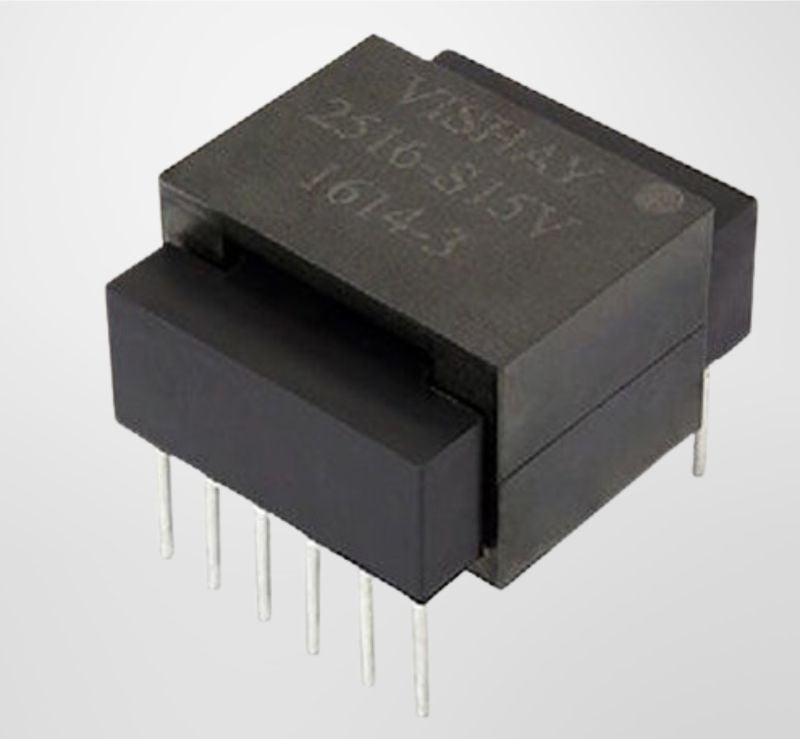
The SGTPL-2516 planar transformer. Image used courtesy of Vishay
Operating over a frequency range of 80 kHz to 300 kHz, the transformers provide high dielectric withstand voltage of up to 1500 VAC, power of 150 W, and leakage inductance of 0.5 µH. They feature a unique winding structure and build technique and a greater copper fill factor, resulting in improved efficiency and power density. Additionally, their winding technology allows easy modification to meet specific design requirements without up-front tooling charges.
These transformers undergo S-level MIL-STD-981 screening and are also available with P-level screening for design validation testing. With over-molded windings and an operating temperature range of -55°C to +130°C, the product ensures rugged operation in the space environment.
Empowering Space Exploration
As scientific pursuits and commercial ambitions expand the space sector, the products from Microchip and Vishay could play an important role in supporting sustainable and successful missions. By ensuring reliability, efficiency, and configurability, these components could contribute to continued exploration and discovery beyond Earth's boundaries.
Related Content