Facebook
 Google
 GitHub
 Linkedin
Magnachip Launches New IGBT Family for Solar and Energy Storage
Magnachip’s 650 V and 1200 V discrete devices target inverter and ESS designs from residential through industrial power levels.
Magnachip Semiconductor has developed a new generation of discrete insulated-gate bipolar transistors aimed at solar inverters and industrial energy storage systems. The launch adds 650 V and 1200 V devices to the company’s power semiconductor lineup and is positioned to support residential, commercial, and industrial systems scaling to around 150 kW.
The IGBTs are based on Magnachip’s latest field-stop trench process and are initially offered in TO-247 and TO-247 Plus packages. According to the company, the generation shift focuses on higher current capability and improved robustness under demanding switching conditions, both of which remain central requirements in photovoltaic and storage power stages where thermal margins and fault tolerance are tightly constrained.
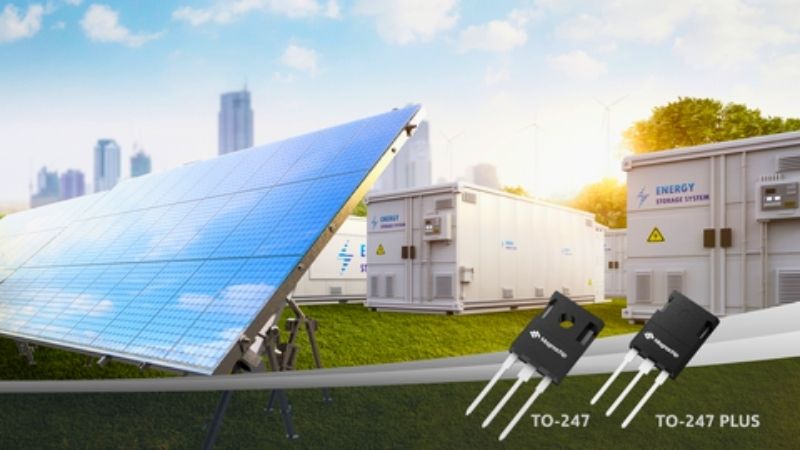
650 V and 1200 V for solar inverters and energy storage. Image used courtesy of Magnachip
Process and Device
At the chip level, Magnachip highlights a roughly 40% reduction in cell pitch compared with its previous IGBT generation. Shrinking cell pitch allows more active area within the same die size, which translates into higher current density and lower conduction losses without forcing designers into larger packages. In inverter applications where multiple devices are paralleled, this can simplify layout and thermal design while preserving current headroom.
The company also claims more than a 30% improvement in reverse-bias safe operating area. RBSOA defines the voltage and current combinations an IGBT can tolerate during turn-off under worst-case conditions, including inductive load switching and abnormal operating states. This is particularly important in solar and ESS systems, where devices are exposed to wide load swings and fault events.
Magnachip’s published device tables provide some context for how these changes look in practice. In the 650 V class, the lineup includes devices rated around 75 A at elevated junction temperatures, with typical VCE(sat) values in the mid-1 V range and switching energy numbers tuned for inverter duty cycles. Several variants integrate SiC Schottky barrier diodes rather than conventional fast recovery diodes, reducing reverse recovery losses and easing thermal stress in high-frequency stages.
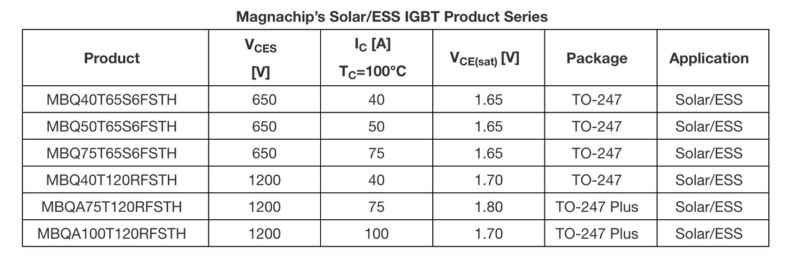
Series specs. Image used courtesy of Magnachip
The 1200 V devices extend the same approach into higher-voltage systems. Here, Magnachip emphasizes higher current ratings and TO-247 Plus packaging, which offers improved thermal performance compared with standard TO-247 outlines. These parts are aimed at larger solar inverters and storage converters where designers still favor 1200 V devices for added voltage margin or specific topology choices.
More Updates in the Roadmap
While the initial release centers on established TO-247 formats, Magnachip is already pointing to packaging updates planned for later this year. On the roadmap is a TO-247 four-lead option with a Kelvin emitter connection, which reduces common emitter inductance by separating the power emitter from the gate drive reference, thereby improving switching behavior and lowering dynamic losses during turn-on and turn-off.
This difference in packaging can have a measurable impact on switching efficiency and electromagnetic behavior for inverter designers, particularly as systems push higher switching frequencies or tighter control bandwidths. It also aligns Magnachip’s discrete IGBT offerings with packaging approaches already common in competing high-performance power devices.
The company has also flagged plans to introduce higher-current 650 V devices rated up to 150 A and to expand into a 750 V class. The latter sits between traditional 650 V and 1200 V segments and can be attractive in certain solar and storage architectures where designers want additional voltage margin without the conduction penalties associated with higher-voltage silicon.
Continued Growth in Solar and Energy
Magnachip’s focus on solar and energy storage reflects continued growth in both markets, even as wide-bandgap devices gain share at the high end. While SiC MOSFETs are increasingly used in premium inverter designs, IGBTs remain entrenched across large portions of the solar and ESS landscape due to cost and availability factors, as well as their proven reliability at scale.
The new generation fits into Magnachip’s wider shift toward power semiconductors following its exit from display driver businesses last year. The company has highlighted new product introductions and longer-term supply relationships in automotive and industrial power, with IGBTs positioned as a core building block alongside MOSFETs and power ICs.
Ultimately, the latest generation adds another option aimed at higher power density and improved ruggedness without departing from familiar device classes and footprints.