Facebook
 Google
 GitHub
 Linkedin
Littelfuse Launches Gate Driver To Simplify SiC, IGBT Designs
The driver integrates adjustable negative bias and reduces external components in automotive power systems.
Littelfuse has developed the IX4352NEAU automotive-qualified low-side gate driver to simplify SiC MOSFET and IGBT power stage design in electric vehicle powertrain and DC-DC converter applications.
The device is the first AEC-Q100-qualified low-side driver to integrate an adjustable negative gate bias regulator. By incorporating the bias regulator internally, the IX4352NEAU claims to reduce component count, improve switching performance, and shorten design time.
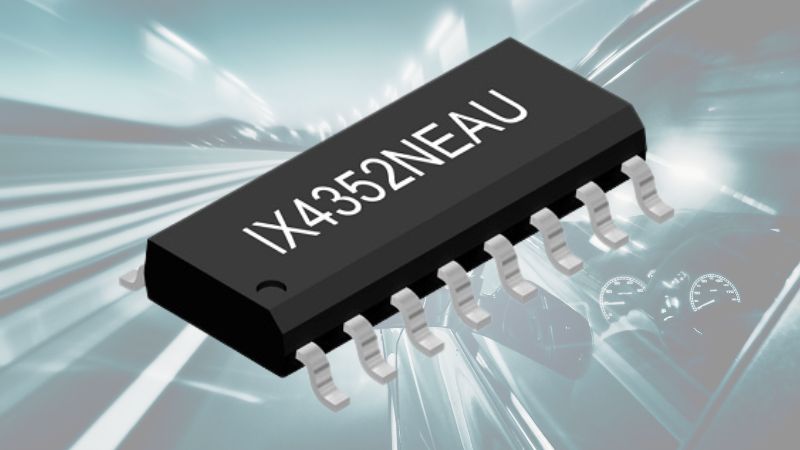
The IX4352NEAU gate driver. Image used courtesy of Littelfuse
IX4352NEAU Details and Features
The IX4352NEAU delivers separate 9 A peak source and sink outputs to unlock tailored turn-on and turn-off transitions. By separating current paths, the device enables designers to optimize switching behavior for reduced losses and improved thermal performance.
Operating across a 13-25 V supply range, the driver supports a selectable negative bias down to -10 V, generated internally through a charge-pump inverter that replaces discrete negative supply rails. The charge pump operates in a closed-loop configuration. It regulates the VSS output by referencing the on-chip 4.6 V regulator, with typical external component values (e.g, 33 Ω for RCP, 68 nF for CCP, and 10 µF for CSS) setting the negative bias level. For systems that already include an external negative supply, the internal charge pump can be disabled via the SET pin.
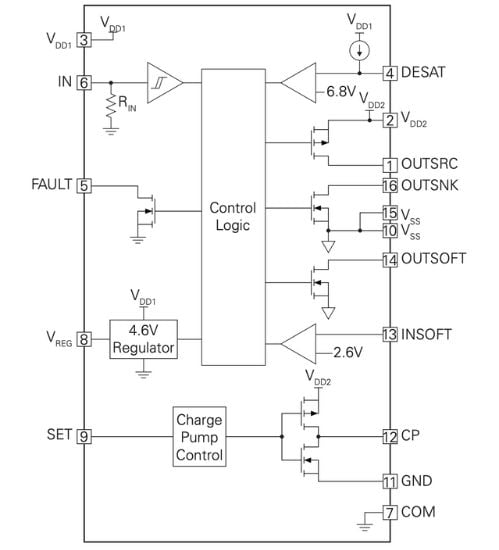
Functional block diagram of the IX4352NEAU. Image used courtesy of Littelfuse
Protection features include desaturation (DESAT) detection with soft shutdown, undervoltage lockout (UVLO) on both positive and negative rails, and thermal shutdown at 160°C with 20°C hysteresis. The DESAT circuitry monitors the collector or drain voltage and initiates a two-stage shutdown when an overcurrent event is detected. First, it engages the 900 mA soft-sink output (OUTSOFT) for controlled turn-off, then it activates the 9 A sink (OUTSNK) once the gate voltage falls below 2.6 V. This sequence prevents high dV/dt transients that can otherwise damage power switches.
Meanwhile, the logic interface accepts standard 3.3-5 V TTL/CMOS signals, tolerant up to 7 V, with input thresholds featuring 400 mV hysteresis. Additional reliability mechanisms include a two-millisecond fault-mask timer (MUTE), an open-drain fault output, and continuous charge-pump operation during thermal or DESAT faults to maintain safe turn-off conditions.
Adjustable Negative Gate Drive Bias
In SiC MOSFET and IGBT applications, engineers must control the gate voltage swing to prevent parasitic turn-on, in which high dV/dt transients during switching inadvertently drive the device into partial conduction. Traditionally, designers apply a negative gate voltage (-5 to -10 V) during turn-off to guarantee the transistor remains fully blocked.
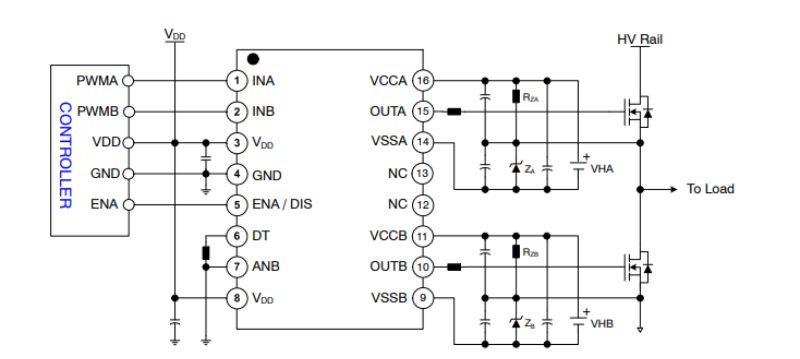
Negative bias with zener diode on single isolated-bias power supply. Image used courtesy of Mouser
Conventional driver circuits achieve this by providing an external negative supply rail or a dedicated isolated DC-DC converter, adding cost and complexity. Integrating an adjustable negative bias regulator, as implemented in the IX4352NEAU, allows a single positive supply to generate both the positive and negative gate drive voltages internally.
In addition to simplifying the power architecture, an internal negative bias generator reduces the potential for ground loops and cross-talk between isolated supplies, improving common-mode immunity. It also enhances dV/dt tolerance in wide-bandgap applications with transition rates exceeding 50 kV/µs.
Impact and Availability
By integrating an adjustable negative bias generator with high-current drive and comprehensive fault protection, the IX4352NEAU could allow EV traction inverters and DC-DC converters to achieve higher power density without external bias networks. As SiC adoption grows in automotive and renewable-energy sectors, such integration can help reduce overall bill-of-materials cost and design complexity.
The IX4352NEAU is available now in tape-and-reel format (2,000 units per reel) through Littelfuse’s authorized distributors worldwide.